

In Wakad’s IT corridor, more women are walking into fertility clinics before a relationship has even started, not after a failed pregnancy attempt. Many work at the tech parks around Hinjewadi, and their question is rarely whether to preserve fertility. It is which method to choose. Egg freezing vs embryo freezing in Wakad is now one of the most common conversations happening in consultation rooms across Pimpri Chinchwad, and the answer depends less on medicine and more on where a woman stands in her life.
Egg freezing preserves unfertilized eggs collected from your ovaries and stored for later use, while embryo freezing preserves eggs that have already been fertilized with a partner’s or donor’s sperm and grown into embryos before storage. Both rely on the same rapid freezing technology called vitrification, and both count as fertility preservation options against the natural decline in egg quality that comes with age. For most women weighing the two, the real difference lies in one practical decision: fertilize now with a known partner or donor, or keep that choice open for later.
What Egg Freezing Actually Involves
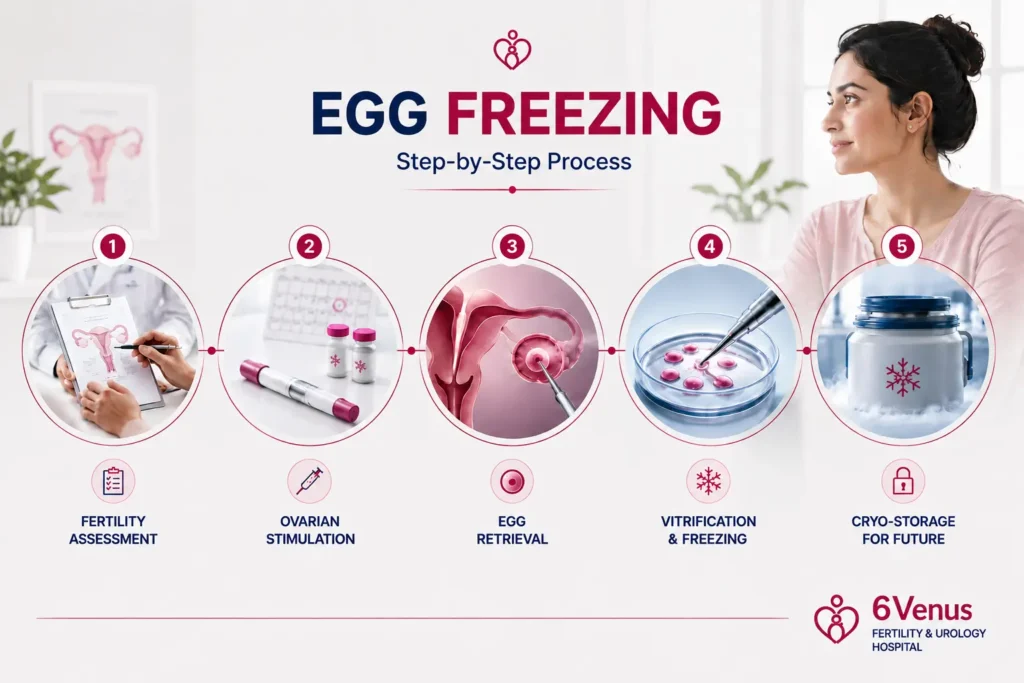
Egg freezing, also called oocyte cryopreservation, starts with ten to fourteen days of hormone injections that encourage the ovaries to produce multiple eggs at once instead of the usual single egg per cycle. A short retrieval procedure under sedation follows, and the collected eggs go straight into egg vitrification without ever meeting sperm. An IVF specialist in Wakad typically walks patients through this timeline before the first injection is prescribed.
This is the option most often chosen by women who have not decided who will father their child, women focused on career milestones at Hinjewadi or Balewadi, and women who simply want more time before making a permanent decision. Nothing about the eggs is locked in. Egg and sperm freezing at this stage keeps every future option open.
What Embryo Freezing Adds to the Process
Embryo freezing, known clinically as embryo cryopreservation, follows the same stimulation and retrieval steps, but with one added stage. The retrieved eggs are fertilized in the lab with a partner’s sperm or donor sperm, then cultured for several days until they reach the blastocyst stage. Only after that are they vitrified. According to Cleveland Clinic, embryo freezing usually happens as a byproduct of an IVF cycle, when a couple has surplus fertilized eggs left after a transfer.
This route gives a fertility specialist far more information before freezing even happens. A blastocyst that survives five days of lab culture has already cleared a hurdle that an unfertilized egg has not. That is a meaningful piece of reassurance, though it comes with a decision that cannot be undone once sperm is chosen.
An unfertilized egg cannot be tested for quality on its own. Its true potential is only known once it is thawed and fertilized, which is why embryo freezing tends to feel more predictable to patients who already have a partner.
Egg Freezing vs Embryo Freezing in Wakad: Comparing What Matters
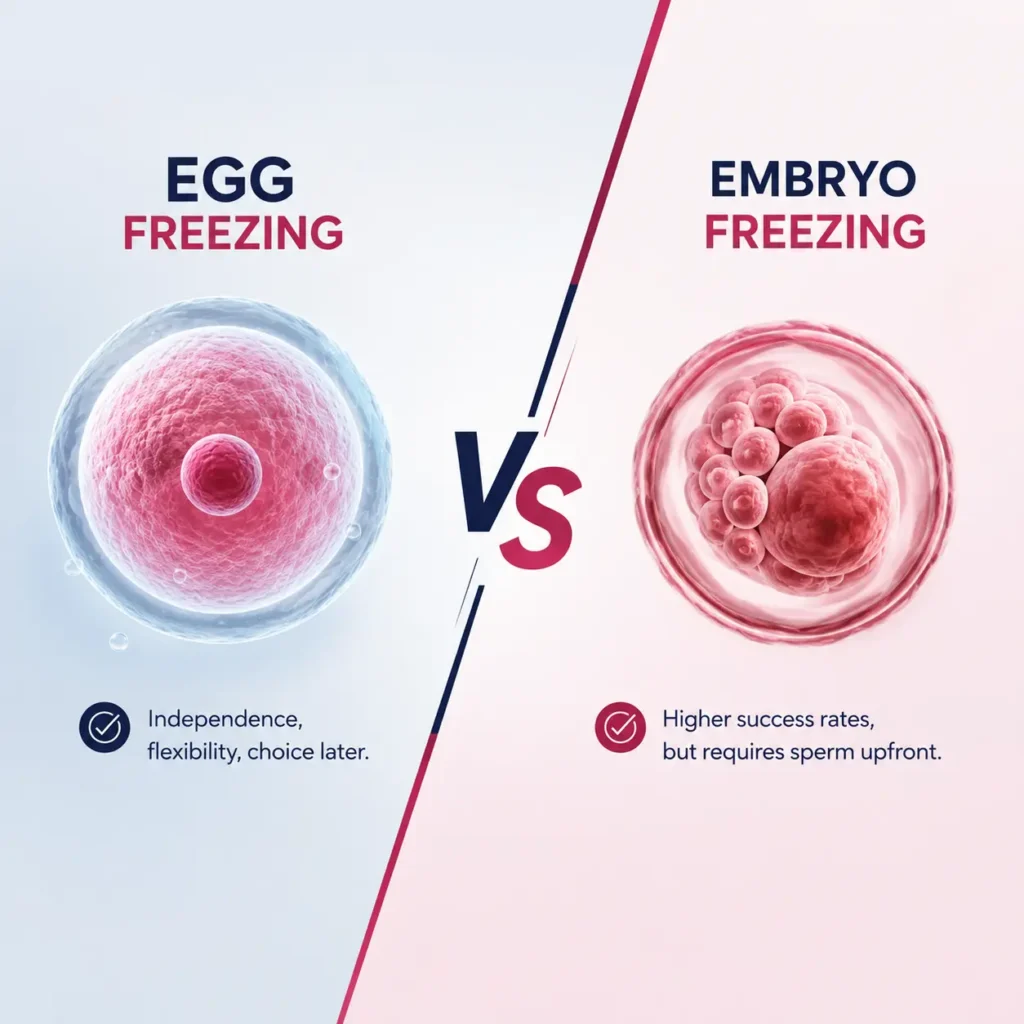
Deciding between egg freezing versus embryo freezing in Pune and Wakad usually comes down to five practical factors rather than one clear winner. These are the factors that typically compare:
- Fertilization timing: Egg freezing delays the decision about sperm. Embryo freezing requires that decision upfront, before storage begins.
- Certainty of outcome: Embryos give your specialist visible development milestones. Eggs remain an unknown quantity until they are thawed and fertilized years later.
- Flexibility for single women: Egg freezing is generally the more flexible choice if you do not yet have a partner or have not chosen a sperm donor.
- Relationship stability: Embryos are considered shared property between the egg and sperm source under Indian law, so any future use typically needs both parties’ consent. Frozen eggs remain solely yours.
- Cost sequencing: Egg freezing is usually the lower upfront cost because fertilization and genetic screening are deferred. Embryo freezing front loads those costs into the first cycle.
Neither option guarantees a future pregnancy. Mayo Clinic notes that success after thawing still depends heavily on age at the time of freezing, not age at the time of use, which is why the timing conversation matters more than the method itself.
Cost and Storage Differences Worth Planning Around
Egg freezing in and around Pune typically involves stimulation medication, monitoring scans, the retrieval procedure, vitrification, and an annual storage fee once the first year ends. Embryo freezing carries similar steps, plus fertilization and often genetic screening of the resulting embryos, which is why it tends to cost more at the outset even though both procedures start the same way.
Storage duration also matters for planning. Under India’s Assisted Reproductive Technology Regulation Act, frozen eggs and embryos can generally be stored for up to ten years, extendable under documented medical circumstances. A woman freezing eggs in her late twenties has considerably more runway than one starting the process at thirty eight, so timing the decision earlier tends to widen every option later.
Is Egg Freezing Legal for Unmarried Women in Wakad?
Yes. Under the ART Regulation Act, 2021, unmarried women can legally freeze their eggs for personal or medical reasons at any ICMR registered clinic. Written informed consent is required at every stage of the process, and the law also protects the legal rights of any child eventually born through the frozen eggs, exactly as it would for a naturally conceived child.
This legal clarity is one reason egg freezing has grown quickly among women working in Wakad and Hinjewadi’s technology sector, where career timelines and family timelines rarely line up neatly. An IVF center in Wakad that is transparent about ICMR registration and consent documentation is worth confirming before any procedure begins.
Choosing Between Egg Freezing and Embryo Freezing: Questions Worth Asking
Patients often walk in asking should I freeze eggs or embryos, and one consultation rarely settles it alone. Before committing to either path, it helps to sit with these questions:
- Do you currently have a partner or donor whose sperm you would want to use, or would that decision be premature right now?
- How do you feel about the possibility of unused embryos needing a joint decision later, compared to unused eggs that remain entirely your own?
- What does your ovarian reserve testing show, and how does your current age compare to the window your specialist recommends?
- What is your budget for the first cycle, and are you prepared for ongoing storage fees regardless of which method you choose?
- Does your embryo quality assessment, if you have already had one done elsewhere, change how confident you feel about either path?
There is no universally correct answer between egg freezing and embryo freezing in Wakad. Some women choose eggs for the flexibility, others choose embryos for the added certainty, and many simply want a specialist to walk them through their own numbers before deciding. What matters most is starting that conversation while more of the timeline is still in your control.
1. How painful is the egg or embryo freezing procedure?
Most women describe the retrieval procedure as mildly uncomfortable rather than painful, since it is performed under sedation. The days of hormone injections leading up to retrieval cause more noticeable side effects, including bloating and mild soreness at the injection site. Recovery from the retrieval itself is usually quick, with most patients resuming normal activity within a day or two. Your specialist will walk you through pain management options specific to your protocol before the cycle begins.
2. Is egg freezing legal for unmarried women in India, including Wakad?
Yes. The ART Regulation Act, 2021 permits unmarried women to freeze eggs for personal or medical reasons at any ICMR registered clinic in India, including those serving Wakad and greater Pune. There is no requirement to be married or in a relationship. Clinics will still walk you through informed consent documentation and explain storage terms clearly, since this is a legal requirement regardless of marital status. Many women choose this route specifically because it does not depend on a partner being present.
3. How long can frozen eggs or embryos be stored?
Under current Indian regulation, frozen eggs and embryos can generally be stored for up to ten years, with extensions possible under documented medical circumstances. Storage requires an annual fee once the first year is complete, so it is worth budgeting for this ongoing cost rather than treating it as a one time expense. If your embryos have already been in storage for a year or more and a transfer has not happened yet, that alone is not a sign of a problem. Vitrified embryos remain stable in storage, and clinics often wait for the right hormonal window or a patient’s own readiness before scheduling a transfer. Ask your clinic directly about their storage renewal process and what happens if fees lapse, since policies can vary between fertility centres.
4. Does freezing eggs later in age still work?
It can, but success depends heavily on age at the time of freezing rather than age at the time of use. Younger eggs generally survive thawing and fertilization more reliably than eggs frozen closer to or after age thirty five. Freezing later is still worth discussing with a specialist, since ovarian reserve varies between individuals and a single test cannot capture everything. Waiting is not disqualifying, but earlier freezing generally keeps more options open.
5. What happens to unused frozen embryos in the future?
Unused embryos require a joint decision from both the egg and sperm source, since embryos are treated as shared property under current regulation. Couples can choose to keep embryos in storage, discard them, donate them to another patient, or in some cases contribute them to research, depending on clinic policy and consent forms signed at the time of freezing. This is one reason some women prefer egg freezing instead, since it avoids needing future agreement from a partner.
6. How much does egg freezing cost in Pune compared to embryo freezing?
Egg freezing is typically the lower cost option upfront, since fertilization and any genetic screening are deferred until the eggs are eventually used. Embryo freezing tends to cost more at the outset because it includes fertilization and often genetic testing of the resulting embryos before storage begins. Both methods carry an ongoing annual storage fee. When comparing clinics, affordability should never be the only filter. Confirm ICMR registration, ask how the lab handles vitrification, and request a full cost breakdown covering medication, monitoring, retrieval, and storage before starting either process at any fertility centre in Pune or Wakad.
7. Can I freeze both eggs and embryos in the same cycle?
In some cases, yes. If a retrieval produces a higher number of eggs than expected, a specialist may recommend fertilizing some and freezing the rest as unfertilized eggs, giving you a mix of both. This is a decision best made in consultation with your embryologist, since it depends on egg count, quality indicators, and your own preferences about future flexibility. Not every clinic offers this as a standard option, so it is worth asking directly during your consultation.
8. If only some of my retrieved eggs are good quality, does that lower my chances?
Not necessarily. It is common for only a portion of retrieved eggs to be mature and suitable for freezing or fertilization, and a lower headline number does not automatically mean a lower chance of success. A specialist focuses on the eggs or embryos that meet quality criteria rather than the total count retrieved. Ten eggs with five graded as good quality can still lead to a healthy pregnancy later, since it typically takes just one viable embryo to succeed. Ask your embryologist for the specific grading of your own eggs or embryos rather than judging the outcome from the retrieval number alone.
9. Do frozen eggs or embryos lose quality over time in storage?
No significant quality loss has been documented in eggs or embryos stored correctly using vitrification, even after many years. The cold storage process essentially pauses biological aging for the stored cells. What matters more than storage duration is the age of the woman at the time of freezing, since that determines the starting quality of the eggs or embryos before they ever enter storage. Proper lab handling and consistent temperature control remain essential throughout.
10. What if IVF fails after using frozen eggs or embryos?
A failed transfer does not necessarily mean the remaining frozen eggs or embryos are unusable. Many women have several eggs or embryos in storage specifically because a single transfer is not always successful. Your specialist will usually review what happened before recommending a next step, which might involve a different protocol, additional testing, or trying a subsequent transfer from the same batch. Emotional support during this period matters as much as the medical plan that follows.
11. Should I choose egg freezing or embryo freezing if I am not sure about my relationship?
If your relationship status feels uncertain, egg freezing is generally the more flexible starting point, since it does not require a decision about whose sperm to use right now. You retain full ownership of unfertilized eggs regardless of what happens in your personal life later. Embryo freezing can always be considered afterward, once you have more clarity, using either fresh eggs or eggs you have already frozen. A consultation can help you weigh this against your age and ovarian reserve specifically.
12. Is a frozen embryo the same thing as a frozen blastocyst?
Not exactly. A blastocyst is an embryo that has developed for about five days after fertilization, reaching a specific stage with a fluid filled cavity and two distinct cell types. Some clinics freeze embryos earlier, around day three, though blastocyst stage freezing has become more common because it lets the embryologist observe further development before committing an embryo to storage. So a frozen blastocyst is a type of frozen embryo, not a separate category altogether. Your embryologist can tell you exactly which stage your own embryos were frozen at and why that stage was chosen for your cycle.
13. Why would a doctor freeze all the embryos instead of doing a fresh transfer?
This is common in women with PCOS or a strong response to stimulation medication, where the ovaries produce a high number of eggs and hormone levels rise sharply. Transferring an embryo into that hormonal environment can lower success rates and raise the risk of ovarian hyperstimulation syndrome. Freezing every embryo and waiting for hormone levels to settle before a later transfer is often the safer, more effective choice in these cases. It is not a sign that the cycle went wrong. This freeze all approach is a different question from choosing egg freezing over embryo freezing for flexibility, since here the embryos already exist and the only open question is timing. Your specialist will explain the specific reasoning behind this recommendation based on your own hormone results and egg count.
14. Are frozen embryo transfer results better than a fresh transfer?
Not universally, but in several patient groups a frozen transfer does show an advantage. When embryos are frozen and transferred later, the uterine lining is not affected by the same stimulation medications used during egg retrieval, which can create a more receptive environment. This is particularly relevant for women with PCOS or a strong ovarian response. For other patients, fresh and frozen transfers tend to perform similarly. The right choice depends on your hormone levels, endometrial thickness, and how your body responded to stimulation, so treat this as a personalized decision rather than a fixed rule that applies to everyone.
15. Can one good embryo still lead to a successful pregnancy?
Yes. Pregnancy does not require multiple embryos, and many women conceive from a single good quality embryo. What matters more than the total number frozen is the quality and developmental stage of that one embryo, along with how receptive the uterine lining is at the time of transfer. Clinics often prefer transferring one embryo at a time specifically to avoid the added risks of a multiple pregnancy. If you only have one embryo in storage, that is not automatically a lower chance scenario. Ask your specialist to walk you through your own embryo’s grading before assuming the outcome either way.
16. I have endometriosis and used a donor egg. Should I choose a fresh or frozen embryo transfer?
This depends on how your body responds to the stimulation and fertilization process rather than on endometriosis alone. With donor eggs, many clinics prefer a frozen transfer so the recipient’s uterine lining can be prepared and timed precisely, without being tied to the donor’s own retrieval schedule. Endometriosis can also affect the uterine environment, and some specialists choose to freeze embryos first, address any inflammation, then transfer once conditions look more favorable. Note that this fresh versus frozen embryo transfer timing question is different from the earlier egg freezing versus embryo freezing decision covered in this article, though patients often mix the two up. This benefits from a personalized review of your specific case rather than a general rule, so bring this exact question to your consultation.