

Roughly one in six people of reproductive age will face infertility at some point, according to the World Health Organization. Even so, many couples in Pimpri Chinchwad say the hardest part was not the tests. It was picking up the phone. If you are reading about the first fertility consultation, what to expect is simpler than most people imagine: an unhurried conversation, a few baseline tests for both partners, and a written plan you can take home.
A first fertility consultation is a detailed appointment with a fertility specialist where both partners’ medical, menstrual and reproductive history is reviewed, existing reports are checked, and baseline tests such as an ovarian reserve test, a pelvic ultrasound and a semen analysis are planned. It ends with a plan for diagnosis, not an immediate decision on IVF.
When to Book a Fertility Doctor Appointment Rather Than Wait Another Six Months
The usual guidance depends mostly on the woman’s age. The CDC infertility guidance suggests couples with regular cycles try for one year if the woman is under 35, and for six months if she is 35 or older. Over 40, it advises an evaluation sooner.
Age is only half of it. Some situations make waiting pointless, because the reason for the delay is already visible.
- Periods that are very irregular, months apart, or absent.
- Severe period pain, or known endometriosis, fibroids or PCOS.
- Two or more miscarriages.
- A past pelvic infection, tubal pregnancy or abdominal surgery.
- A male partner with an earlier semen report showing low count or motility, an undescended testis, or mumps after puberty.
- Cancer treatment planned or completed for either partner.
If any of these apply, knowing when to see a fertility specialist is easy: book now, whatever your age. An early visit is not a commitment to treatment. Often it simply confirms that things look fine.
Your First Fertility Consultation: What to Expect on Cost and Time
Uncertainty about the bill is one of the most common reasons couples put off booking. The consultation is charged as a single fixed fee, which the front desk quotes when you book. Tests are billed separately, and only the ones the doctor orders for you.
When couples compare fertility consultation costs in Pune, the consultation fee is rarely what makes the difference. The tests do. A good first visit should therefore end with a written list of tests and their prices before anything is done.
- Who you see: fertility consultations at 6Venus are with Dr Pavan Bendale.
- How long it takes: about an hour for the conversation and examination, plus extra time if a scan or blood draw happens the same day.
- If IVF is already on your mind: our separate guide to IVF cost in Pimpri Chinchwad covers the full cycle.
Reports Worth Bringing to Your First Visit to a Fertility Clinic
Nothing is compulsory for a first visit. Couples sometimes delay booking because they think they need a full file first. You don’t. Still, anything you already have saves repeat tests and money, so treat this as your IVF initial consultation checklist.
- Blood reports from the last year: AMH, TSH, prolactin, FSH, LH, haemoglobin and blood sugar, if done.
- Ultrasound reports: especially pelvic or follicular scans, with dates.
- Tube test reports: an HSG, SSG or laparoscopy report.
- The male partner’s semen report: a semen analysis from the last three to six months is the most useful document for him.
- Earlier treatment records: ovulation induction, IUI or IVF stimulation charts, medicine doses and embryology notes.
- Surgery summaries: for any abdominal, pelvic or testicular operation.
- Your period dates: the start dates of your last three cycles.
- Current medicines: including thyroid tablets, metformin, vitamins and Ayurvedic preparations.
Lost a report? Bring what you remember. The doctor would rather repeat one test than have you postpone the visit.
What Tests Are Done Before IVF, Split by Partner
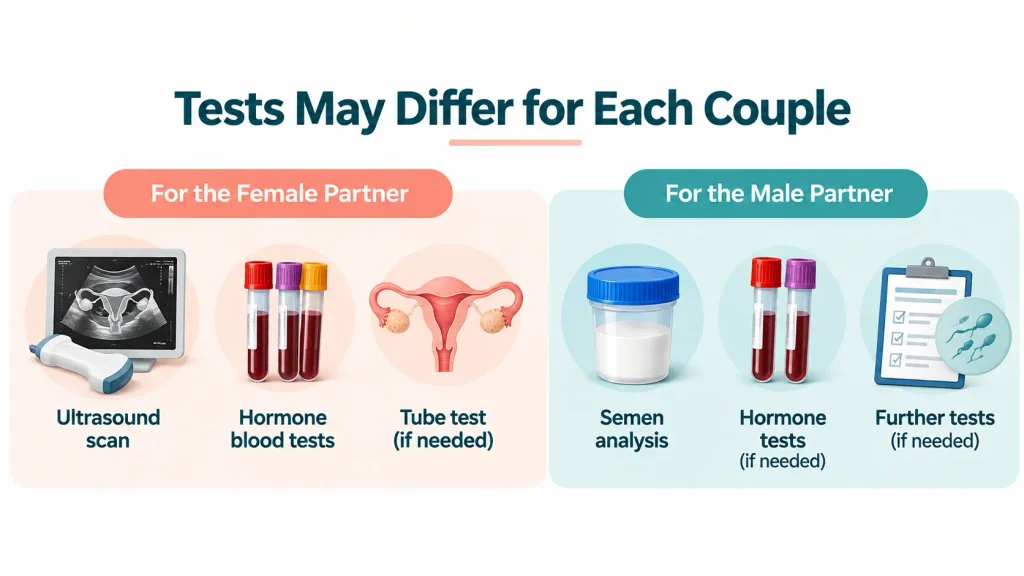
Most couples are surprised by how much of the early workup is simple blood tests and one scan. The exact list depends on your history, but infertility tests for male and female partners usually look like this.
For the female partner
- Transvaginal ultrasound: checks the uterus, the lining and the ovaries, and counts the small resting follicles (the antral follicle count). Fertility sonography is usually done on the day of the visit.
- AMH blood test: estimates ovarian reserve and can be done on any cycle day.
- Day 2 or 3 hormones: FSH, LH and estradiol, timed to the early days of your period.
- Thyroid and prolactin: both can quietly disturb ovulation.
- Tube test (HSG or SSG): scheduled after your period stops and before ovulation, so rarely on day one.
- Routine screening: blood group, haemoglobin, sugar, and infection screening for HIV, hepatitis B and C, and syphilis, needed before any IUI or IVF.
For the male partner
- Semen analysis: ideally after 2 to 7 days without ejaculation, the window WHO laboratory standards use.
- A repeat sample: if the first is abnormal, since one result can vary with fever, stress or a short abstinence gap.
- Hormones or a scrotal ultrasound: only if the semen report or examination points that way.
Testing both partners together is standard practice, not an extra. The Mayo Clinic diagnosis guide lists semen analysis alongside ovulation and ovarian reserve testing in the same first workup.
What the Doctor Is Assessing in That First Hour
The questions can feel personal. Each one has a purpose. In that first hour, the specialist is building four pictures, and every test that follows is chosen to complete one of them.
- The ovulation picture: whether you release an egg each month, judged from cycle length, symptoms and hormones.
- The reserve picture: roughly how many eggs remain, from the follicle count and AMH testing. AMH predicts egg number, not egg quality, so a low value is not a verdict on its own.
- The pathway picture: whether the tubes are open and the uterus is ready to hold a pregnancy.
- The male factor picture: sperm count, movement and shape, plus any history affecting sperm production.
Expect questions about sleep, shift work, smoking, alcohol, weight and how often you have intercourse around ovulation. Answer honestly. Nothing is judged, and small details often change the plan.
Questions Worth Writing Down Before You Come
Nerves make people forget. Couples who walk in with written questions usually leave with clearer answers.
- What are the most likely reasons we have not conceived?
- Which tests do we need, and which can be done today?
- What will the tests cost in total?
- Is there anything we should change before the next cycle?
- Do we need treatment at all, or should we keep trying naturally?
- If treatment is needed, what is the simplest option for us?
- When will results come in, and who will explain them?
- Who do we call between visits with a question?
If the male partner’s semen report comes back abnormal, it is fair to ask whether a urology review with Dr Sunil Palve would help, since some causes of low sperm count are treatable on their own.
What You Leave With: a Plan, a Timeline and a Cost Range
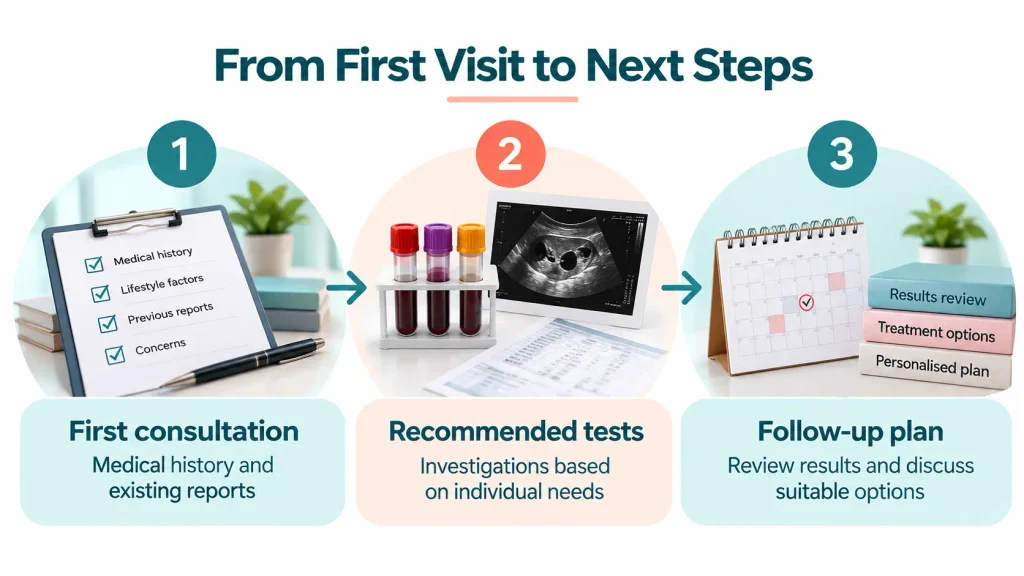
A good first consultation does not end with pressure to start IVF that week. It ends with clarity, in three parts.
- A written test plan: which tests, on which cycle day, in what order.
- A timeline: when reports will be ready and when the follow up visit is due, usually within one or two cycles.
- A cost range: for the tests ordered and for options that might follow, from timed intercourse and ovulation induction to IUI or IVF.
Many couples never need IVF. Some conceive after a thyroid correction or better timed intercourse, while others need a few cycles of ovulation medicine. The treatment decision comes at the second visit, once results are in and you have both had time to think.
A point specific to India: under the Assisted Reproductive Technology (Regulation) Act, 2021, written informed consent and identity proof are required before procedures such as IUI or IVF. A consultation needs neither, but keep Aadhaar or another photo ID ready for both partners if you go ahead with treatment.
Booking and Reaching 6Venus From Across Pimpri Chinchwad
6Venus Fertility and Urology Hospital is on the third floor of Darekar Heights, Dange Chowk Road, opposite Pandit Petrol Pump, Yashoda Colony, Wakad, Pune 411057. Dange Chowk is a familiar landmark across PCMC, so couples from Thergaon, Rahatani, Pimple Saudagar, Hinjewadi, Ravet, Chinchwad, Pimpri, Akurdi and Nigdi usually find the route easy. To book a fertility doctor appointment in Pimpri Chinchwad, call or WhatsApp +91 8446684194. More details about our Pimpri Chinchwad centre are on its own page.
- Book for days 2 to 5 of your period if you can, so early hormones and the scan fit into one visit.
- Ask when booking whether any test needs fasting.
- Come together, with your reports in one folder.
- Use the washroom just before the internal scan, which is easier with an empty bladder.
The visit itself is a conversation, a scan and a few blood tests. For couples searching for the first fertility consultation, what to expect comes down to this: you leave knowing more than when you arrived, with a plan in writing and no decision you have to make on the spot.
Frequently Asked Questions About the First Fertility Visit
1. When should a couple see a fertility specialist?
If the woman is under 35 with regular cycles, most guidance suggests trying for a year first. At 35 or older, see a specialist after six months. Over 40, an earlier evaluation is reasonable. At any age, don’t wait if periods are very irregular or absent, if there is known endometriosis, PCOS or a past pelvic infection, after two or more miscarriages, or if the male partner has an abnormal semen report. A consultation commits you to nothing, and for many couples it simply confirms that nothing serious is wrong.
2. What does the first fertility consultation cost in Pune?
The consultation is one fixed fee, and the 6Venus front desk tells you the current amount when you book. Tests are billed separately and depend on what the doctor orders after hearing your history. Across Pune, tests usually make up most of the first month’s spend, not the consultation itself. Ask for a written list of tests and prices before anything is done, so you can decide what to do now and what can wait.
3. Which reports should I bring to my first appointment?
Bring whatever you already have, even if it is old: AMH, thyroid, prolactin and hormone reports, pelvic ultrasound reports, an HSG or laparoscopy report, the male partner’s semen analysis, and records of any earlier IUI or IVF, including medicine doses. Note the start dates of your last three periods and list your current medicines. None of this is required to book. Couples with no reports are still assessed fully, and the doctor orders whichever baseline tests are missing.
4. Does my husband need to come to the first visit?
It helps a great deal. Male factors play a part for a large share of couples who struggle to conceive, and the doctor needs his history too: illnesses, surgeries, medicines, smoking, alcohol and work patterns. Coming together means the semen analysis can be planned in the same visit, and you both hear the same explanation. If he truly cannot come, you can still have the consultation and bring his reports. He may need a short visit later for an examination or a sample.
5. What tests are done on the first day?
Usually a transvaginal ultrasound to check the uterus and ovaries and count resting follicles, plus blood tests such as AMH, thyroid and prolactin, which work on any cycle day. If you come on day 2 to 5 of your period, FSH, LH and estradiol can be added. The male partner can give a semen sample if he has abstained for 2 to 7 days. The tube test is not done on day one, because it has to fall after your period ends and before ovulation.
6. How long before we get a treatment plan?
You leave the first visit with a written test plan and a likely direction. The full treatment plan normally comes at the second visit, once results are in, usually within one or two menstrual cycles. Blood and semen reports often return within a few days, while a tube test waits for the right days of your next cycle. If your history already makes the direction clear, such as blocked tubes on an earlier report, the doctor can discuss options at the first visit itself.
7. Will the doctor recommend IVF straight away?
Not usually. IVF is one option among several, and many couples conceive with simpler steps: correcting thyroid levels, managing PCOS, timing intercourse around ovulation, ovulation medicine or IUI. IVF comes up early only when there is a clear reason, such as blocked tubes, a severe male factor, very low ovarian reserve, or a long history of unsuccessful treatment elsewhere. Even then, the decision is yours, and you should have time to think it over without being rushed.
8. Can I come for a consultation during my periods?
Yes, and days 2 to 5 of your period are often the most useful time. Early cycle hormones like FSH, LH and estradiol are measured then, and the antral follicle count is clearest on the scan. Bleeding does not prevent an internal ultrasound, and the team is used to it. If your periods are irregular or have stopped for a while, come whenever suits you. The doctor plans the timed tests from there and may give medicine to bring on a period if testing needs it.
9. Is the internal ultrasound painful?
For most women, a transvaginal ultrasound feels like mild pressure rather than pain, and it takes only a few minutes. A slim probe with a covered, lubricated tip is used, and you can ask the doctor to stop or slow down at any point. An empty bladder makes it more comfortable. You can ask for a female attendant to be present, and if you have never had an internal examination, say so beforehand so each step is explained first.
10. Can we consult just for advice, without starting treatment?
Yes. Many couples come only to understand where they stand: whether their reports are normal, whether age is becoming a factor, or whether egg or sperm freezing makes sense for later. A consultation carries no obligation to begin treatment, buy a package or do every test listed. You can take your plan and reports home, discuss it with family, or seek another opinion. Everything you share stays confidential between you and the treating team.