
A thirty year old and a thirty five year old can walk into the same fertility clinic, ask for the same procedure, and walk out with very different odds of ever using their eggs successfully. That gap is not about effort, lifestyle, or luck. It comes down to biology, and it is exactly why so many women across Wakad are now asking about egg freezing at 30 vs 35 in Wakad before they assume five years makes no real difference.
Egg freezing, medically known as oocyte cryopreservation, is a fertility preservation procedure in which mature eggs are retrieved from the ovaries, frozen through a rapid process called vitrification, and stored for future use in IVF or ICSI. It allows a woman to preserve eggs collected at a younger age even if she plans to conceive later.
What Actually Changes Between 30 and 35
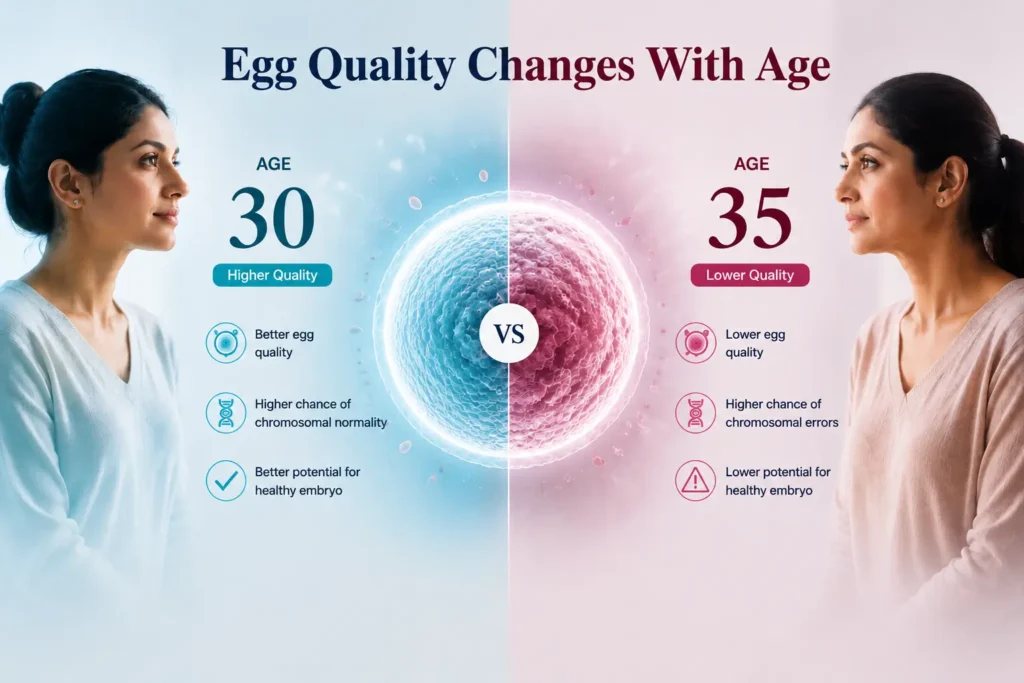
Every woman is born with the total number of eggs she will ever have. By the time she reaches her thirties, that reserve has already been declining for years, and the decline accelerates after 35. This is not just about quantity. Egg quality drops too, because older eggs carry a higher chance of chromosomal errors, which lowers the odds that a fertilized egg develops into a healthy embryo.
Fertility specialists consistently observe that egg quantity and quality decline gradually through the early thirties and then more sharply from the mid thirties onward, which is why age at the time of freezing, not age at the time of use, is the number that matters most.
According to Cleveland Clinic, the chance of a successful pregnancy from frozen eggs depends heavily on the age at which those eggs were collected, since younger eggs are more likely to survive thawing and fertilize successfully. That single detail explains why the conversation around egg freezing at 30 in Pune sounds so different from the conversation around egg freezing at 35 in Pune.
Egg Freezing at 30: What the Numbers Usually Look Like
Women who freeze their eggs at 30 typically respond well to ovarian stimulation. More follicles tend to develop, more mature eggs are usually retrieved per cycle, and a larger share of those eggs are chromosomally normal. Fewer cycles are often needed to bank a reasonable number of eggs, which also means lower total cost and less time spent on injections and monitoring.
This does not mean 30 is the only good age. It means the biological starting point is stronger, so the same effort tends to produce a deeper reserve of usable eggs for the future.
Egg Freezing at 35: What Changes Biologically
Thirty five is often described as a turning point rather than a cliff edge. Ovarian reserve, commonly estimated through an AMH (anti Mullerian hormone) blood test and an antral follicle count on ultrasound, tends to be noticeably lower than it was five years earlier. Stimulation protocols may need to be adjusted, and more eggs are usually needed at retrieval to end up with the same number of chromosomally normal ones.
None of this means egg freezing at 35 in Pune is a poor decision. Many women in this age group still bank enough eggs for a strong future chance, especially with two cycles instead of one. It simply means the conversation with a fertility specialist becomes more specific: how many eggs, how many cycles, and what timeline makes sense.
Egg Freezing at 30 vs 35 in Wakad: A Side by Side Comparison
| Factor | Freezing at Age 30 | Freezing at Age 35 |
|---|---|---|
| Typical ovarian response | Generally strong | Often moderate, varies by individual AMH level |
| Eggs retrieved per cycle | Usually higher | Usually lower, more variable |
| Proportion of chromosomally normal eggs | Higher | Lower, gradually declining |
| Cycles often required to bank a strong reserve | Often one | Sometimes two |
| Overall approach | Preserve early, decide later | Preserve promptly, plan for possible second cycle |
The table is not a verdict on any individual case. General data on egg quality by age in Pune and elsewhere still shows wide variation between individuals, and two women of the same age can have very different ovarian reserves. That is exactly why a personal AMH test and ultrasound assessment matter more than the calendar alone.
Does Five Years Really Change the Outcome
Yes, for most women, though the size of that change varies. NHS guidance on IVF notes that age is one of the strongest factors influencing treatment success, alongside the underlying cause of infertility and lifestyle factors such as smoking and body weight. Egg freezing does not remove age as a factor. It simply locks in the biological age of the eggs at the point of freezing, even if the pregnancy itself happens years later.
So the honest answer to whether five years matter is this: it depends less on the number 35 itself and more on what your ovarian reserve looks like right now. Some 35 year olds have the egg quality of a much younger woman. Some 30 year olds have already started declining faster than expected. A blood test tells you more than a birthday does, which is exactly why anyone weighing egg freezing at 30 vs 35 in Wakad should start with an ovarian reserve test rather than a calculator.
How to Decide the Best Age for Egg Freezing in Wakad
There is no single correct age. There is a correct process for deciding.
- Get an AMH blood test and an antral follicle count to see your current ovarian reserve rather than assuming based on age alone.
- Discuss your family planning timeline honestly with your fertility specialist, including how many years you expect to wait before trying to conceive.
- Ask how many eggs your specialist recommends banking for your specific age and reserve, since the target number changes with age.
- Understand whether one cycle is likely to be enough or whether two cycles should be planned from the start.
- Factor in cost, time off work, and how the process fits around your career, since these are legitimate parts of the decision too.
Patients often ask what the best age for egg freezing in Wakad actually is, expecting a single number. The honest clinical answer is earlier rather than later, but the more useful answer is whatever age you are when your reserve is tested and the decision becomes informed instead of guessed.
What Happens During Fertility Preservation in Wakad
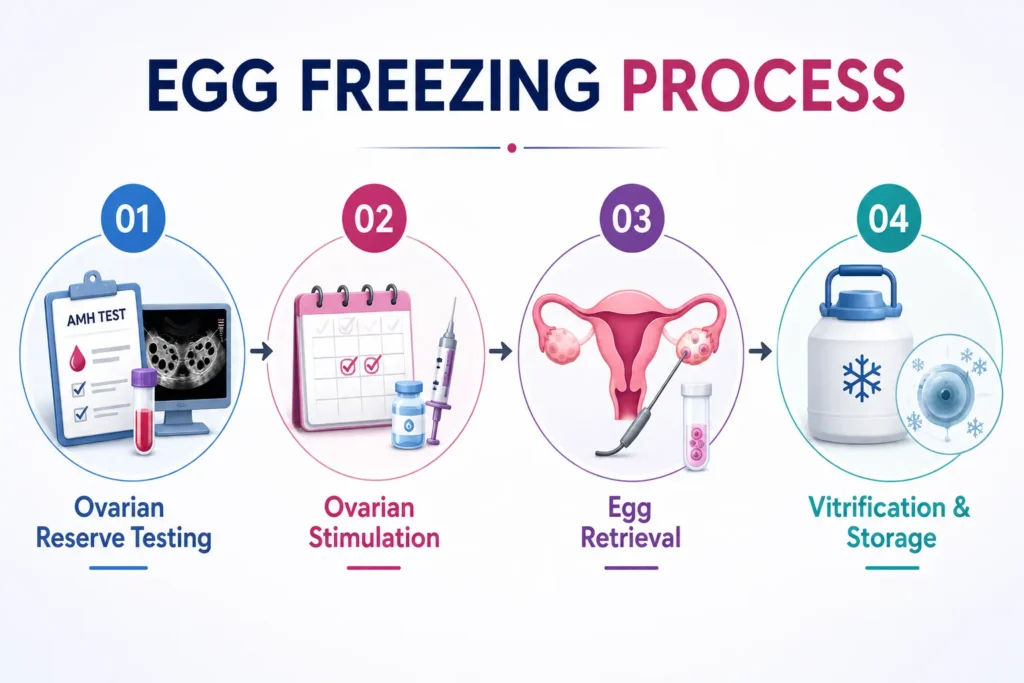
The process is the same regardless of age, though the medication dose and monitoring schedule may differ based on ovarian reserve.
- Baseline testing, including AMH, antral follicle count, and a general health screening.
- Ovarian stimulation using injectable hormones over roughly ten to twelve days, with regular ultrasound monitoring.
- Egg retrieval under sedation, a short outpatient procedure that typically takes about twenty minutes.
- Vitrification, where mature eggs are rapidly frozen and stored until the patient is ready to use them.
Patients considering this path in Wakad can review the egg and sperm freezing page to understand eligibility, the testing sequence, and what a consultation actually covers before committing to a cycle.
Why Wakad Women Are Freezing Eggs Earlier
Wakad sits inside the Hinjewadi IT corridor, and a large share of patients here are professionals balancing demanding careers with decisions about starting a family. Many have delayed marriage or childbearing for education, career growth, or simply because the right timing had not arrived yet. This pattern is not unique to Wakad, but the concentration of working professionals in this belt means fertility preservation conversations happen earlier and more practically than in many other parts of Pune.
Rather than waiting until fertility becomes a pressing concern, more patients are choosing to test their ovarian reserve in their late twenties or early thirties, purely to have accurate information before deciding whether to freeze eggs now or later. It is a common conversation at consultations for egg freezing at 30 vs 35 in Wakad, and it usually starts with a simple question: what does my own reserve actually look like today.
Choosing an Egg Freezing Clinic in Pune
Not every egg freezing clinic in Pune offers the same depth of monitoring, laboratory standards, or counseling before the procedure. When comparing options, ask about the clinic’s vitrification success rate, the experience of the embryology team, and whether the fertility specialist actually reviews your individual AMH and antral follicle results before recommending a plan rather than applying a standard protocol to every patient.
Patients based in and around Wakad can also review the IVF center in Wakad to see the range of fertility services available locally, including consultations that combine ovarian reserve testing with a clear discussion of realistic outcomes for your specific age and health profile.
Whether you are 30, 35, or somewhere in between, the decision around egg freezing at 30 vs 35 in Wakad ultimately comes down to your own biology, timeline, and comfort with uncertainty, not a rule that applies equally to everyone.
Frequently Asked Questions About Egg Freezing at 30 vs 35
1. Is 35 too late to freeze eggs
No. Thirty five is not too late, though egg quantity and quality are typically lower than at 30. Many women in their mid thirties still bank a meaningful number of eggs, sometimes across two cycles instead of one. An AMH test and antral follicle count will give a far clearer picture than age alone.
2. How many eggs should I freeze at 30
Most fertility specialists recommend banking enough eggs to give a reasonable chance of at least one live birth later, which often means aiming for a healthy number of mature eggs collected across one or occasionally two cycles. Your specialist will personalize this number based on your ovarian reserve results.
3. How many eggs should I freeze at 35
Because egg quality and quantity are usually lower at 35, specialists often recommend banking more eggs than they would at 30 to reach a similar chance of future success. This sometimes means planning for two retrieval cycles from the outset rather than assuming one will be enough.
4. Does egg freezing hurt
The egg retrieval procedure is performed under sedation, so patients do not feel it happening. Mild cramping, bloating, or spotting afterward is common and usually resolves within a few days. The daily hormone injections during stimulation can cause minor site irritation but are generally well tolerated.
5. What is a normal AMH level for my age
AMH levels vary widely between individuals, but they generally decline with age. Rather than comparing your number to a generic chart, your fertility specialist will interpret your AMH alongside your antral follicle count and overall health to estimate your personal ovarian reserve.
6. How long can frozen eggs be stored
Vitrified eggs can typically be stored for many years without a meaningful decline in quality, since the freezing process halts biological aging at the cellular level. Storage duration limits and renewal requirements vary by clinic and by current regulations, so confirm details directly with your provider.
7. Does egg freezing guarantee a future pregnancy
No fertility procedure can guarantee a pregnancy. Egg freezing improves the odds of a future live birth compared to relying only on eggs conceived naturally at an older age, but outcomes depend on the number and quality of eggs frozen, the age at freezing, and individual health factors at the time of use.
8. What is the ideal age to freeze eggs
There is no single ideal age that applies to everyone. Egg quantity and quality are generally strongest in the twenties and early thirties, which is why many specialists encourage earlier testing and freezing when timelines allow. The more useful marker is your individual ovarian reserve rather than a fixed number.
9. How much does egg freezing cost in Wakad
Cost varies based on the number of stimulation cycles needed, medication dosage, and annual storage fees. Because women who freeze later sometimes need a second cycle to bank enough eggs, total cost can end up higher when the decision is delayed. A consultation will give an accurate, personalized estimate.
10. Can lifestyle changes improve egg quality before freezing
Maintaining a healthy weight, avoiding smoking, managing stress, and treating conditions such as thyroid imbalance or PCOS can support overall reproductive health. However, lifestyle changes cannot reverse the natural age related decline in egg quantity and quality, so they should be seen as supportive rather than a substitute for timely testing.
11. Is an AMH of 0.5 too low to freeze eggs after 40
An AMH of 0.5 in your forties generally points to a significantly reduced ovarian reserve, and it does make egg freezing more challenging, though not automatically impossible. Some women in this situation still retrieve a small number of eggs, while others are advised to explore other paths sooner rather than later. This is a conversation to have directly with a fertility specialist, since an AMH number alone does not tell the whole story.
12. My AMH is 0.6 at age 31, should I freeze my eggs now
An AMH of 0.6 at 31 is lower than typically expected for that age, and many specialists would treat this as a signal to act sooner rather than wait. It does not automatically mean natural conception is impossible, but it usually means egg freezing or another fertility path should be discussed promptly rather than left for a few more years. A full evaluation, including antral follicle count and a partner fertility check, will give clearer direction.
13. Can I still do IVF with my own eggs if my AMH is very low
A very low AMH, especially in the forties, does not always rule out using your own eggs, but it usually means fewer eggs are likely to be retrieved and expectations need to be realistic. Some patients proceed with their own eggs after a detailed consultation, while others are advised to discuss donor eggs as an alternative. Your fertility specialist can explain which path fits your specific test results and overall health.
14. Does a low AMH mean I cannot get pregnant naturally
Not necessarily. AMH reflects the size of your remaining egg reserve, not whether you can conceive naturally right now. Many women with a lower than average AMH still conceive without treatment, though it can mean a shorter window to do so. A low AMH is more useful as an early signal to plan sooner than as a definite prediction of infertility.
15. What is considered a low AMH for someone in their early thirties
AMH ranges vary between laboratories, so your fertility specialist will interpret your result against the specific lab’s reference range rather than a single universal number. As a general pattern, values that sit well below the typical range for the early thirties are usually flagged for closer review alongside an antral follicle count. This is exactly the kind of detail that makes the egg freezing at 30 vs 35 in Wakad comparison less about age on paper and more about your actual test results, so ask your specialist to explain what your number means for your specific situation rather than comparing it to figures found online.