

Most couples who walk into a fertility clinic assume only one partner needs to think about freezing anything. Then the doctor asks a question neither of them expected: has your partner had a semen analysis yet? For couples weighing egg freezing or sperm freezing in Wakad, that single question often changes the entire plan. Fertility preservation is rarely a one partner’s decision, and treating it as one is where most couples lose time they did not need to lose.
What Freezing Together Actually Means
Couple fertility preservation is the practice of both partners preserving reproductive material, eggs from the female partner and sperm from the male partner, within the same planning window rather than treating one partner’s timeline as more urgent than the other’s. It does not mean both procedures happen on the same day. It means both partners are evaluated, tested, and given a timeline before either one commits to freezing alone.
This matters because fertility decline is not exclusive to women. Sperm quality, count, and DNA integrity also change with age, illness, and lifestyle, though the slope is gentler and less talked about. Joint fertility decisions start with acknowledging that both partners have a clock, even if only one of them has been told so directly.
What Egg Freezing Involves for Her
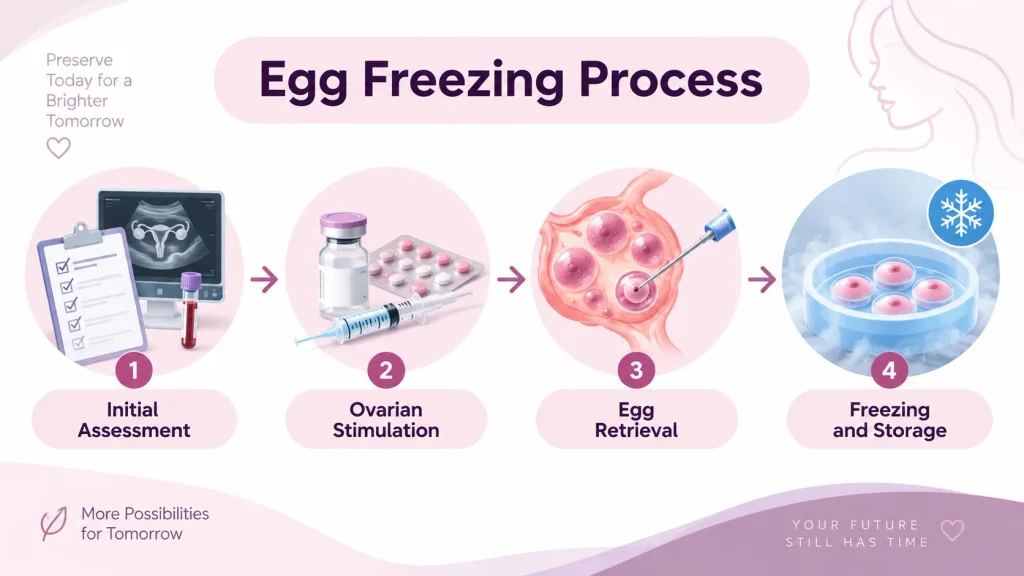
Egg freezing begins with roughly two weeks of hormone injections to stimulate the ovaries, followed by a short retrieval procedure done under sedation. The eggs are frozen almost immediately using a fast freeze technique called vitrification. Our egg and sperm freezing program at 6Venus follows this same protocol, with monitoring scans every few days to track follicle growth before retrieval.
Outcomes depend heavily on age and egg count. According to NHS fertility preservation guidance, women under 35 who freeze around 12 eggs have roughly a 40 to 50 percent chance of a successful pregnancy later, and that rises to 75 to 80 percent with around 20 eggs. Between 8 and 9 out of every 10 frozen eggs are expected to survive the freezing and thawing process. Those numbers are the reason clinicians push female partners to test and act earlier rather than later.
What Sperm Freezing Involves for Him
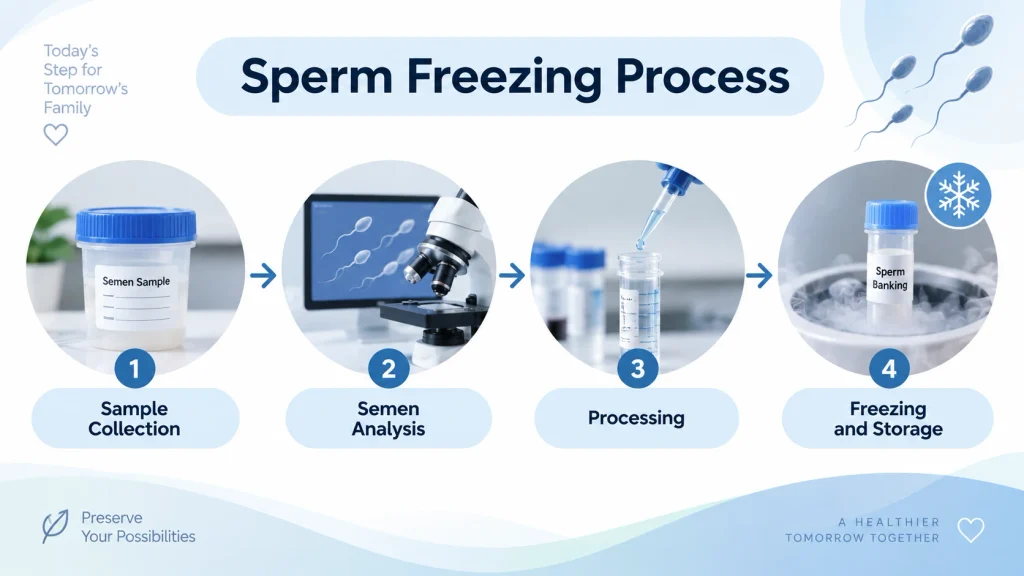
Sperm freezing is comparatively straightforward. According to Cleveland Clinic sperm banking, a blood test screens for infections, a semen sample is collected after a short period of abstinence, and the sample is analysed for count and motility before being frozen in liquid nitrogen. Men are typically asked to abstain from ejaculation for 24 to 72 hours before giving a sample, which improves the quality of what gets frozen.
There is no injection cycle, no sedation, and no recovery day. That simplicity sometimes leads couples to assume the male side of the plan can wait. It usually should not, especially if semen parameters have never actually been checked.
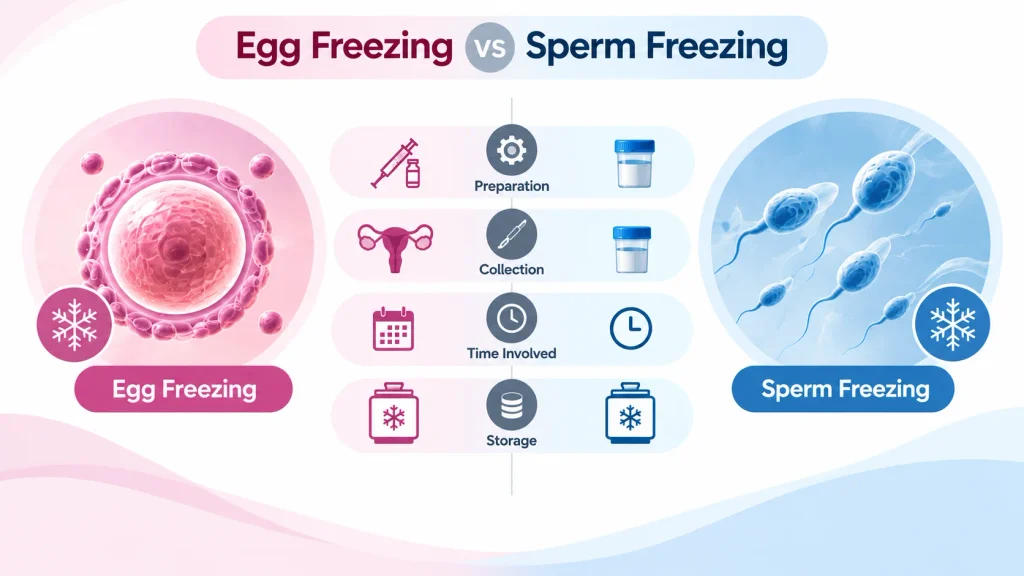
| Factor | Egg Freezing | Sperm Freezing |
|---|---|---|
| Process length | About two weeks, including stimulation and monitoring | A single visit in most cases |
| Invasiveness | Injections plus a sedated retrieval procedure | A semen sample and a blood test |
| What drives urgency | Age and ovarian reserve, both measurable early | Semen quality, upcoming treatment, or planned surgery |
| Typical decision window | Best planned before age 35 where possible | Can often be arranged within the same week |
Why the Decision Often Comes Down to Timing, Not Gender
Couples frequently default to whichever partner’s fertility feels more urgent on paper. That instinct is not wrong, but it is incomplete. A woman’s ovarian reserve, measured through an AMH blood test, can decline noticeably over a few years. A man’s semen quality can shift too, from stress, travel heavy work schedules common among Wakad’s IT professionals, medication changes, or simply age.
The honest answer for most couples is that neither partner’s fertility should be assumed fine without a test. A joint fertility decision starts with both partners getting baseline results, not with guessing whose biology is under more pressure.
Our fertility specialists at 6Venus put it plainly to couples in consultation: get both partners tested before you decide who freezes first. Waiting on one partner while assuming the other has time is the single most common reason couples end up freezing later than they wanted to.
Should You Freeze Together or One at a Time
There is no universal answer, but a few factors consistently tip the decision one way or the other.
- One partner has an upcoming medical treatment, such as chemotherapy or a planned vasectomy, that makes freezing time sensitive.
- There is a meaningful age gap between partners, with one closer to the point where fertility decline accelerates.
- Testing has already shown reduced ovarian reserve or below average semen parameters in one partner.
- Budget realistically allows for one procedure now and the second within a defined, near term window rather than an open ended “eventually”.
- Both partners are in good reproductive health for their age, in which case freezing together locks in current fertility for both rather than waiting on one.
Understanding the Cost Picture for Couples in Wakad and Pune
Cost is usually the question that surfaces once the medical picture is clear. Egg freezing and sperm freezing sit at very different price points because of how different the procedures are, and couples in Wakad and greater Pune often plan around staggering the two rather than paying for both at once. The full breakdown, including storage fees and what typically drives the total up or down, is covered in our egg freezing cost guide and our sperm freezing cost guide, both worth reading before you set a budget for either procedure.
A useful rule of thumb: sperm freezing rarely changes the household budget significantly, while egg freezing is the larger financial commitment because of the medication and monitoring involved. Planning the female partner’s procedure first financially, even when both partners test at the same time, is common for exactly this reason.
A Step by Step Approach to Deciding Together
- Book baseline testing for both partners, an AMH and antral follicle count for her, a semen analysis for him.
- Review both results with a fertility specialist in the same consultation, not separately.
- Identify whether either partner has a time sensitive factor, medical, occupational, or related to age.
- Set a realistic budget and timeline for one or both procedures based on that urgency.
- Confirm storage terms, consent requirements, and what happens if life plans change before either specimen is used.
- Schedule the procedure for whichever partner’s results indicate the greater time pressure, with the second partner’s procedure planned within a defined window rather than left open.
Choosing a Fertility Clinic for Egg or Sperm Freezing
Once a couple has decided to explore fertility preservation, the next step is choosing a fertility clinic where both partners can have their needs assessed. Having consultations and testing coordinated through the same fertility team can make it easier to compare results, understand the timing involved and plan the next steps together.
It can be helpful to ask about the tests recommended for each partner, the freezing process, laboratory facilities, storage arrangements, total treatment costs and what follow-up care is available. Couples should also feel comfortable asking how their individual results may affect the recommended timeline.
Don’t decide which partner should freeze first based on assumptions. Start by understanding both partners’ fertility assessments, age and future plans. Once we know where the time pressure actually exists, we can make a more informed decision about whether to preserve eggs, sperm, or both. Dr Pavan Bendale
1. Do both partners need to freeze at the same time?
No. Freezing at the same time is convenient for some couples, but it is not medically required. What matters more is that both partners get tested early so the decision is based on real numbers rather than assumptions about who needs to act first. Many couples end up freezing a few weeks or months apart once results come back, once the specialist has a clear picture of both partners’ fertility and can recommend a realistic order and timeline for each procedure.
2. Is sperm freezing necessary if the man has normal semen parameters?
Not usually, unless there is a specific reason such as upcoming surgery, cancer treatment, or a known decline over time. Normal results today do not guarantee normal results in five years, but for most men with healthy parameters and no immediate medical concern, sperm freezing becomes more relevant closer to when the couple plans to use IVF or IUI. A repeat semen analysis every couple of years is a reasonable way to keep track of any changes without committing to freezing too early.
3. How much does egg freezing cost compared to sperm freezing in Wakad?
Egg freezing costs substantially more than sperm freezing because it involves hormone medication, repeated monitoring scans, and a retrieval procedure under sedation. Sperm freezing typically involves a single collection, testing, and freezing fee. Exact figures vary by clinic and by how many freezing cycles are needed, and by ongoing storage charges for both eggs and sperm, so a direct consultation gives couples in Wakad the most accurate estimate for their specific situation.
4. Can we freeze eggs and sperm and still try to conceive naturally first?
Yes. Freezing is a backup plan, not a replacement for trying naturally if that is still the couple’s preference. Many couples freeze as an insurance policy while continuing to try conceiving on their own timeline, with the frozen eggs and sperm available only if natural conception does not happen within the window they are comfortable with. It removes the pressure of a ticking clock while the couple keeps trying on their own terms.
5. What happens to frozen eggs and sperm if the couple separates?
This depends on the consent forms signed at the time of freezing, which specify what happens to stored material in different scenarios, including separation. It is worth discussing this openly with the clinic before freezing begins, since unfertilised eggs and frozen sperm are generally treated as individually owned material rather than joint property, unlike frozen embryos. Each partner typically retains control over their own stored material and can decide independently what happens to it.
6. Does age matter more for egg freezing or sperm freezing?
Age affects both, but the impact on egg quality and quantity is steeper and more time sensitive, particularly after the mid thirties. Sperm quality declines more gradually, though it is not unaffected by age. This is why fertility specialists usually recommend testing the female partner’s ovarian reserve sooner rather than later, even if the male partner’s timeline feels less urgent.
7. How long can eggs and sperm stay frozen before they are used?
Both can typically remain frozen for many years under proper storage conditions, with sperm often considered viable indefinitely when stored correctly, and eggs generally remaining usable for a decade or longer. Clinics will have specific storage terms and renewal requirements, so it is worth confirming these details, including any time limits set by local regulations, before committing to long term storage for either partner.
8. Is one round of egg freezing usually enough?
It depends on the woman’s age and how many eggs are retrieved in that cycle. Younger women with a good ovarian reserve often get enough eggs in one cycle, while some women need two cycles to reach a number their specialist considers a reasonable chance at future pregnancy. Your specialist will discuss this after your first monitoring scans, once early results show roughly how many eggs are likely to be collected.
9. Do we need a referral to start fertility preservation testing?
No referral is required to book initial testing at most fertility clinics, including AMH testing for women and semen analysis for men. Couples can approach a fertility centre directly to begin baseline testing before deciding on next steps. Bringing any previous test results or medical history to the first appointment helps the specialist give a more precise, personalised recommendation from the start.
10. What is the first appointment actually like for a couple?
The first appointment usually involves a joint consultation where both partners discuss their health history and goals, followed by scheduling baseline tests. It is less clinical and more conversational than most couples expect, and it is the appointment where most of the “who should freeze first” questions actually get answered with real data rather than guesswork. Couples typically leave with a clear next step for both partners, not just one.