

A single semen sample can sometimes be divided into multiple vials after it reaches the fertility laboratory. That means one collection may provide more than one opportunity for future treatment, depending on the sample quality and the laboratory’s assessment. For couples planning fertility treatment, sperm freezing can be a practical option when the male partner cannot be present on the treatment day, when semen parameters are a concern, or when having a backup sample would make treatment planning easier.
Planning Sperm Freezing for IUI or IVF
One of the most common questions couples have is whether frozen sperm works as well as a fresh sample. The answer depends on the treatment being considered, the quality of the original semen sample, and how well the sperm survives freezing and thawing.
Planning ahead can be useful. A decision made only a day or two before treatment may leave limited time to assess how a sample responds to freezing and thawing. Arranging storage earlier gives the laboratory an opportunity to evaluate the sample, determine how it should be divided, and discuss whether additional collections would be useful.
For couples in Pimpri-Chinchwad who are balancing work, travel, or fertility treatment appointments, having a stored sample can also reduce the need to coordinate a fresh collection with a specific treatment date.
What Does Frozen Sperm Mean?
Frozen sperm is a semen sample that has been treated with a cryoprotectant, cooled to very low temperatures, and stored in liquid nitrogen until it is needed. Before freezing, the laboratory checks the sperm count, motility, and overall quality and may divide the sample into separate vials.
When treatment is planned, the required vial is thawed and checked again to see how well the sperm has survived the freeze-thaw process. The sample is then prepared for IUI, IVF, or ICSI, depending on the couple’s treatment plan and sperm quality.
When Is Sperm Freezing a Practical Option?
Fresh sperm may be appropriate when the male partner can provide a sample on the day it is needed. Freezing becomes particularly useful in situations such as:
- The male partner works away from Pune or travels frequently and may not be available on the treatment day.
- Semen analysis shows a low sperm count or reduced motility, and the fertility team recommends banking additional samples as a precaution.
- Sperm needs to be obtained surgically, such as through TESA or Micro-TESE, and the retrieved sperm needs to be preserved for a future treatment cycle.
- The couple is freezing or storing eggs separately and wants sperm available when the eggs are later used for treatment.
- A planned medical treatment, such as chemotherapy, may affect future fertility, making sperm banking an important fertility-preservation option.
- A planned procedure such as vasectomy could make future sperm collection more difficult.
Our sperm freezing services at 6Venus are designed for situations where preserving sperm in advance can make fertility treatment planning easier. The laboratory team can assess the sample and discuss storage requirements with you before treatment.
Frozen Sperm for IUI vs IVF
IUI and IVF use sperm differently, so the laboratory requirements are not identical. During IUI, prepared sperm is placed inside the uterus and fertilisation still occurs naturally within the reproductive tract. For this reason, the number and motility of usable sperm after preparation are important.
With IVF, fertilisation takes place in the laboratory. With ICSI, a single selected sperm is injected directly into an egg. This can make ICSI an option when sperm numbers or motility are significantly reduced, although the appropriate treatment depends on the individual fertility assessment.
| Factor | IUI with Frozen Sperm | IVF/ICSI with Frozen Sperm |
|---|---|---|
| How sperm is used | Prepared sperm is placed into the uterus and fertilisation occurs naturally. | Fertilisation occurs in the laboratory; with ICSI, one selected sperm is injected into an egg. |
| Importance of post-thaw motility | Important because sperm must still move through the reproductive tract and fertilise the egg. | Less dependent on overall motility when ICSI is used, because an embryologist can select an individual usable sperm. |
| When it may be considered | Planned absence, donor or stored sperm use, or selected cases of mild male-factor infertility. | More significant male-factor infertility, surgically retrieved sperm, or other situations where IVF/ICSI is clinically appropriate. |
Our IUI treatment programme in Pimpri-Chinchwad includes assessment of the prepared sample before the procedure so that the fertility team can make decisions based on the available sample rather than assuming that every frozen sample will behave in the same way.
Where Does ICSI Fit In?
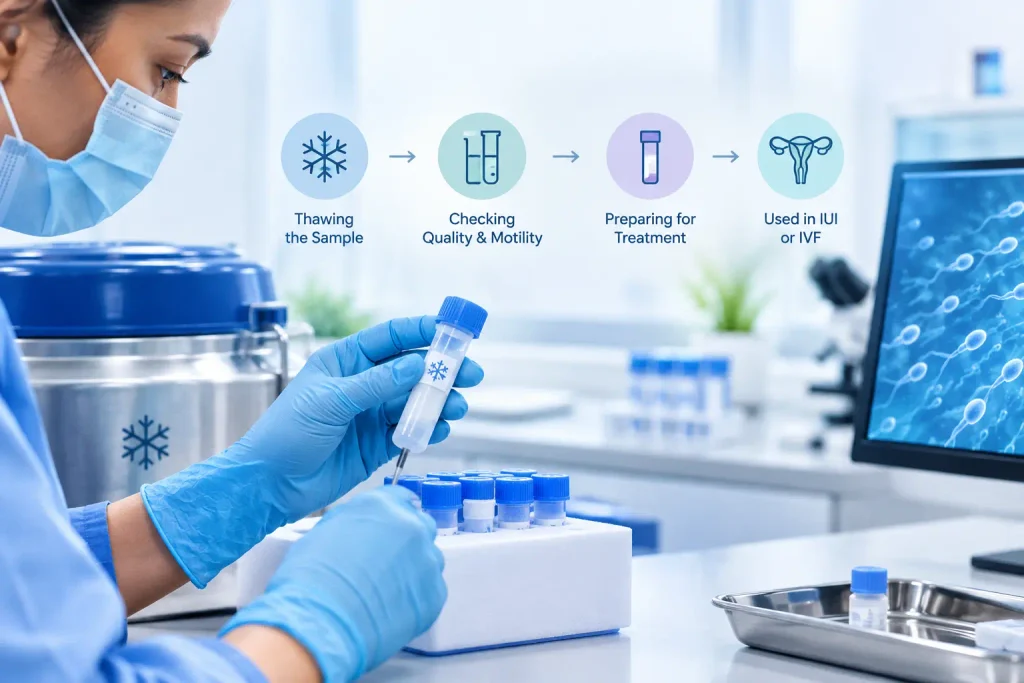
ICSI can be particularly useful when the available sperm count is very low or when sperm has been obtained through a surgical retrieval procedure. During ICSI, the embryologist selects an individual sperm and injects it directly into the egg.
Because ICSI can work with a very small number of usable sperm, it may be considered when a stored sample has limited sperm available after thawing. It does not mean that ICSI is automatically required whenever frozen sperm is used; the decision depends on semen analysis, previous treatment history, egg factors, and the fertility specialist’s assessment.
For men with azoospermia or certain forms of severe male-factor infertility, our surgical sperm retrieval programme can retrieve sperm directly from testicular tissue when clinically appropriate. Retrieved sperm may then be preserved for use in a future ICSI cycle.
What Happens Before Sperm Is Used for IUI or IVF?
- The male partner provides a semen sample according to the instructions given by the fertility clinic, including any recommended period of abstinence.
- The laboratory evaluates the sample, including sperm count, motility, and morphology, before deciding how it can best be processed and stored.
- A cryoprotective medium is added to help protect sperm cells during the freezing process, and the sample is stored at very low temperature in liquid nitrogen.
- Required infectious-disease screening and other laboratory checks are completed according to the clinic’s storage protocols and applicable requirements.
- When the sample is needed, the laboratory thaws the appropriate vial, assesses the sperm again, and prepares it for IUI, IVF, or ICSI as planned.
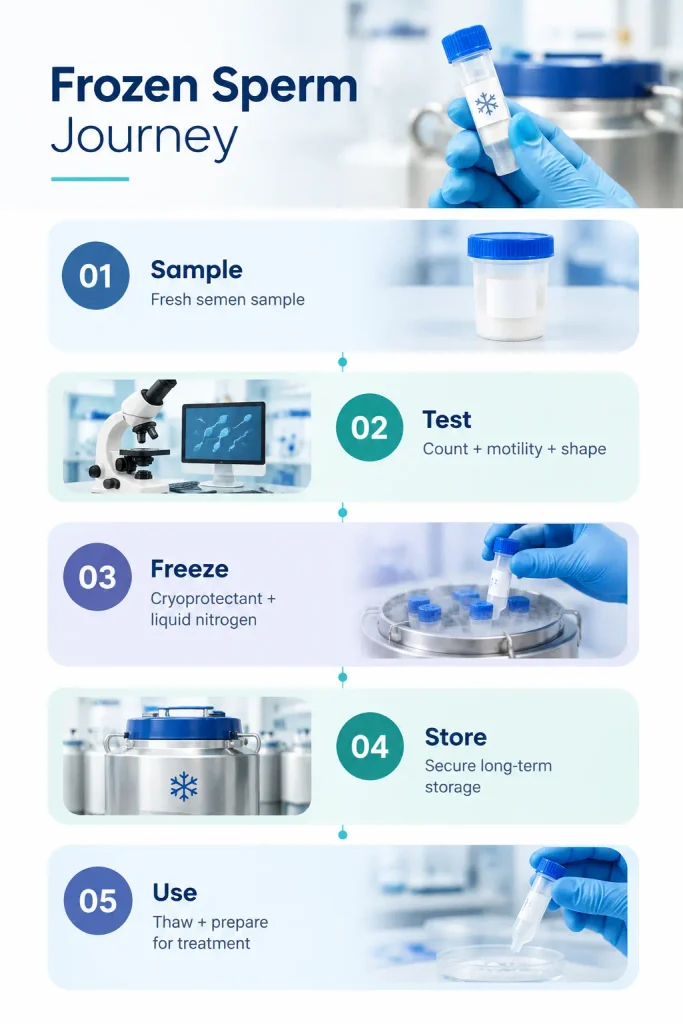
There is no single waiting period that applies to every patient. If sperm is being frozen as a backup for a planned treatment cycle, it is sensible to arrange the process early enough for the laboratory to evaluate the sample and, if necessary, collect and freeze an additional sample. Your fertility team can advise on the appropriate timing for your treatment plan.
How to Choose a Fertility Clinic for Sperm Freezing
When comparing an IVF centre or fertility clinic in Pimpri-Chinchwad, ask how sperm samples are processed, labelled, tracked, stored, and monitored. It is also reasonable to ask whether samples are processed and stored on site and what happens if a sample has poor post-thaw quality.
When choosing an IVF specialist in Pimpri-Chinchwad, you can also ask:
- How is each stored sample identified and tracked?
- How is sample quality checked before and after freezing?
- How are samples stored and monitored?
- What happens if the sample does not survive thawing as expected?
- Would the fertility team recommend storing more than one sample in my situation?
- What are the processing and annual storage charges?
A frozen sample does not necessarily mean that treatment cannot proceed. The important step is to understand the quality of the stored sample and how it fits into the planned treatment.— Dr Pavan Bendale
Does Frozen Sperm Lower IUI or IVF Success Rates?
This is an important question, but there is no single success rate that applies to every frozen sample or every fertility treatment. Outcomes depend on the original sperm quality, how the sample responds to freezing and thawing, the treatment method, and other fertility factors.
For IVF and especially ICSI, the effect of reduced sperm motility after thawing may be less limiting because fertilisation takes place in the laboratory and ICSI allows an embryologist to select an individual usable sperm. IUI can be more dependent on the number and movement of sperm available after preparation.
Cleveland Clinic’s information on sperm banking explains that sperm quality and the freezing process are important considerations when sperm is stored for future use. Information from Guy’s and St Thomas’ NHS Foundation Trust also describes sperm freezing as an established fertility-preservation option and discusses the testing and storage process.
For many couples, storing sperm in advance can reduce the practical pressure of arranging a fresh sample on the exact day of treatment. Whether it is the right choice for you depends on your fertility assessment and treatment plan.
Frequently Asked Questions
1. Can frozen sperm be used for IUI?
Yes. Frozen sperm can be thawed, prepared, and used for IUI when the fertility team considers it appropriate. The laboratory checks the sample after thawing and preparation because the number and movement of usable sperm can vary from one sample to another.
2. Is frozen sperm as effective as fresh sperm for IVF?
Frozen sperm can be used successfully in IVF. With ICSI, the embryologist selects an individual sperm for injection, so the treatment is less dependent on the overall number of progressively motile sperm than IUI. The expected outcome still depends on the couple’s overall fertility factors and the quality of the stored sample.
3. How long can sperm stay frozen?
Sperm can be stored in liquid nitrogen for long periods when appropriate storage conditions are maintained. The practical duration of storage also depends on clinic policies, consent requirements, and applicable regulations. Ask your clinic about renewal dates and the terms of long-term storage.
4. What is the difference between frozen sperm for IUI and frozen sperm for ICSI?
For IUI, the prepared sperm needs sufficient movement and quantity because it must travel through the reproductive tract and fertilise the egg naturally. With ICSI, an embryologist selects an individual sperm and injects it directly into the egg. This can make ICSI useful when sperm numbers or motility are very low.
5. Does sperm freezing affect the baby’s health?
Using frozen sperm does not automatically mean that a baby will have a higher health risk. Fertility treatment outcomes depend on many factors, including the health of the parents, the underlying fertility condition, and the treatment used. Your fertility specialist can explain any individual risks that apply to your situation.
6. How many vials of frozen sperm are needed for one IUI cycle?
There is no fixed number of vials that applies to every IUI cycle. The laboratory decides how a sample should be divided based on the original sperm count and quality, the intended treatment, and the amount of sperm needed after thawing and preparation. Your clinic can tell you whether one vial is expected to be sufficient or whether additional storage would be useful.
7. Can frozen sperm be used if the male partner has a low sperm count?
Yes. Men with a low sperm count may be able to use stored sperm, although the most appropriate treatment depends on the severity of the male-factor infertility. In some cases, IVF with ICSI is considered because only an individual usable sperm is needed for injection into each selected egg.
8. What tests are required before sperm freezing?
A semen analysis is commonly performed to assess sperm count, motility, and morphology. Fertility clinics may also require infectious-disease screening and other checks before long-term storage. The exact requirements can vary according to the clinic and applicable regulations.
9. How much does sperm storage cost in Pune?
Storage costs vary between clinics and depend on factors such as the initial processing, number of samples, duration of storage, and whether surgical sperm retrieval is required. Before starting, ask for a written breakdown covering collection, processing, freezing, storage, and any renewal charges.
10. When should a couple arrange sperm freezing before IVF?
It is usually better to discuss sperm banking well before the planned treatment cycle rather than waiting until the treatment date is close. Starting early gives the laboratory time to assess the sample and allows additional collections to be considered if the fertility team recommends them. The ideal timing depends on your treatment plan, so your fertility clinic should provide the final schedule.