
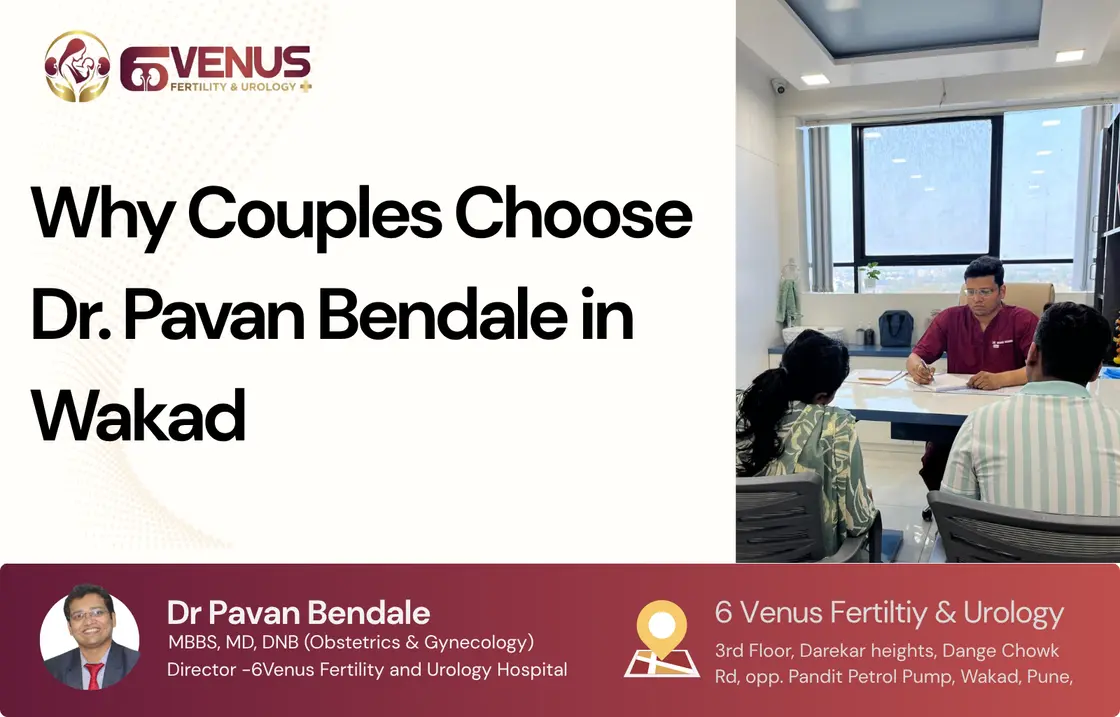
Finding the right IVF doctor in Wakad Pune is not just a medical decision – it is one of the most personal choices a couple will ever make. You are not simply selecting a clinic. You are placing your trust, your time, your money, and your hope in one person’s hands. That is a weight most fertility websites ignore completely, and it is exactly why getting this decision right matters so much.
If you are searching for the best fertility specialist in Wakad, the top most IVF specialist Pune, or a reproductive specialist in Wakad Pune who treats both partners together – then you landed up on correct page.
Dr. Pavan Bendale, MBBS, DGO, DNB OBGY, FRM, is the founder and best fertility specialist in Wakad at 6Venus Fertility and Urology Hospital. He brings over 12 years of clinical experience, has completed more than 2,500 IVF cycles, and specialises in some of the most challenging fertility cases – including recurrent implantation failure and complex male infertility. He is also among the first specialists in the region to offer Pre-implantation Genetic Testing (PGT), a technology that identifies chromosomal issues in embryos before transfer and significantly improves outcomes in high-risk cases.
What separates Dr. Bendale from a general gynaecologist in Wakad who also handles fertility? Everything. Reproductive medicine is its own field entirely, and the difference between a generalist and a dedicated fertility specialist – in terms of diagnosis accuracy, protocol selection, and success rates – is enormous. This article walks you through exactly what that difference means for your treatment, what to expect at 6Venus, and how to make the most informed decision before your first consultation.
What 1 in 6 Couples in India Need to Hear First
According to data reviewed across national registries, roughly 1 in 6 couples in India currently face some form of infertility. That number has been rising steadily, driven by delayed marriages, urban lifestyle patterns, stress, and conditions like PCOS and endometriosis that often go undiagnosed for years. In cities like Pune – particularly the IT-heavy western corridor of Wakad, Hinjewadi, and Pimple Saudagar – the pattern is even more pronounced. Long working hours, sedentary desk jobs, and lifestyle-related hormonal disruption are taking a measurable toll on fertility for both men and women.
What most couples do not know when they start this journey is that in 30% of infertility cases, the problem is with the male partner. In another 30%, it is a female factor. In 30% of cases, both partners have contributing issues. And in the remaining 10%, no clear cause is ever found – what clinicians call unexplained infertility. This is why proper bilateral evaluation – testing both partners together at the start – is not optional. It is foundational. Missing a male factor early means months of unnecessary female-only treatment, wasted cycles, and added emotional cost.
Dr. Bendale’s clinic is built around this understanding. At 6Venus, male and female infertility are evaluated in parallel from day one, not sequentially. This alone saves couples weeks and sometimes months of diagnostic delay.
Dr. Pavan Bendale: Credentials That Go Beyond the Certificate on the Wall
Dr. Bendale completed his MBBS from Government Medical College, Latur, followed by a Diploma in Obstetrics and Gynaecology (DGO) from BJ Medical College, Pune – one of Maharashtra’s most respected institutions. He then pursued his DNB in Obstetrics and Gynaecology from Jehangir Hospital, Pune, through the National Board of Examinations in 2018. His Fellowship in Reproductive Medicine (FRM) specifically prepared him for advanced IVF protocols, embryo selection, and the management of complex fertility cases that most general gynaecologists are not trained to handle.
Before founding 6Venus, he worked with leading fertility institutions including Indira IVF, Nova IVF Fertility, and other established centres in Pune and Aurangabad. This exposure across multiple high-volume fertility environments gave him a clinical foundation that is difficult to replicate in a single-institution career.
Over 12 years and more than 2,500 completed IVF cycles, Dr. Bendale has developed particular expertise in:
- Recurrent implantation failure – cases where embryos repeatedly fail to implant despite good quality
- Severe male factor infertility – including azoospermia managed with surgical sperm retrieval through TESA and Micro-TESE
- PCOS-related infertility – particularly in women with irregular ovulation patterns or hyperresponsive ovaries
- Poor ovarian reserve – low AMH, low antral follicle count, and diminished response to stimulation
- Pre-implantation Genetic Testing (PGT) – embryo genetic screening before transfer, reducing miscarriage risk and improving live birth rates
- IUI to IVF transition planning – helping couples avoid prolonged cycles of ineffective treatment and move to the right protocol at the right time
Patients who have visited him consistently describe two things: he listens without rushing, and he explains without overwhelming. That combination – clinical precision and genuine communication – defines the 6Venus experience.
Why the Location of Your IVF Clinic in Wakad Pune Actually Matters
For couples living in Wakad, Hinjewadi, Pimple Saudagar, Marunji, or the broader Pimpri-Chinchwad area, the location of your fertility clinic near Wakad is not a minor convenience – it directly affects treatment compliance. IVF monitoring requires frequent visits: blood tests and ultrasounds sometimes three or four times in a single week during stimulation. If your clinic is far, those visits become logistical stress. Stress, as any reproductive specialist will tell you, is not good for fertility treatment outcomes.
6Venus Fertility and Urology Hospital is located on the 3rd floor of Darekar Heights, Dange Chowk Road, opposite Pandit Petrol Pump, Yashoda Colony, Wakad – just minutes from Hinjewadi IT Park and accessible from both Pimpri-Chinchwad and Baner. For IT professionals and working couples in Wakad’s tech corridor, this matters. You can attend a morning monitoring scan and still make it to your office by 9:30 AM.
The hospital operates as a full fertility and urology centre under one roof. This means semen analysis, ultrasound, IVF procedures, embryo culture, hysteroscopy, and sperm retrieval are all handled internally – no outsourcing to third-party labs, no disjointed paperwork between providers.
What Makes 6Venus Different from Other IVF Clinics in Wakad Pune
Pune’s western corridor has several fertility clinics, and the competition is real. What distinguishes 6Venus is not just technology or location – it is the integration model. Most fertility clinics treat female infertility. Most urology centres treat male reproductive problems. 6Venus is one of the very few centres in Wakad that treats both under the same clinical roof, with direct coordination between the fertility specialist and a dedicated urologist.
This matters enormously for couples where the male partner has a urology-linked issue – varicocele, infection, anatomical obstruction, or hormonal imbalance – that is the root cause of infertility. In a conventional setup, the woman sees a gynaecologist in Wakad while the man is referred elsewhere. Weeks pass. Reports get lost. Nobody is looking at the full clinical picture simultaneously. At 6Venus, both partners are evaluated, discussed, and treated as a single case from the first appointment.
Dr. Bendale’s own words capture this well: “Fertility is a journey involving both partners, yet the medical infrastructure often treats them separately. By bringing advanced IVF technology and urology expertise together, we cut down the diagnosis time and offer a seamless path to parenthood.”
The IVF Process at 6Venus: What Each Stage Actually Looks Like
Many couples arrive at a fertility clinic near Wakad having read about IVF online but still unsure what it actually involves, day to day. Here is a clear breakdown of how a typical IVF cycle runs under Dr. Bendale’s protocol at 6Venus:
- Initial evaluation (Week 1-2): Both partners undergo baseline testing. The female partner gets blood tests for AMH, FSH, LH, thyroid, prolactin, and estradiol, along with a transvaginal ultrasound to assess antral follicle count and uterine structure. The male partner provides a semen sample for full analysis including morphology, motility, count, and DNA fragmentation if indicated.
- Diagnosis and protocol selection: Dr. Bendale reviews all results and selects a stimulation protocol tailored specifically to the woman’s ovarian reserve, age, and any prior treatment history. There is no one-size-fits-all protocol at 6Venus. This is where experience makes the most visible difference – a seasoned IVF expert in Pune Wakad selects differently than a general gynaecologist who performs occasional IVF cycles.
- Ovarian stimulation (Days 2-12 approximately): Daily injectable hormones stimulate the ovaries to develop multiple follicles. Monitoring scans every 2-3 days track follicle growth and estradiol levels. Dr. Bendale adjusts dosages in real time based on your response. This prevents both under-stimulation and ovarian hyperstimulation syndrome (OHSS).
- Egg retrieval: When follicles reach optimal size, a trigger injection is given. Egg retrieval happens 34-36 hours later, under light sedation, as a day procedure. The embryology team at 6Venus isolates mature eggs immediately in the on-site laboratory.
- Fertilisation and embryo culture: Eggs are fertilised using standard IVF or ICSI depending on sperm quality. Embryos are cultured for 3-5 days. Blastocyst-stage transfer on Day 5 typically shows better implantation rates than Day 3 transfers.
- Pre-implantation Genetic Testing (PGT) – if recommended: For couples with a history of miscarriage, chromosomal conditions, or repeated IVF failure, embryo biopsy is performed and samples sent for genetic analysis. Only genetically normal embryos are transferred.
- Embryo transfer: The selected embryo is placed into the uterine cavity through a thin catheter. The procedure takes minutes and requires no anaesthesia. A 10-15 day wait follows before the pregnancy blood test.
- Frozen embryo storage: Any good-quality remaining embryos are vitrified and stored for future frozen embryo transfer (FET) cycles, which carry comparable or sometimes better success rates than fresh transfers.
IVF Success Rates: What the Numbers Actually Mean for You
Every fertility clinic in India advertises success rates. Before those numbers mean anything to you personally, you need to understand what they are measuring. Some clinics report clinical pregnancy rates – a heartbeat on ultrasound. Others report live birth rates, which is the real outcome: a baby born alive. These are very different figures, and the distinction matters. Always ask your doctor which measure they use.
Across India, IVF success rates currently range from 35% to 55% per cycle for women under 35, with younger patients and better ovarian reserve achieving rates toward the higher end. Women between 35 and 40 typically see rates in the 25-40% range. After 40, success with a woman’s own eggs often falls below 20%, though donor egg IVF can restore rates to 60-70%.
As a Mayo Clinic overview confirms, age is the single most consistent predictor of IVF outcome. After 35, egg quality and quantity both decline in ways that no stimulation protocol can fully compensate for. This is why Dr. Bendale’s consistent advice to couples who are considering IVF but delaying it is blunt: the best time to do this is now, not next year.
What can genuinely improve your individual success rate includes:
- An accurate diagnosis before starting – not guessing at protocols
- PGT for couples with prior failures or chromosomal risk
- ICSI in cases with any male factor abnormality
- Blastocyst transfer over cleavage-stage transfer where possible
- Optimising uterine receptivity with hysteroscopy if there is any structural concern
- Frozen embryo transfer (FET) in cases where the uterine environment may be suboptimal after stimulation
When Should You See an IVF Doctor in Wakad – Not a General Gynaecologist
This question matters more than most couples realise. A general gynaecologist in Wakad handles obstetrics, routine reproductive health, contraception, and common hormonal conditions. They are excellent at what they do. But IVF is not routine gynaecology. It is a subspecialty that requires specific training, access to an embryology laboratory, surgical skills for egg retrieval, and the clinical judgment to manage complex stimulation cases.
You should specifically seek a reproductive specialist in Wakad Pune – not just a gynaecologist who also does IVF – in any of these situations:
- You have been trying to conceive for 12 months without success (or 6 months if you are over 35)
- You have had two or more miscarriages
- You have been told your AMH is low or your ovarian reserve is reduced
- Your partner’s semen analysis has come back abnormal – low count, poor motility, or poor morphology
- You have been diagnosed with PCOS, endometriosis, blocked fallopian tubes, or a uterine abnormality
- You have already tried IUI without success
- A previous IVF cycle has failed and nobody explained why
All of these situations require the specific skills of an infertility doctor in Wakad who is fully dedicated to reproductive medicine. Dr. Bendale evaluates each of these presentations regularly and is specifically equipped to give you answers that a general gynaecologist may not be positioned to provide.
Male Infertility: The Half of the Problem Most Clinics Still Undertreat
One of the most consequential gaps in Indian fertility care is the consistent underdiagnosis of male infertility. Many couples spend months in ovulation induction and IUI cycles before anyone properly investigates the male partner. By the time a semen analysis is done, months have been lost.
At 6Venus, male fertility evaluation happens on day one. If semen analysis reveals low sperm count (oligozoospermia), poor motility (asthenozoospermia), or abnormal morphology (teratozoospermia), Dr. Bendale’s urology co-founder Dr. Sunil Palve evaluates whether a treatable underlying cause exists. Varicocele – a venous dilation in the scrotum that raises testicular temperature and damages sperm – is one such cause. Treating it surgically sometimes improves sperm parameters enough to make IUI viable where IVF seemed inevitable.
For men with zero sperm count (azoospermia), 6Venus offers TESA (Testicular Sperm Aspiration) and Micro-TESE (Microsurgical Testicular Sperm Extraction) – surgical procedures that retrieve sperm directly from testicular tissue. This means fatherhood remains a possibility even in cases where no sperm are present in the ejaculate. As a PubMed analysis of ART data in India notes, ICSI is performed in roughly 52% of all cycles specifically because of male factor infertility, underscoring just how frequently male-side issues drive treatment decisions.
PGT: The Technology That Changes the Odds for High-Risk Cases
Pre-implantation Genetic Testing is not standard in every IVF cycle – but for specific patients, it is transformative. Dr. Bendale was among the early adopters of PGT in this region of Pune, and the technology has particular relevance for:
- Couples who have had 2 or more miscarriages – chromosomally abnormal embryos are a leading cause
- Women over 37, whose eggs carry higher chromosomal abnormality rates
- Couples with a known genetic condition in the family
- Those who have had 2 or more failed IVF cycles despite apparently good embryo quality
PGT involves a biopsy of one or a few cells from the embryo at the blastocyst stage. These cells are sent for chromosomal analysis. Only embryos with the correct chromosomal number (euploid embryos) are transferred. The result is a lower cycle-by-cycle success rate – because fewer embryos are available for transfer – but a significantly higher live birth rate per transfer, because the embryos being transferred have already been screened. For couples with recurrent failure, this is not an optional extra. It is often the difference between a successful pregnancy and another heartbreak.
IVF vs. IUI: Making the Right Call Before Starting Treatment
A common point of confusion for couples starting fertility treatment is whether to begin with IUI or go straight to IVF. The right answer depends entirely on your specific diagnosis, and it is one of the first clinical decisions Dr. Bendale makes in consultation.
IUI – Intrauterine Insemination – places prepared sperm directly into the uterus at the time of ovulation. It is less invasive, significantly less expensive, and appropriate for specific indications: mild male factor (borderline sperm count), unexplained infertility in a younger woman with open tubes, or cervical factor issues. Success per cycle is 10-20%, and it works best in women under 35 with no structural problems.
IVF becomes the appropriate choice when fallopian tubes are blocked or absent, when sperm parameters are severely abnormal, when ovarian reserve is low, when previous IUI cycles have failed, or when the woman is over 38. Proceeding with repeated IUI cycles in any of these situations delays effective treatment without improving outcomes. For more on how Dr. Bendale compares these two paths in clinical detail, read the 6Venus explainer on IVF vs IUI.
Fertility Diet, Lifestyle, and What You Can Actually Control Before IVF
One of the most common questions couples ask after deciding to pursue IVF is: “Is there anything we can do to improve our chances?” The answer is yes – with some important qualifications.
Dr. Bendale’s approach at 6Venus includes lifestyle counselling alongside medical planning. The evidence-supported lifestyle factors that genuinely influence IVF outcomes include:
- BMI normalisation: Both underweight and obese women show reduced stimulation response and lower implantation rates. A BMI between 19 and 25 is clinically linked to better outcomes.
- Quitting smoking: Smoking measurably reduces egg quality and ovarian reserve. Quitting at least 3 months before a cycle significantly improves follicular response.
- Reducing alcohol consumption: Regular alcohol intake reduces both sperm quality and embryo quality.
- Dietary support: A Mediterranean-style diet with adequate folate, antioxidants, and omega-3 fatty acids supports egg quality and uterine health. The 6Venus blog on fertility diet planning in Pune goes into specific food choices in more detail.
- Sperm-specific supplementation: For the male partner, antioxidants like CoQ10, Vitamin C, Vitamin E, and zinc support sperm quality in the 70-90 days before a cycle – the timeframe it takes for a full sperm production cycle.
- Stress management: Chronic cortisol elevation disrupts hypothalamic-pituitary-gonadal axis function and interferes with ovulation. This is not just theory – it is a documented hormonal pathway.
None of these factors replace medical treatment. But they are the part of IVF success that sits in your hands, and Dr. Bendale’s team addresses them directly as part of the pre-cycle planning process.
Embryo Quality: The Factor That Decides Everything Else
You can have the most skilled infertility surgeon in Wakad and the most advanced laboratory, but if embryo quality is poor, outcomes suffer. Embryo quality is determined by egg quality, sperm quality, and the conditions inside the embryology lab. At 6Venus, the embryology laboratory maintains tightly controlled temperature, pH, and gas levels throughout the culture period. Small deviations in these parameters can compromise embryo development, which is why in-house, dedicated lab management matters.
Dr. Bendale’s team assesses embryo quality at both Day 3 and Day 5, preferring blastocyst transfer when possible. A blastocyst has undergone more developmental selection – only the strongest embryos reach that stage. Transferring a blastocyst is therefore a more informed bet than transferring a Day 3 embryo whose developmental potential is still uncertain. For a deeper clinical breakdown of what embryo quality means for your cycle, see the 6Venus guide on embryo quality.
Recurrent Implantation Failure: When IVF Keeps Not Working
Some of the most difficult patients Dr. Bendale sees are couples who have already been through IVF elsewhere – sometimes two or three cycles – and received no clear explanation for why it did not work. Recurrent implantation failure (RIF) is defined as the failure to achieve pregnancy after transfer of 3 or more good-quality embryos. It is one of the most demoralising experiences in fertility treatment, and it requires systematic investigation rather than simply repeating the same protocol.
At 6Venus, RIF evaluation covers:
- Uterine assessment – hysteroscopy to exclude polyps, adhesions, submucosal fibroids, or uterine septum that block implantation
- Endometrial receptivity analysis – ensuring the uterine lining is genuinely ready to receive an embryo on the day of transfer
- Thrombophilia and immunological screening – some women have blood clotting or immune issues that cause the embryo to be rejected
- PGT if not already done – chromosomally abnormal embryos are the most common cause of RIF in women over 35
- Sperm DNA fragmentation testing – high DNA damage in sperm can impair early embryo development even when fertilisation appears normal
The 6Venus article on embryo implantation failure covers the investigative approach in full detail and is worth reading if you have already experienced a failed IVF cycle.
How to Book a Consultation with Dr. Pavan Bendale
If you are based in Wakad, Hinjewadi, Pimple Saudagar, Marunji, or Pimpri-Chinchwad, you can reach 6Venus Fertility and Urology Hospital at Darekar Heights, Dange Chowk Road, opposite Pandit Petrol Pump, Yashoda Colony, Wakad, Pune – 411033. Online consultations are available for couples who cannot visit in person initially.
When you book, bring whatever reports you already have: previous semen analyses, hormonal blood tests, HSG reports, previous cycle summaries. Even if a previous clinic gave you little explanation, Dr. Bendale will review those records carefully and give you a clear clinical picture of where things stand and what the realistic next steps look like. That transparency – telling you the truth about your situation rather than what you want to hear – is one of the things patients at 6Venus consistently mention in reviews.
Fertility treatment requires trust. The best IVF doctor in Wakad Pune is not the one with the best marketing. It is the one who has the experience to handle your case, the honesty to explain it clearly, and the infrastructure to execute it well. By those measures, Dr. Pavan Bendale at 6Venus stands as one of the most reliable choices available to couples in Pune’s western corridor today.
Frequently Asked Questions: IVF Doctor in Wakad Pune
1. How long should we try naturally before seeing an IVF doctor in Wakad Pune?
The standard medical guideline is 12 months of regular unprotected intercourse for women under 35. If you are 35 or older, that timeline shortens to 6 months before you should see a fertility specialist. If you have known risk factors – irregular periods, a history of PCOS, endometriosis, previous pelvic infection, or a male partner with known low sperm count – there is no reason to wait at all. Seeing an infertility doctor in Wakad early does not mean you will immediately start IVF. It means you will get an accurate picture of where you stand.
2. Is IVF the only option or will Dr. Bendale suggest simpler treatments first?
Not at all. Dr. Bendale’s clinical approach starts with diagnosis. Many couples at 6Venus go on to conceive through medication and timed intercourse, or through IUI, without ever needing IVF. IVF is recommended when the diagnosis specifically indicates it – blocked tubes, severe male factor, failed IUI, poor ovarian reserve, or when time is a factor for an older patient. The fertility specialist in Wakad will always recommend the least invasive effective treatment for your specific situation.
3. What is the cost of IVF treatment at 6Venus in Wakad Pune?
IVF costs in Pune typically range from Rs. 80,000 to Rs. 1,80,000 per cycle for a standard protocol, with additional costs for medications, PGT, sperm retrieval procedures, or frozen embryo transfers if required. 6Venus offers IVF treatment packages on EMI starting at Rs. 9,999 per month (terms apply). For an accurate cost estimate based on your specific diagnosis and protocol, a consultation with Dr. Bendale is required. Be cautious of any clinic that quotes a fixed price without reviewing your reports first.
4. What is the IVF success rate at 6Venus in Wakad?
Dr. Bendale has completed over 2,500 IVF cycles in his career. Success rates depend on your age, diagnosis, ovarian reserve, and the specific protocol used. For women under 35 with no severe pathology, rates at specialist centres in India are typically 45-55% per cycle. For accurate rates applicable to your individual case, Dr. Bendale reviews your specific reports before giving you any number – because a blanket percentage without context is not clinically meaningful.
5. Does 6Venus handle male infertility as well, or only female?
Both. 6Venus is a dual-specialty centre with an in-house urology department led by Dr. Sunil Palve, MCh Urology, alongside Dr. Bendale’s fertility wing. Male fertility evaluation, varicocele management, and advanced sperm retrieval procedures like TESA and Micro-TESE are all performed at the same centre. This makes 6Venus one of the most complete fertility clinics near Wakad for couples where both partners may have contributing issues.
6. I have had two failed IVF cycles elsewhere. Can Dr. Bendale help?
Yes, and this is actually one of Dr. Bendale’s areas of clinical focus. Recurrent implantation failure (RIF) requires a structured investigation – hysteroscopy, endometrial receptivity analysis, sperm DNA fragmentation testing, immunological screening, and PGT are all tools that can identify why previous cycles failed and how to approach the next one differently. Simply repeating the same protocol after failure is not sound medicine. A thorough review of your previous cycle records is the starting point at 6Venus.
7. How is IVF different from IUI? Which one should we start with?
IUI places washed sperm directly into the uterus at the time of ovulation. It is simpler, less invasive, and costs less – but it works only in specific clinical situations. IVF fertilises eggs in the laboratory and transfers a developed embryo. The right starting point depends entirely on your diagnosis. See the IVF vs IUI guide on 6Venus for a clear clinical breakdown, and discuss your specific reports in your first consultation with Dr. Bendale before assuming which path applies to you.
8. What tests do both partners need before starting IVF?
The female partner typically undergoes: AMH, FSH, LH, estradiol, thyroid panel, prolactin, transvaginal ultrasound (antral follicle count and uterine scan), HSG or hysteroscopy if tubal or uterine pathology is suspected, and infectious disease screening. The male partner needs a semen analysis with morphology, motility, and count – and DNA fragmentation testing if abnormal results are found. Both partners need HIV, Hepatitis B, and Hepatitis C screening before an IVF cycle can proceed.
9. Does IVF require multiple hospital stays? How disruptive is it for working couples?
IVF does not require hospitalisation. The egg retrieval is a day procedure – you arrive, undergo retrieval under light sedation, recover for 2-3 hours, and go home. Monitoring visits during stimulation are short outpatient scans. For IT professionals and working couples in Wakad and Hinjewadi, 6Venus’s location minimises commute disruption. The entire stimulation phase typically spans 10-12 days of monitoring, with most visits manageable before standard office hours.
10. What happens if the first IVF cycle does not work?
A failed cycle is not the end of the road. Dr. Bendale reviews what happened in the cycle – how many eggs were retrieved, how many fertilised, embryo quality, the transfer details, and any laboratory observations – before advising on whether and how to approach a second attempt. Cumulative IVF success rates increase significantly by the third cycle for most patient profiles. If good-quality embryos were frozen from the first cycle, a frozen embryo transfer (FET) can be attempted without repeating the full stimulation phase.