

Two dates in an IVF cycle cannot move: egg retrieval and, in a fresh cycle, embryo transfer. Everything else can be shaped around a work calendar if the plan is made before the first injection. For IVF treatment for working couples in Hinjewadi, Wakad and the wider Pimpri Chinchwad belt, the harder part is rarely the medicine. It is the 8 am commute, the client call that runs late or the shift roster that changes every fortnight.
Couples from the IT parks of Hinjewadi and the factories of MIDC Bhosari ask the same questions before they start. How many days off will this take? Which visits need both partners? What do we tell a manager?
How Many Clinic Visits Does IVF Treatment for Working Couples Really Involve?
An IVF cycle follows the same medical steps for every patient: ovarian stimulation with daily injections, scan monitoring, egg retrieval, fertilisation in the laboratory and embryo transfer. For working couples, the useful difference is planning. Most visits are short scans, and only retrieval and transfer need fixed dates.
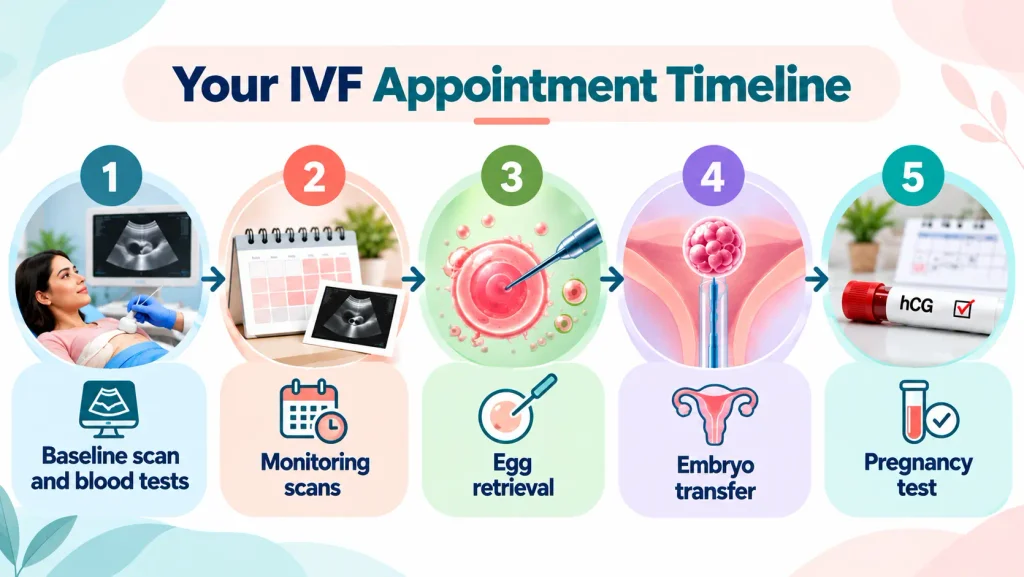
Most fresh cycles involve about 7 to 10 visits between the baseline scan and the pregnancy test. Your protocol sets the exact number, and your doctor confirms it before you start. In order, the visits look like this:
- Baseline scan and blood tests at the start of your cycle, usually a short morning visit.
- Three to five monitoring scans during stimulation, each timed by follicle growth.
- Egg retrieval, a day procedure that takes most of a working day.
- Embryo transfer, a short procedure that often fits into half a day.
- Pregnancy test, a blood test roughly two weeks after transfer.
Think of the IVF appointment schedule as five anchors rather than ten disruptions. Part days cover most of them, and a realistic answer to how many days of leave for IVF is about three to five days across the whole cycle. The NHS IVF guide describes the same sequence, and our IVF step by step page explains what happens medically at each stage.
Why the Scan Window Between Days 5 and 12 Is the Tight Part of Your Calendar
Ovarian stimulation usually runs about 8 to 14 days. Daily injections encourage several follicles to grow, and scans track their progress. For anyone attempting IVF while working full time, the difficulty is simple: scan number three cannot be booked on day one.
Scan dates are set one scan at a time. Follicle growth, not the calendar, decides when you come back.
A few habits keep that uncertainty manageable:
- Keep two or three mornings in the scan window free of fixed meetings, ideally within the same week.
- Ask for the next scan date before you leave the clinic each time.
- Share the window with your manager, not the diagnosis: “three short absences over ten days” is enough.
- Set a phone alarm for the daily injection, because a missed time is easier to prevent than to fix.
Egg Retrieval and Embryo Transfer: The Two Dates You Cannot Move
A trigger injection matures the eggs, and retrieval follows about 36 hours later. Because the trigger is timed to the hour, often late at night, you usually learn the retrieval date only a day or two ahead.
Retrieval takes roughly 20 to 30 minutes under short sedation, and most women go home the same day. Egg retrieval recovery time varies: many feel ready for desk work the next day, while others need two days for cramping to settle. Plan for the longer end.
- Arrange a companion or a cab, since sedation rules out driving that day.
- Follow the clinic’s fasting instructions exactly.
- Sort out the semen sample early. The male partner provides it on retrieval day, and a frozen sample can often be arranged in advance if work travel clashes.
- Keep the following morning light, or work from home.
Embryo transfer is simpler. Doctors usually perform it without sedation, and it takes a few minutes. In a fresh cycle it happens a few days after retrieval. In a freeze all cycle, the embryos are frozen and transferred in a later cycle, which lets you pick a date that suits your diary. Your doctor decides whether that suits your case. Both procedures happen at the clinic, so factor in the journey to our Wakad IVF centre near Dange Chowk.
Early Morning Scan Slots and the Hinjewadi Commute
A monitoring scan is brief. The journey to it is what eats the morning, especially around Dange Chowk and the Hinjewadi roads at peak hours.
Couples searching for an IVF doctor in Hinjewadi or an IVF clinic in Wakad should ask three practical questions before choosing where to be treated:
- What is the earliest scan slot, and on which days does it run?
- Can the blood test and the scan happen in a single visit?
- Will I see the same doctor on each scan day?
A first slot of the morning lets you scan and still reach your desk after a short delay. For couples based in the IT corridor, our page on the IVF centre near Hinjewadi covers the services available to them.
Night Shifts, Rotating Rosters and Fertility Treatment: What the Evidence Says
Research on night shift and fertility treatment is mixed. A recent night shift review describes the overall impact as complex and still incompletely understood, so nobody should tell you to leave a night job because of it. Practical steps matter more:
- Take stimulation injections at the same clock time every day, whatever your shift.
- Tell your doctor your roster before the protocol is chosen, so trigger and retrieval timing can be planned around it.
- Avoid stacking night shifts on retrieval day and the day before.
- Protect your sleep on both sides of retrieval.
Fertility treatment for IT professionals in Pune often collides with late evening calls with overseas clients, which is when injections are commonly due. An alarm and a private five minutes solve most of it.
Men carry part of this. Long sitting hours and disrupted sleep may affect semen quality, as covered in our guide to male infertility in Pune, so the male partner should discuss his own schedule with the doctor too.
Talking to HR: What to Share and What to Keep Private
You need to share dates, not diagnoses. Most workplaces accept a medical certificate for personal leave, and a certificate can be worded in general terms. Two sentences you can copy:
- I have a medical procedure planned over the next four weeks, and I will need a few short morning absences and two full days off.
- Could you confirm how part day leave and work from home are recorded for medical appointments?
Share only what your role requires. If a manager asks for more, “a planned medical procedure” is a complete answer.
Work From Home Weeks and the Two Week Wait
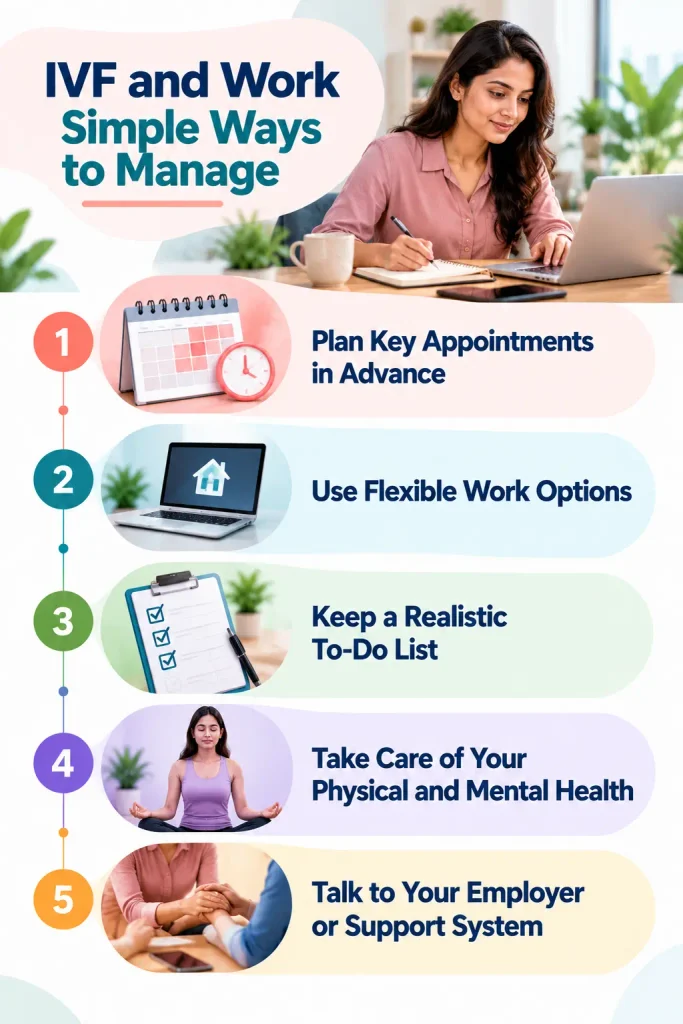
After transfer, normal desk work is usually fine. Bed rest has not been shown to improve results, and your doctor will tell you what to avoid in your case.
The two week wait is heavier emotionally than physically. Working from home helps some couples, mainly because it removes the effort of hiding a nervous mood at the office. Move big presentations if you can.
- Eat regular meals on workdays, since office lunches get skipped. A fertility diet plan built around local food gives you an easy template.
- Put the pregnancy test date in your calendar and keep that morning easy.
A Sample IVF Cycle Calendar Mapped Against a Five Day Work Week
Treat this IVF cycle calendar as an illustration, not a prescription. Your protocol and your response to the medicines set the real dates.
- Week 1: baseline scan and blood tests on cycle day 2 or 3, a part day. Injections start that evening.
- Week 2: two monitoring scans, two or three days apart, each a part day. Injections continue at the same time daily.
- Week 3: one or two final scans, then the trigger injection at the time your doctor sets. Retrieval follows about 36 hours later: one full day of leave and a light day after.
- Week 4: embryo transfer in a fresh cycle, taking half a day to a full day, or later in a frozen cycle.
- Two weeks after transfer: pregnancy blood test, a short visit.
Total leave in this sample: about three to five days, mostly part days. Mark your own fixed meetings against it and take the list of clashes to your first consultation.
Who Plans Your Cycle: Dr Pavan Bendale at 6Venus Hospital in Wakad
Your calendar comes from your protocol, and the protocol comes from your doctor. At 6Venus Fertility and Urology Hospital in Wakad, couples consult Dr Pavan Bendale (MBBS, DGO, DNB OBGY, FRM), founder and fertility specialist at the hospital. NMC or State Medical Register number: [to be added by the clinic before publishing]. Male partner assessments are supported by the hospital’s urology team.
Bring your shift pattern, your commute and your leave balance to the first visit, and ask:
- How many visits will my protocol need, and which two dates are fixed?
- What is the earliest scan slot, and how much notice will I get for retrieval?
- Could a freeze all cycle make sense in my case, and what would it change?
- How will my work travel or shift roster affect the plan?
General education only. Outcomes depend on age, diagnosis and many other factors, and no clinic can guarantee a result. Your treating doctor’s advice for your own case always comes first.
Build the Calendar Before the First Injection
IVF treatment for working couples works best when the calendar exists before the first injection: two fixed dates, a handful of flexible mornings and one honest conversation at work. Take your commute, your roster and your leave balance to a first consultation, and ask for a written visit plan. A single page turns an unpredictable month into one you can manage.
Frequently Asked Questions About IVF and Work in Pimpri Chinchwad
1. How many clinic visits does one IVF cycle need?
Most fresh cycles need about 7 to 10 visits: a baseline scan, three to five monitoring scans, egg retrieval, embryo transfer and a pregnancy test. Frozen cycles shift the pattern, because transfer happens in a later cycle. Most visits are short part day appointments. Your doctor confirms the exact number once the protocol is set, since your response to the injections can add or remove a scan. Ask for a written visit plan at the first consultation.
2. How many days of leave should I plan for IVF?
A realistic plan is about three to five days across the whole cycle, mostly as part days for scans. Retrieval needs a full day, and the next day works best as a light or work from home day. Transfer needs half a day to a full day. Your leave policy, your commute and your response to the medicines all move the number, so treat it as a planning figure and adjust it with your doctor.
3. Can I work during IVF stimulation?
Most women keep working through stimulation. Injections take a few minutes, and scans are brief. Bloating and tiredness tend to build toward the end, so a lighter workload in the last two or three days helps. Keep a few mornings free for scans, since dates are set scan by scan. If your job involves heavy lifting, long hours on your feet or chemical exposure, tell your doctor so the advice fits your role.
4. Do night shifts affect IVF outcomes?
The evidence is mixed. A recent review in PubMed Central describes the effect of night shift work on fertility as complex and not fully understood, and studies define night work differently, which makes comparison hard. No research tells women to leave a night job before IVF. Take injections at the same clock time daily, protect your sleep, and share your roster with your doctor before the protocol is set.
5. How long is recovery after egg retrieval?
Most women go home the same day and feel ready for light desk work within one to two days. Cramping, bloating and mild spotting are common and usually settle within a few days. Sedation rules out driving on the day itself. Severe pain, heavy bleeding, fever, vomiting or a swollen abdomen need a same day call to your clinic, because they can signal a complication such as ovarian hyperstimulation.
6. Can I travel for work during the two week wait?
Short, routine travel is manageable for many women, since ordinary activity is not known to harm an embryo after transfer. Long flights, heavy luggage, missed medicines and disrupted sleep are the real concerns. Carry your medicines in hand luggage, keep timings in a phone reminder and share the travel dates with your doctor before transfer. Your doctor may suggest moving a long trip until after the pregnancy test.
7. Do both partners need to attend every visit?
No. Most scans involve only the woman. The male partner is needed for the first consultation, where both partners are assessed, and for the semen sample on retrieval day. If he travels or works shifts, tell the clinic early, because a frozen sample can often be arranged beforehand. Many couples attend retrieval and transfer together for support, which is a personal choice and not a requirement.
8. Can I take my injections at the office?
Stimulation injections are small and usually given at home, often in the evening. If a dose falls during work hours, you can take it in a private room, but check each medicine’s storage instructions first, since some need cool storage. Carry the prescription and keep medicines in their original packaging. A consistent daily time matters more than the location, so set an alarm. Ask a clinic nurse to demonstrate the technique first.
9. Will my employer need to know that I am having IVF?
You decide what to share. Most workplaces accept a medical certificate or a note about a planned medical procedure without naming the diagnosis. Read your leave policy to see how part day leave and work from home are recorded. If more detail is requested, ask your doctor to word the certificate in general terms. Share dates, not details, and approach the HR contact for medical leave.
10. Can scans be done early in the morning before work?
Many clinics offer early morning monitoring slots, but availability differs, so ask directly. Check the earliest slot, the days it runs, whether blood tests and the scan happen in one visit, and how results reach you. A first slot lets you reach the office after a short delay. Allow extra time for the morning peak on the Hinjewadi and Wakad roads, because the scan is brief but the journey is not.