

About one in six people worldwide experiences infertility at some point in life, according to a WHO report on infertility published in 2023. For a couple living near Chinchwad Station, Akurdi or Nigdi, that number becomes a practical question: where can we get a proper assessment without losing half a day on the road? Couples searching for an IVF centre in Chinchwad are usually asking exactly that, and a useful answer starts with what lab based treatment needs and which parts of care can stay close to home.
An IVF centre is a fertility clinic with its own embryology laboratory. Doctors collect eggs from the ovaries, the laboratory fertilises them with sperm outside the body, and embryologists grow the embryos for a few days before one is placed in the uterus. Scans, blood tests and counselling surround each of those steps.
Fertility Care Near Home: What an IVF Centre in Chinchwad Needs to Offer
Chinchwad, Nigdi, Akurdi, Bhosari, Chikhali and Moshi make up one of the most densely settled parts of PCMC. Many gynaecologists and family doctors across this belt manage early fertility concerns well, from ovulation tracking to basic hormone tests. Lab based treatment is a different matter. An embryology laboratory needs controlled air quality, stable incubators and trained embryologists, so this care sits in a limited number of places. That reflects infrastructure, not the skill of local doctors.
Whichever clinic you consider, check four things before you commit.
- An in house embryology laboratory, with an embryologist who can answer your questions.
- Ultrasound and blood test monitoring that fits your commute.
- A full range of options, including IUI, IVF, ICSI and freezing, so the plan follows your diagnosis.
- A written plan and cost range after the first visit.
A search for fertility clinic in Chinchwad returns many names. The Pimpri Chinchwad IVF centre page shows what 6Venus provides for couples across the city, and the checklist above works for any clinic you compare it with.
Travelling from Chinchwad, Nigdi, Akurdi and Bhosari to the Wakad Centre
Distance matters in IVF for one reason: monitoring. During ovarian stimulation, most couples attend several scans over about ten to twelve days. Scan dates depend on how your follicles grow, so they cannot be fixed far in advance. A route you can manage on a tight morning counts for more than a short distance on a map.
Couples who search for IVF treatment in Akurdi, an IVF centre in Nigdi or infertility treatment in Bhosari tend to ask the same thing: how bad is the drive at scan hour? Traffic on the Chinchwad to Wakad stretch, including the Thergaon and Dange Chowk side, changes sharply between early morning and the school run. Ask the front desk for current clinic timings and the quieter scan slots for your route when you book your visit to the Wakad IVF centre.
Choose the scan routine you can keep up for two weeks, not the clinic that looks closest on the map.
Which Visits Stay Short and Which Ones Need the Lab
Not every appointment in a cycle depends on the laboratory. Splitting the cycle into two kinds of visit makes the schedule easier to plan around work and family.
Visits that stay short
- First consultation and history taking.
- Ultrasound scans that track follicle growth during stimulation.
- Blood tests that check hormone levels.
- Follow up consultations to adjust medicine doses.
Visits that involve the laboratory
- Egg retrieval, a day procedure usually done under sedation.
- The semen sample, usually given on the day of retrieval.
- Embryo transfer, whether fresh or frozen.
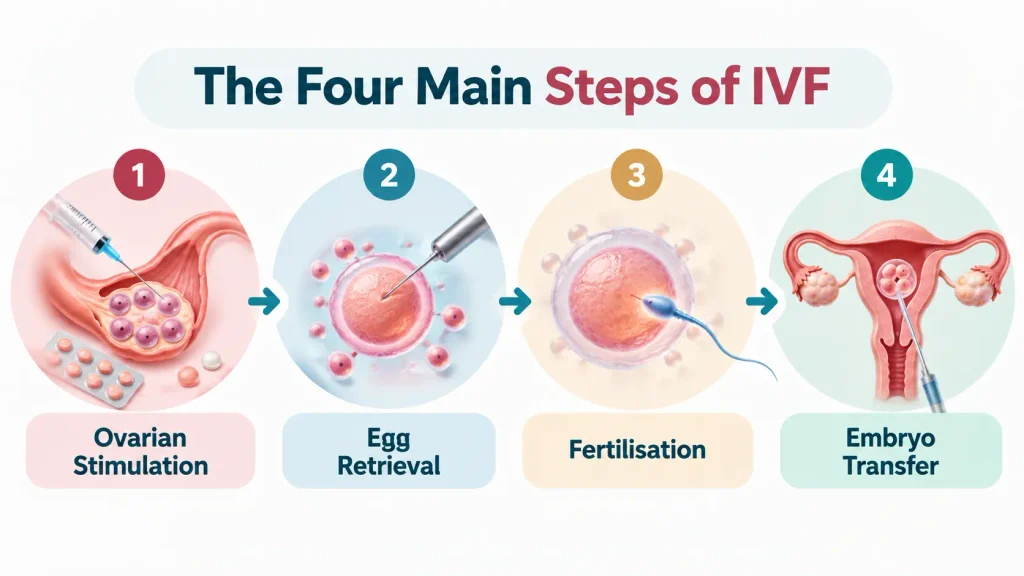
The standard stages of a cycle are described in the NHS IVF treatment steps from Guy’s and St Thomas’ hospital: medicines to produce eggs, egg collection, sperm collection, fertilisation and embryo transfer. Your own plan may differ, and your fertility specialist will explain which version applies to you.
Four Situations That Bring Couples from This Belt to Wakad
Couples rarely arrive with a diagnosis. They arrive with a situation, and these four come up often.
- A year of trying without an answer. Many specialists advise an assessment after twelve months of regular attempts, or after six months when the woman is 35 or older.
- An earlier IUI or medicine cycle that did not work. You want to know what the next step looks like.
- An abnormal semen report. A low count or poor motility can point toward ICSI rather than standard IVF.
- A wish to plan ahead. Some people choose egg and sperm freezing because of medical treatment, career timing or personal circumstances.
None of these situations means IVF is the only route. A first assessment often shows that a simpler treatment is reasonable, and the doctor will say so.
What Happens at Your First Visit
- History. The doctor asks about cycle length, how long you have been trying, earlier treatment, and any surgery or medical conditions in either partner.
- Examination and ultrasound. A pelvic scan checks the uterus and ovaries and counts the small antral follicles that indicate ovarian reserve.
- Baseline tests. An AMH blood test estimates egg reserve, which reflects egg quantity rather than egg quality. The male partner gives a semen sample for semen analysis, and the laboratory tells you how many days to abstain beforehand. Exact tests vary from couple to couple.
- Review and plan. The doctor explains what the results suggest and outlines the options.
Nobody expects a decision that day. Most couples leave with a written plan, a timeline and a cost range to discuss at home. Consultations are with the clinic’s fertility specialists, including Dr Pavan Bendale, and bringing earlier reports helps the doctor avoid repeating tests.
The first fertility consultation guide covers reports to bring and day one tests in full.
Treatments Offered: IUI, IVF, ICSI and Freezing
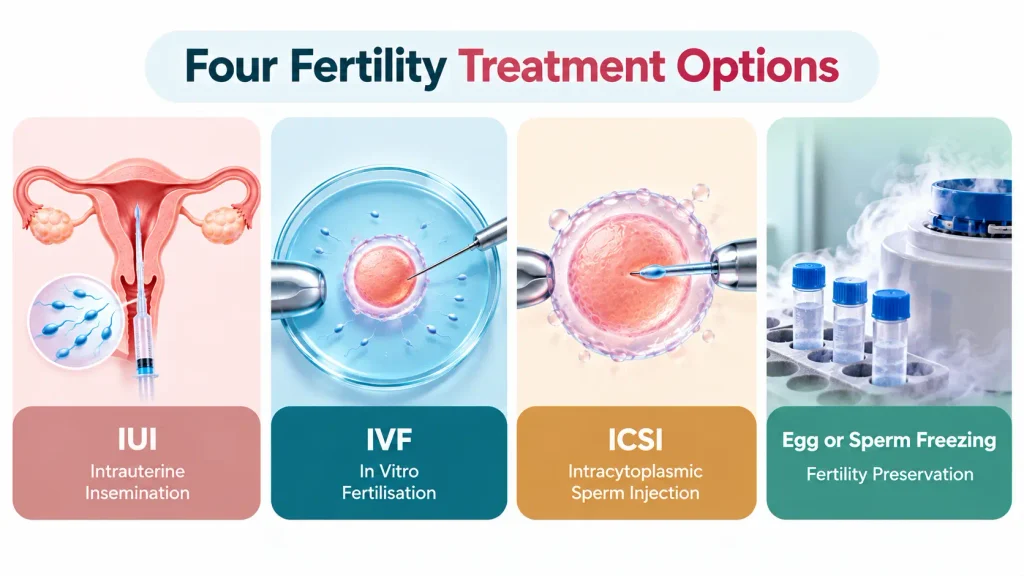
A fertility specialist matches treatment to diagnosis, not the other way round. The common options:
- IUI. Prepared sperm is placed in the uterus around ovulation. Doctors often consider it for mild male factor infertility or unexplained infertility, and the IUI treatment page explains who it suits.
- IVF. Eggs are collected after ovarian stimulation, fertilised in the laboratory, and one or more embryos are transferred later. Doctors often consider it for blocked fallopian tubes, endometriosis, or after other treatments have not worked.
- ICSI. A single sperm is injected into each mature egg. Doctors use it for low sperm counts or earlier fertilisation problems.
- Freezing. Eggs, sperm or embryos are stored for later use. A frozen embryo transfer takes place in a later cycle.
Which option fits depends on age, ovarian reserve, tube health and semen quality. Your doctor will explain the reasoning, and you can ask for a second opinion at any point.
Cost and Payment Planning for Families in This Belt
IVF costs differ between couples because the medicine dose is the biggest swing factor, and it depends on age, AMH and how the ovaries respond. Add ons such as ICSI, embryo freezing or genetic testing change the total further. A figure quoted before any assessment is a guess.
Ask every clinic the same question: what sits outside the quoted package?
Anaesthesia, storage after the first year, repeat scans and medicines after transfer are the items most often left out of a headline figure. Ask for a written estimate after your first consultation, and read the IVF cost in Pimpri Chinchwad guide for a stage by stage view.
Getting There: Timings, Parking and What to Carry
Choose a first appointment slot that avoids the heaviest traffic, and tell the front desk which area you are travelling from. Staff can suggest scan times that suit your route. Confirm these points when you book:
- Current clinic timings and the earliest scan slot.
- Parking arrangements near the centre.
- The nearest landmark for the final turn.
- Previous reports, prescriptions and any semen analysis results.
Choosing an IVF centre in Chinchwad, or travelling a short distance beyond it, comes down to three things: a laboratory you can ask questions about, a scan routine you can sustain, and a doctor who explains the plan in plain language. Every couple’s situation differs, and treatment choices follow your doctor’s assessment. Book a first consultation, bring the reports you have, and decide with a written plan in hand.
Questions Couples in Chinchwad, Nigdi and Akurdi Ask Before Booking
1. Where can couples from Chinchwad get lab based IVF treatment?
Several fertility clinics practise across Pimpri Chinchwad and Pune, and lab based treatment is concentrated in a limited number of locations. 6Venus treats couples from Chinchwad, Nigdi and Akurdi at its Wakad centre, where the embryology laboratory is. When you compare options, look past distance on a map. Ask about the laboratory, the monitoring routine and who manages your cycle, then judge how realistic the scan schedule is for your own commute.
2. How far is Wakad from Nigdi and Akurdi?
The answer depends on the hour more than the kilometres. A drive that takes a short while at seven in the morning can take much longer during the school run or evening rush. Test the route at the time you would actually travel for scans, on a working day. Ask the front desk for current clinic timings and available scan slots, and consider a trial drive before stimulation begins. Monitoring visits are brief once you arrive, so the journey is the part worth planning.
3. Can I do scans near home and only travel for retrieval?
In some cases the treating doctor accepts scan reports from a trusted local centre. Many prefer to monitor the whole cycle in house, because the same team and the same ultrasound machine make follicle measurements comparable, and medicine doses can change the same day. Speak to your doctor before arranging scans elsewhere. The decision depends on your protocol and on how closely your ovaries need to be watched.
4. What does IVF cost for families in the Chinchwad belt?
Cost does not change with your address inside PCMC, because treatment happens in one laboratory. It changes with your age, AMH level, medicine doses and any add ons such as ICSI or embryo freezing. Quoted packages often leave out anaesthesia, storage and repeat scans. Ask for a written estimate after your first consultation, and ask what the estimate excludes before you pay anything.
5. Is there parking at the clinic?
Parking arrangements can change, so confirm them with the front desk when you book instead of relying on a general answer. Ask where to park, how far it is from the entrance, and whether an easier drop off point exists for retrieval day. You will be sedated that day and should not drive home, so plan for your partner or a family member to accompany you.
6. When should a couple see a fertility specialist?
Many specialists advise an assessment after twelve months of regular unprotected intercourse without a pregnancy, or after six months if the woman is 35 or older. Do not wait if cycles are very irregular, if you have known endometriosis or tubal problems, if either partner has had pelvic surgery or cancer treatment, or if a semen report was abnormal. An early assessment does not commit you to treatment. It shows you where you stand.
7. Do both partners need to attend the first visit?
Fertility is a shared question, and history from each partner shapes the plan. A semen analysis is often one of the first tests, so the male partner will need to give a sample at some point. If one of you cannot attend the first appointment, the other can still come and bring all available reports. The doctor can then outline next steps and tell you what the absent partner should arrange.
8. How many scans does one IVF cycle need?
Most cycles involve several scans over roughly ten to twelve days of stimulation. They usually begin around the fifth or sixth day of medicines and become more frequent as follicles mature. The number varies with how your ovaries respond, so the doctor cannot fix it in advance. Ask for a rough calendar at the start, and plan leave around the retrieval and transfer days.
9. Can I keep working during IVF?
Many women continue working through stimulation, with short breaks for scans and blood tests. Retrieval day needs leave because of sedation, and many doctors advise taking the rest of that day easy. Embryo transfer is quicker, and plans for returning to work vary. You only need to share with your employer what your leave policy requires. Talk to your doctor about timing, especially if you work night shifts.
10. Does IVF guarantee a pregnancy?
No. No doctor or clinic can guarantee a pregnancy. Outcomes depend on age, ovarian reserve, egg and sperm quality, embryo development, uterine health and some element of chance. Many couples need more than one cycle. Ask any clinic how it reports results, and whether a figure refers to pregnancy or live birth per started cycle. A clear, honest answer to that question tells you a lot about the clinic.