
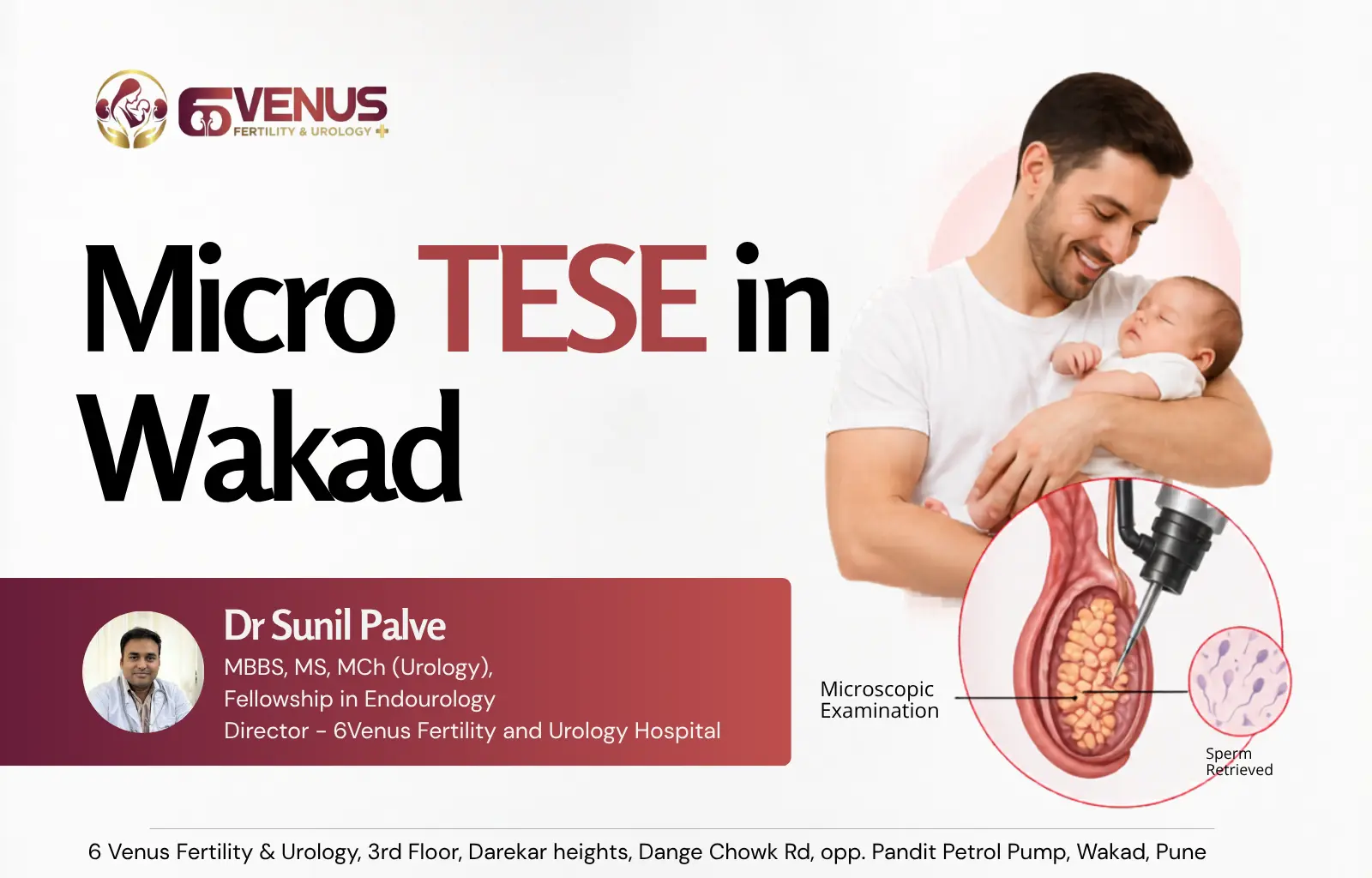
A semen analysis that comes back with zero sperm is one of the hardest things a couple can hear during a fertility workup. For many men in Wakad and across Pune, that result feels like a door slamming shut. It is not. Microdissection testicular sperm extraction, known as Micro TESE, is a surgical procedure that goes directly into the testes to find and retrieve sperm when none appear in the ejaculate. For men with certain types of azoospermia, this procedure is the difference between biological fatherhood remaining impossible and becoming genuinely achievable. At 6Venus Fertility and Urology Hospital in Wakad, both the fertility and the surgical expertise required to offer Micro TESE are available under one roof.
What Zero Sperm Count Actually Means and Why the Type Matters
Azoospermia is the medical term for the complete absence of sperm in a man’s semen. It affects roughly 1 to 2 percent of all men and accounts for approximately 10 to 15 percent of all male infertility cases. However, azoospermia is not a single condition. It has two fundamentally different causes, and understanding which type a man has determines everything about how he should be treated. Globally, centres offering Vancouver Micro TESE have helped define how both types are approached, and the protocols developed there now inform how specialists in Wakad and across India plan sperm retrieval for azoospermic men.
Two types of azoospermia exist. Getting the diagnosis right determines everything that follows.
Obstructive Azoospermia (OA): Sperm Present, Path Blocked
- Testes produce sperm normally
- A blockage stops sperm from reaching the semen epididymal scarring, prior surgery
- Treatment: TESA, a simple needle aspiration, is usually sufficient
- Vancouver Micro TESE protocols specifically reserve microsurgical retrieval for cases where TESA fails or is insufficient in OA
Non-Obstructive Azoospermia (NOA): Where Vancouver Micro TESE Changes Everything
- The testes produce little or no sperm at all
- No blockage involved, the production itself has failed
- Causes: Klinefelter syndrome, Y chromosome microdeletions, orchitis, undescended testes, chemotherapy, or no identifiable cause
- This is the most severe form of male infertility
- Vancouver Micro TESE, developed at leading Canadian reproductive centres, is the gold standard intervention here, now followed by fertility specialists in Wakad, Pune, and across India
Why a Needle Cannot Do What Vancouver Micro TESE Does
In NOA, sperm production is not uniform across the testis. Tiny isolated tubules may still produce small amounts of sperm, surrounded by completely inactive tissue. A blind needle has almost no chance of finding them.
Vancouver Micro TESE solves this by:
- Handing it directly to an embryologist for immediate sperm search
- Opening the testicle under an operating microscope at high magnification
- Visually identifying enlarged, sperm-bearing tubules from inactive ones
- Extracting only the targeted tissue, nothing blind, nothing random
How Micro TESE in Wakad Is Performed
The procedure is done in an operating theatre under general anaesthesia, so the patient is fully asleep and comfortable throughout. Once anaesthesia is established, the surgeon makes a single small incision along the midline of the scrotum. The testicle is gently delivered through this incision and opened under an operating microscope that magnifies the tissue up to 25 times its actual size.
At this level of magnification, the seminiferous tubules inside the testis, which are the tiny coiled tubes responsible for sperm production, become clearly visible. Tubules that are producing sperm appear larger and more opaque under the microscope than tubules that are not. The surgeon methodically examines the entire cross-section of the testis, systematically searching for these whitish, dilated tubules and extracting small samples of the most promising ones. The extracted tissue is immediately passed to an embryologist in the adjacent lab, who examines it under a separate microscope to search for viable sperm cells.
When sperm are found, they are either used fresh in an ICSI cycle that has been coordinated to take place on the same day, or they are cryopreserved for use in a future ICSI cycle. The procedure typically takes 2 to 3 hours. The scrotal incision is closed with absorbable sutures, and most patients are discharged on the same day or after one night of observation. Recovery involves scrotal support, avoiding strenuous activity for approximately two to three weeks, and a short course of pain relief and antibiotics.
Who Qualifies for Micro TESE at 6Venus Fertility Hospital, Wakad
Not every man with azoospermia is a candidate for Micro TESE. A thorough evaluation is always done first to determine whether the procedure is likely to be successful and appropriate.
The pre-procedure workup at 6Venus includes a detailed semen analysis confirming azoospermia, hormonal blood tests covering FSH, LH, testosterone, and prolactin levels, a scrotal ultrasound to assess testicular volume and structure, and genetic testing including karyotype analysis and Y chromosome microdeletion screening. This last point is critical. Men with complete deletions of the AZFa or AZFb regions of the Y chromosome have essentially no chance of finding sperm even with Micro TESE, and the procedure is not recommended for them. Men with AZFc deletions, Klinefelter syndrome, or idiopathic NOA do have sperm retrieval rates that justify attempting the procedure. You can learn more about the role of genetic testing and semen analysis in male fertility evaluation through the semen analysis service at 6Venus.
Micro TESE in Wakad is most commonly recommended for men who have confirmed non-obstructive azoospermia after complete evaluation, men who have had a failed TESA or conventional TESE procedure elsewhere, men with Klinefelter syndrome seeking biological fatherhood, men with a history of chemotherapy or radiation where sperm production was affected, and men with idiopathic NOA where no specific cause has been identified.
For men with obstructive azoospermia, the simpler TESA procedure available at 6Venus is typically sufficient and avoids the need for the more involved microsurgical approach. Understanding which procedure applies to your specific situation is part of the initial consultation.
Micro TESE vs TESA: Understanding the Difference
The two procedures are not interchangeable, and the distinction matters considerably for outcomes.
TESA, or testicular sperm aspiration, uses a fine needle inserted into the testis to aspirate tissue and fluid. It is minimally invasive, does not require an operating microscope, and is typically done under local anaesthesia. It works well for obstructive azoospermia because in those cases sperm are plentiful throughout the testicular tissue and a needle will reliably capture them. The recovery is faster and the procedure is simpler. However, in non-obstructive azoospermia, TESA’s blind approach means it often misses the rare productive pockets of tissue that Micro TESE can visually identify and target.
Micro TESE requires general anaesthesia, an operating theatre, a high-powered operating microscope, and a surgeon trained in microsurgical techniques working alongside an experienced embryologist in the adjacent laboratory. The procedure is longer, more technically demanding, and takes more recovery time. But for men with non-obstructive azoospermia, it offers a meaningfully higher chance of finding viable sperm than any other available method. The 6Venus TESA and Micro TESE sperm retrieval service page explains both procedures and the clinical criteria used to determine which is appropriate for each patient.
What Are the Real Success Rates for Micro TESE?
Sperm retrieval rates for Micro TESE in non-obstructive azoospermia vary by the underlying cause of the condition. This is one of the most important things to understand before the procedure, because realistic expectations matter enormously for couples planning their fertility journey.
Across large published studies, the overall sperm retrieval rate for Micro TESE in NOA ranges from 40 to 60 percent. Research published on PubMed involving 968 NOA patients found an overall sperm retrieval rate of 44.6 percent, with rates varying significantly by cause: orchitis cases showed retrieval rates as high as 81 percent, cryptorchidism cases achieved 62 percent, while idiopathic NOA was lower at around 31 percent. Men with Klinefelter syndrome showed retrieval rates of approximately 44 percent. These figures are substantially higher than the 25 to 30 percent sperm retrieval rates seen with conventional random biopsy TESE in NOA cases, which reflects the advantage of the microscope-guided approach.
When sperm are successfully retrieved and used for ICSI, fertilisation rates are comparable to ICSI with ejaculated sperm. The overall chance of a live birth delivery when Micro TESE succeeds in retrieving sperm and ICSI cycles are completed runs at approximately 25 to 37 percent per transfer cycle, varying by the female partner’s age and embryo quality. For couples who have been told donor sperm is their only option, these figures represent a genuine alternative path to biological parenthood.
It is equally important to be honest about the cases where Micro TESE does not find sperm. This happens in a significant proportion of men with NOA, particularly those with idiopathic causes or Sertoli cell-only syndrome across the entire testis. When no sperm are found, the procedure is complete and recovery proceeds normally. No permanent damage to testosterone production or testicular function occurs when the procedure is performed by an experienced microsurgeon, which is one of its important advantages over earlier, more aggressive biopsy methods.
Combining Micro TESE With IVF and ICSI at 6Venus, Wakad
Micro TESE cannot be used with conventional IVF or IUI, because those methods require a sufficient quantity of sperm to fertilise eggs through standard pathways. The sperm retrieved through Micro TESE are testicular sperm, present in very small numbers, and they must be injected directly into individual eggs through a technique called ICSI, intracytoplasmic sperm injection. In ICSI, a single selected sperm is injected into a single mature egg under microscopic control in the embryology laboratory.
This means that a Micro TESE cycle at 6Venus is always coordinated with the female partner’s IVF stimulation cycle. While the male partner undergoes Micro TESE, the female partner has completed ovarian stimulation and egg retrieval. Retrieved sperm are handed to the embryologist immediately after extraction, and fertilisation is attempted on the same day using ICSI. Alternatively, if the couple prefers or if the timing does not align, retrieved sperm can be cryopreserved for use in a future cycle, which avoids the need to synchronise both procedures. The IVF centre at 6Venus Wakad has the IVF laboratory infrastructure and embryology team required to support this coordinated approach.
For couples in Wakad, Hinjewadi, Pimpri-Chinchwad, Baner, and surrounding areas of Pune, having the urology and fertility teams under the same roof at 6Venus removes one of the biggest logistical challenges of this treatment. In most cities, male infertility surgery and IVF happen at separate facilities, requiring couples to coordinate between a urologist and a fertility clinic independently. At 6Venus, the combined model means both procedures can be planned together and the embryology team is already in position when the Micro TESE begins.
What to Expect From Your First Consultation for Micro TESE at 6Venus
The first consultation for a man with azoospermia at 6Venus Fertility Hospital in Wakad begins with a full review of existing reports if available, including prior semen analyses, hormonal panels, and any previous sperm retrieval attempts done elsewhere. If these have not been done, the workup begins at the clinic.
Dr. Pavan Bendale reviews both the male and female partner’s reports together, because the couple’s overall fertility picture, including the female partner’s age, ovarian reserve, and uterine health, influences the timing and approach to treatment. A man who is 28 and has a female partner with excellent ovarian reserve has a different treatment calculus than a man who is 42 with a partner who is 38 and has declining reserves. These realities are discussed directly and honestly during the consultation.
If Micro TESE is indicated, the surgical approach, expected sperm retrieval rates based on the specific diagnosis, recovery timeline, and coordination with the IVF cycle are all explained in detail before anything is scheduled. Couples leave the consultation with a clear plan, not a vague suggestion to think about it. Male infertility that has already caused years of waiting deserves a direct clinical response, and that is what the team at 6Venus aims to provide.
If you or your partner have received a diagnosis of azoospermia and are exploring Micro TESE in Wakad as a treatment option, a consultation at 6Venus Fertility and Urology Hospital is the most efficient next step. Zero sperm in the ejaculate is not the same as zero sperm in the body, and for many men, Micro TESE is how that difference is turned into a family.
Frequently Asked Questions About Micro TESE in Wakad
1. Is Micro TESE painful? What does recovery feel like?
The procedure is performed under general anaesthesia, so there is no discomfort during surgery. After the procedure, men typically experience mild scrotal soreness and swelling for a few days, managed with prescribed pain relief. A scrotal support is worn for 1 to 2 weeks. Most men are able to return to desk work within 5 to 7 days and resume normal physical activity within 2 to 3 weeks. The discomfort is comparable to a minor surgical procedure and resolves fully with recovery.
2. Can Micro TESE damage the testes or reduce testosterone levels permanently?
When performed by an experienced microsurgeon, Micro TESE causes significantly less testicular damage than conventional random biopsy TESE because the targeted approach removes far less tissue overall. Studies consistently show that testosterone levels return to their pre-procedure baseline within weeks to months. The risk of permanent hypogonadism from Micro TESE performed by a skilled surgeon is very low. This is one of the key advantages of the microsurgical approach over older, less targeted sperm retrieval methods.
3. What happens if no sperm are found during Micro TESE?
If the procedure does not find sperm, the surgery concludes and recovery proceeds normally. There is no additional procedure performed. The couple then discusses next steps with the fertility team, which may include a second Micro TESE attempt at a later date, genetic counselling, or exploring donor sperm options. A failed retrieval is disappointing but does not close all doors, and the clinical team will walk through the remaining options clearly.
4. How is Micro TESE different from a regular testicular biopsy?
A standard testicular biopsy removes one or a few random tissue samples from the testes without visual guidance. It works reasonably well in obstructive azoospermia where sperm are distributed throughout the tissue. In non-obstructive azoospermia, it misses the isolated productive pockets that Micro TESE identifies using an operating microscope that magnifies tissue up to 25 times. This visual discrimination is what gives Micro TESE its significantly higher sperm retrieval rate in NOA cases.
5. How far in advance should the Micro TESE be scheduled relative to the IVF cycle?
If the sperm are being used fresh, the Micro TESE is coordinated to coincide with the female partner’s egg retrieval day, requiring detailed cycle planning between both procedures in advance. If sperm are being frozen for future use, the Micro TESE can be done independently at a convenient time, and the ICSI cycle is planned separately once cryopreserved sperm are confirmed. Your fertility team will advise which approach suits your specific situation.
6. Can Micro TESE work if I have Klinefelter syndrome?
Yes. Men with Klinefelter syndrome (47,XXY karyotype) are among the best-studied groups for Micro TESE outcomes. Sperm retrieval rates in Klinefelter syndrome are reported at 40 to 50 percent across major studies, and when sperm are retrieved, live birth rates through ICSI are comparable to other NOA causes. Klinefelter syndrome is one of the strongest indications for attempting Micro TESE rather than defaulting to donor sperm without trying.
7. What genetic tests are needed before Micro TESE?
Standard pre-procedure genetic testing includes a blood karyotype to identify chromosomal abnormalities and Y chromosome microdeletion analysis to check for AZFa, AZFb, and AZFc deletions. Men with complete AZFa or AZFb deletions have essentially zero chance of sperm retrieval even with Micro TESE and are counselled accordingly before any procedure is scheduled. Men with AZFc deletions can still achieve successful retrieval and are candidates for the procedure.
8. Is it possible to attempt Micro TESE more than once if the first attempt fails?
Yes. Repeat Micro TESE is performed at many centres for men who did not achieve successful retrieval on the first attempt, particularly when the first procedure was done without an operating microscope or under suboptimal conditions. There is a waiting period of 3 to 6 months between procedures to allow testicular tissue to recover. Success rates on a second attempt are lower than the first but not zero, especially if the first procedure was a conventional rather than microsurgical technique.
9. Does the female partner need treatment as well before a Micro TESE cycle?
Yes. Micro TESE sperm must be used with ICSI, which requires eggs retrieved through an IVF ovarian stimulation cycle. The female partner undergoes fertility evaluation including AMH levels, antral follicle count, and uterine assessment to confirm she can respond to stimulation and support embryo implantation. A comprehensive fertility evaluation for both partners before starting any treatment cycle is standard practice at 6Venus.
10. How much does Micro TESE cost in Wakad and is EMI available?
The cost of Micro TESE at 6Venus Fertility Hospital in Wakad covers the surgical procedure, anaesthesia, operating theatre charges, embryologist fees for sperm identification and processing, and cryopreservation if required. When combined with an ICSI cycle for the female partner, the total investment includes the IVF stimulation and egg retrieval as well. 6Venus offers IVF treatment packages with EMI options starting at Rs 9,999 per month, making the combined treatment more accessible for couples in Wakad, Hinjewadi, and across Pune. Contact the clinic directly for a detailed cost breakdown based on your specific diagnostic reports and treatment plan.