
A single frozen egg has roughly the same odds of becoming a baby as a coin landing on its edge, somewhere between 2 and 12 percent per egg, depending on age and lab quality. That number surprises most patients who walk into a fertility consultation expecting a guarantee. If you are trying to work out the chances of pregnancy with frozen eggs in Pimpri-Chinchwad, the honest answer sits between hope and arithmetic, and both parts matter.
Frozen egg IVF is not one procedure. It is three hurdles stacked on top of each other: thaw survival, fertilization, and embryo development. Each hurdle carries its own success rate, and the final pregnancy chance depends on clearing all three in sequence. Knowing where the drop-offs usually happen changes how you plan the entire journey, from how many eggs you freeze to which clinic you trust with the thaw.
Egg thaw survival, using modern vitrification, typically runs between 85 and 95 percent. Fertilization after thaw succeeds in about 65 to 80 percent of surviving eggs. From there, only a portion develop into embryos strong enough to transfer. A woman with 10 frozen eggs and a woman with 20 frozen eggs are not simply twice as different in probability. They often sit in entirely different outcome brackets.
What Happens Inside the Lab Before Your Frozen Eggs Become an Embryo
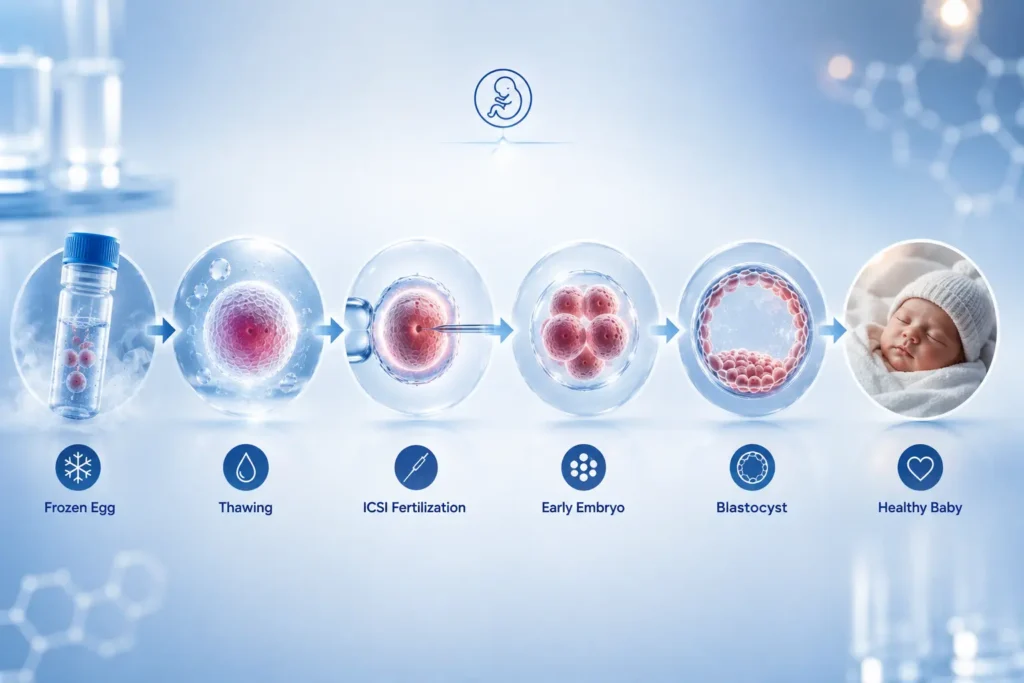
Every frozen egg cycle starts the same way at the storage tank. The eggs are warmed slowly under controlled conditions, checked under a microscope for structural integrity, then fertilized directly using a single sperm injected into each egg, a method called ICSI. This step is used almost universally with frozen eggs because the outer shell hardens slightly during vitrification, and natural fertilization struggles to get through it.
- The embryologist warms the eggs and lets them stabilize for one to two hours.
- Each surviving egg is checked for maturity and physical damage.
- Sperm is injected directly into mature eggs using ICSI.
- Fertilized eggs are cultured for five to six days to reach the blastocyst stage.
- Genetically normal embryos are selected for transfer, and the rest are frozen again for future attempts.
According to Cleveland Clinic’s fertility lab, embryos that have already reached the blastocyst stage before freezing survive their own thaw at rates of 95 to 98 percent, which is why many specialists prefer to freeze embryos rather than eggs whenever a partner or donor sperm is already available. Frozen eggs, by contrast, still have to clear fertilization after the thaw, which is where most of the loss occurs.
The Real Chances of Pregnancy With Frozen Eggs in Pimpri-Chinchwad by Age
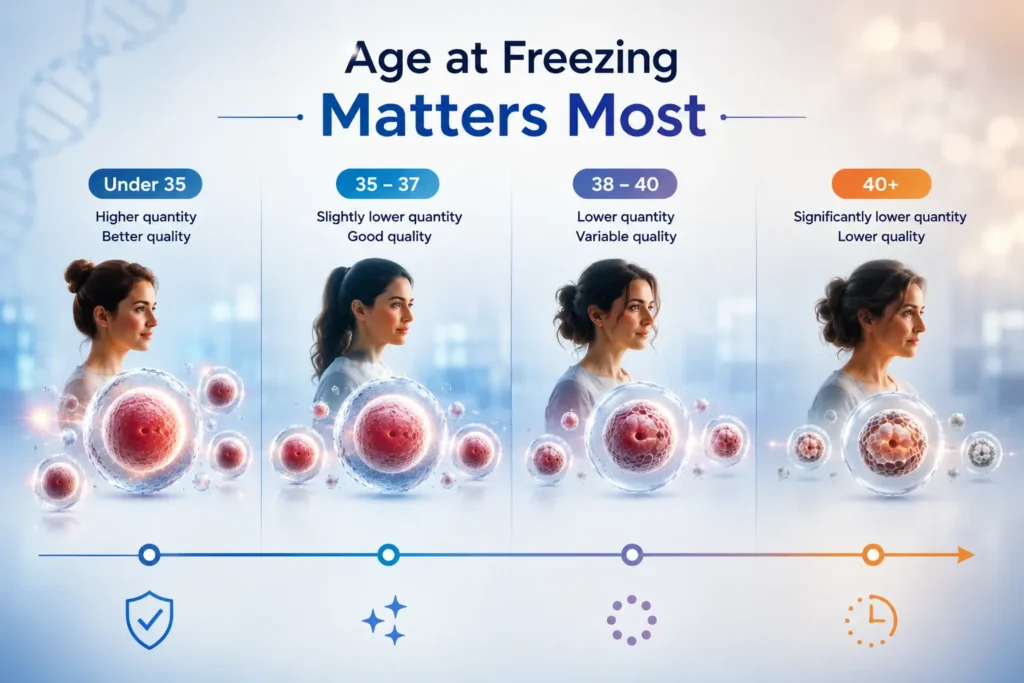
Age at the time of freezing, not age at the time of transfer, drives most of the outcome. A 32 year old who froze her eggs and uses them at 40 carries roughly the same odds as any other 32 year old undergoing IVF, because the egg quality was locked in on the day it was frozen.
| Age at Egg Freezing | Typical Live Birth Rate With 15 to 20 Eggs Frozen |
|---|---|
| Under 35 | 70 to 88 percent |
| 35 to 37 | 60 to 80 percent |
| 38 to 40 | 50 to 73 percent |
| Above 40 | Below 55 percent, fewer eggs typically retrieved |
These ranges come from pooled clinic data and should be read as a planning guide, not a personal prediction. The frozen egg success rate quoted by any single clinic in Pune can differ from national averages based on their embryologist team and thaw protocol, so treat the table above as a starting point rather than a final answer. Your own fertility specialist in Pimpri-Chinchwad will calculate a more specific estimate once your egg count, hormone levels, and partner’s semen analysis are on the table.
Egg quality is set the day the egg is frozen. Nothing about the storage time changes it, whether the eggs sit for one year or ten.
How Many Frozen Eggs You Actually Need for One Pregnancy
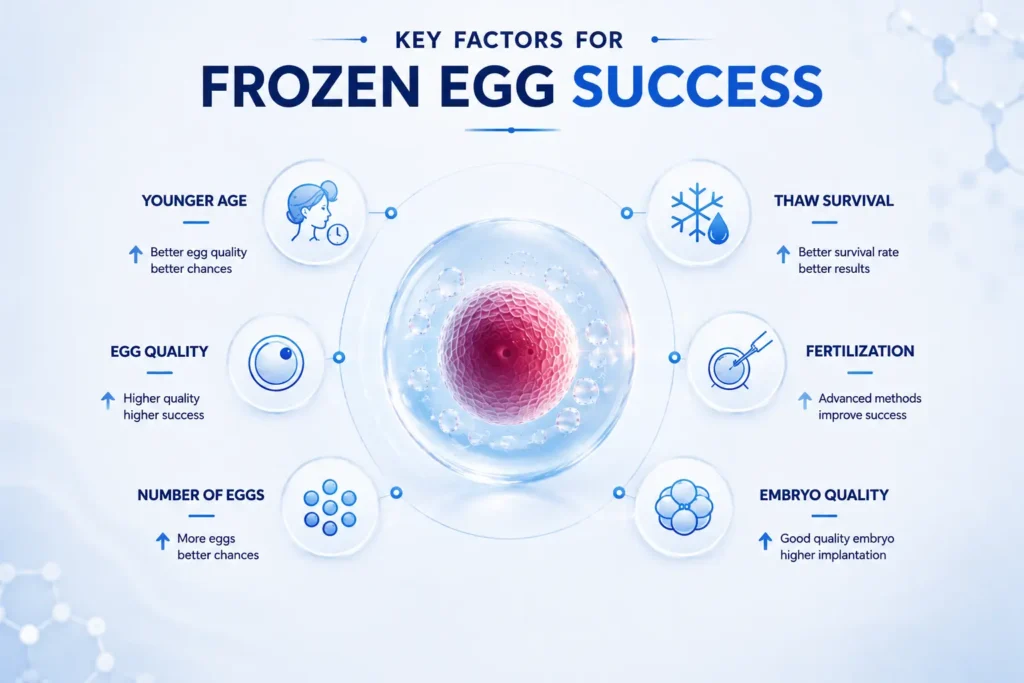
Patients often ask for a single number, and specialists usually resist giving one, because the honest answer depends on age, egg quality, and how many rounds of retrieval a patient is willing to do. As a working guide:
- Under 35, freezing 15 to 20 mature eggs generally supports a strong chance of one live birth.
- Between 35 and 38, most specialists recommend closer to 20 to 25 eggs.
- After 38, 25 to 30 eggs is a more realistic target, often across two retrieval cycles.
- Fewer than 10 frozen eggs still offer a real chance, just a considerably lower one.
This is also where a frank conversation with your doctor matters more than any online calculator. Two patients with identical egg counts can have very different outcomes based on ovarian response, sperm quality, and how the lab handles the thaw, which is exactly why the chances of pregnancy with frozen eggs in Pimpri-Chinchwad should always be discussed as a personal number, not a general statistic.
IVF Using Frozen Eggs Versus a Fresh IVF Cycle
Patients frequently assume frozen egg IVF is a lesser version of a fresh cycle. It is not. Once an egg survives the thaw and fertilizes, its embryo behaves identically to one created from a fresh egg. The gap in success rates comes almost entirely from the thaw and fertilization steps, not from anything that happens after.
This distinction matters for expectations. A fresh IVF cycle skips the thaw hurdle entirely, which is why per egg success can look slightly higher on paper. But for someone who froze eggs years earlier for medical or personal reasons, frozen egg IVF is often the only path back to using eggs from a younger, healthier version of their own body. The comparison is not fresh versus frozen quality. It is thaw survival versus a hurdle that never existed in the first place.
Why Fertility Preservation Success Depends on More Than the Freezer
Understanding what actually moves the chances of pregnancy with frozen eggs in Pimpri-Chinchwad often comes down to lab quality rather than technology alone. Vitrification gets most of the credit for improving frozen egg outcomes over the last decade, and it deserves it. But fertility preservation success in practice depends just as heavily on three things patients rarely think to ask about: the embryologist’s experience with thaw protocols, how the eggs were graded for maturity before freezing, and whether the lab tracks its own thaw survival data honestly.
The Mayo Clinic notes that eggs generally survive freezing and thawing at rates up to around 85 percent, a figure that varies meaningfully between labs. Ask any clinic directly for their own thaw survival numbers rather than a generic industry average. A clinic that cannot answer that question clearly is not one to trust with a cycle that cannot be repeated.
Choosing an IVF Specialist in Pimpri-Chinchwad for Your Frozen Egg Cycle
Pimpri-Chinchwad has grown into one of Pune’s busiest healthcare corridors, and patients here increasingly have a genuine choice of fertility centers rather than a single option. That choice should be used carefully. Ask about the clinic’s ICSI fertilization rate specifically for previously frozen eggs, not their overall IVF success rate, since the two numbers can differ considerably.
A good starting point is reviewing how your own eggs or embryos were frozen in the first place. Patients who went through the egg and sperm freezing process at the IVF center Pimpri-Chinchwad patients already trust tend to walk into the transfer stage with fewer surprises, since their lab already holds the full freezing record. If your original freezing was done elsewhere, bring your retrieval report and freezing protocol details to your first consultation so your new specialist can assess quality rather than guess at it.
Patients weighing pregnancy with frozen eggs in Pune sometimes also look at published outcomes from nearby hubs such as the reported IVF success rates in Wakad, since lab protocols and embryologist teams often overlap across a single hospital network operating in both areas.
What to Expect at Your First Frozen Egg Consultation
Assessing the chances of pregnancy with frozen eggs in Pimpri-Chinchwad properly starts here, not at the transfer stage. Your first visit should feel less like a sales pitch and more like a stock check. A thorough specialist will review how many eggs are in storage, at what age they were frozen, and what freezing method was used. They will also want a current semen analysis if a male partner is involved, since sperm quality affects fertilization rates just as much as egg quality does.
From there, expect a realistic, individualized percentage rather than a marketing number. If a clinic quotes the same success rate to every patient regardless of age or egg count, that is worth questioning rather than accepting at face value. Getting a clear, honest number at this stage is the single biggest factor in understanding your true chances of pregnancy with frozen eggs in Pimpri-Chinchwad.
Frequently Asked Questions
1. How many frozen eggs do I need for one baby?
Most specialists suggest 15 to 20 mature eggs for a woman under 35 to have a strong chance of one live birth, rising to 25 or more eggs for women closer to 40. The number depends heavily on egg quality at the time of freezing, not just the raw count, so two patients with the same number of eggs can end up with very different odds.
2. Does egg freezing guarantee a pregnancy later?
No fertility procedure can promise a guaranteed outcome, and frozen egg IVF is no exception. Each stage, from thaw survival to fertilization to embryo development, carries its own drop off. Egg freezing improves your odds compared to waiting and using eggs at an older age, but the chances of pregnancy with frozen eggs remain a probability, not a certainty, and your specialist should walk you through that probability honestly before you begin.
3. What percentage of frozen eggs survive the thaw?
With modern vitrification, most reputable labs report thaw survival rates between 85 and 95 percent. Slow freezing, an older technique rarely used now, produced survival rates closer to 60 to 75 percent. Always ask your clinic for their specific thaw survival data rather than relying on general figures.
4. Is IVF with frozen eggs different from a normal IVF cycle?
The main difference happens before fertilization. Frozen eggs must first be warmed and checked for survival, then fertilized almost always through ICSI rather than conventional insemination. Once an embryo forms successfully, the remaining steps, culture, grading, and transfer, are identical to a fresh IVF cycle.
5. Does my age when I froze the eggs matter more than my age now?
Yes. Egg quality is essentially fixed at the moment of freezing. A woman who froze eggs at 32 and uses them at 41 has odds much closer to a 32 year old undergoing IVF than a 41 year old, because the eggs themselves have not aged in storage.
6. What happens if my frozen eggs do not survive the thaw?
Occasionally, one or more eggs do not survive the warming process, which is why specialists usually thaw more than the minimum needed whenever the stored quantity allows it. If very few eggs survive, your doctor will discuss whether to proceed with fertilization immediately or consider an additional retrieval cycle for more eggs before continuing.
7. How long can frozen eggs stay stored before pregnancy chances drop?
Storage duration itself does not appear to reduce egg quality, based on current data from clinics using vitrification. Eggs stored for one year and eggs stored for a decade have shown comparable thaw and pregnancy outcomes when frozen using the same method and at the same age.
8. Is frozen egg IVF more painful or different from fresh IVF for the embryo transfer?
The embryo transfer itself is identical whether the original eggs were fresh or frozen. It is a short, generally painless procedure done without anesthesia. Any additional discomfort in a frozen egg cycle typically relates to hormone preparation of the uterine lining before transfer, not the transfer procedure itself.
9. Can genetic testing improve my chances of pregnancy with frozen eggs?
Preimplantation genetic testing, done after the embryo forms, helps identify which embryos are chromosomally normal before transfer. This does not increase the number of usable embryos, but it can improve the pregnancy rate per transfer by avoiding embryos unlikely to implant or that could end in early miscarriage.
10. Should I freeze eggs or embryos if I already have a partner?
When a partner or chosen sperm donor is already part of the plan, many specialists recommend freezing embryos rather than eggs, since embryo thaw survival rates tend to run slightly higher. The right choice still depends on personal circumstances, so this is worth discussing directly with your fertility specialist rather than deciding based on statistics alone.