

A single vial of sperm frozen this year in a Wakad lab can sit in liquid nitrogen for two decades and still go on to help create a healthy baby. That single fact surprises most men who walk into a fertility clinic for the first time. They expect an expiry date, the way milk has one. Sperm does not work that way once it is properly frozen.
Patients across Wakad, Hinjewadi, and the wider Pimpri Chinchwad belt ask the same question in different words. Some are IT professionals delaying fatherhood because of long work hours. Some are about to start chemotherapy. Some simply want a backup sample before an IVF cycle. The honest answer to how long sperm can be frozen in Wakad depends less on biology and more on paperwork, consent, and how often you renew your storage plan.
How Long Sperm Can Be Frozen in Wakad
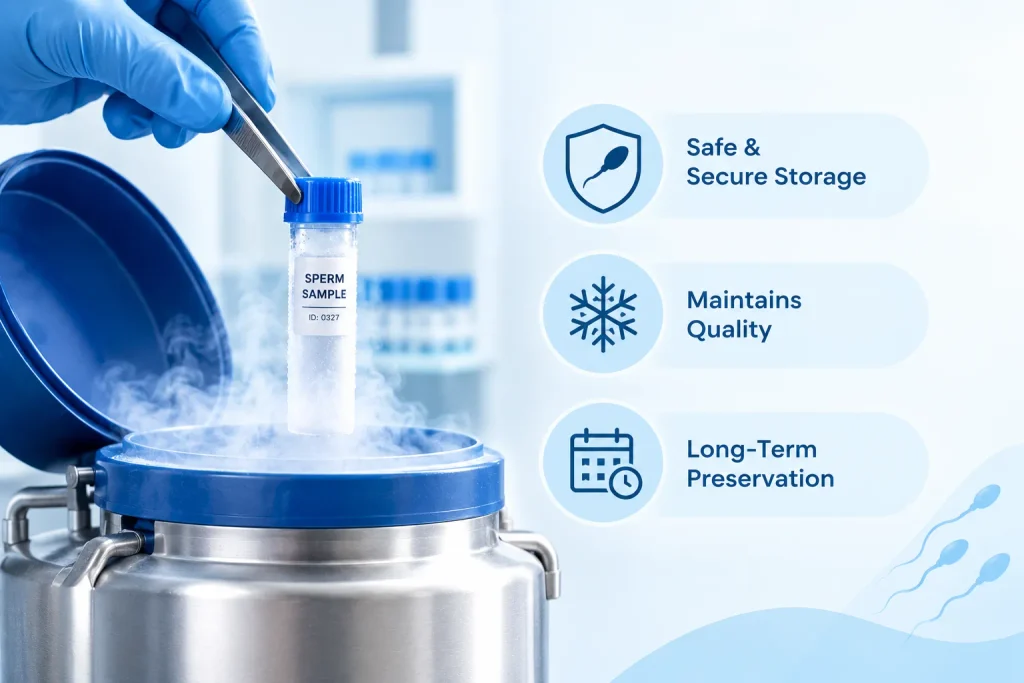
Sperm frozen at minus 196 degrees Celsius does not age. Cell activity effectively stops at that temperature, so the sample stays biologically the same after one year or twenty. In practice, how long sperm can be frozen in Wakad is set by your storage consent with the clinic, not by any biological deadline.
India’s Assisted Reproductive Technology Rules set a standard storage period, with clinics maintaining detailed records for around ten years before older files move to the national registry. Clinics can extend storage well beyond that for men freezing sperm ahead of cancer treatment or other medical circumstances, once the required permission is in place. Your fertility specialist in Wakad will walk you through exactly what applies to your case, including how it fits with our broader egg and sperm freezing programme.
What Happens Inside a Sperm Bank in Wakad

The freezing process itself is quick, but every step matters for how well the sample survives storage.
- You provide a semen sample at the clinic, usually after two to five days of abstinence.
- The lab checks sperm count, movement, and shape under a microscope.
- A cryoprotectant fluid is mixed with the sample to protect the sperm from ice damage.
- The sample is loaded into small labelled straws or vials.
- Straws are cooled gradually before being lowered into liquid nitrogen tanks.
- The sample is stored at minus 196 degrees Celsius until you need it.
Around a quarter to half of the sperm in any sample does not survive the freeze and thaw process. This is normal and expected. A good lab accounts for this by freezing enough vials to leave you with a usable sample when you need it.
Does Long Term Sperm Storage Change Sample Quality
This is the question that worries most patients considering long term sperm storage, and it has a reassuring answer.
A long term cryostorage study tracking frozen human sperm samples over fifteen years found the freeze and thaw survival rate eased from about 85.7 percent to 73.9 percent, with no meaningful drop in the ten years before that point.
That gentle decline over well over a decade is not the same as the sample becoming unusable. Clinics routinely use sperm frozen for ten, fifteen, even twenty years in IUI and IVF cycles with results comparable to fresher samples. What matters more than the calendar is how well the sample was frozen in the first place, and that comes down to lab quality, not luck.
Sperm Storage Plans Available in Wakad and Pune
Fertility centres serving Wakad, Pimpri Chinchwad, and the greater Pune region typically offer a few standard plans for frozen sperm storage rather than one fixed rule for everyone.
- Short backup storage for men undergoing an IVF or IUI cycle who may struggle to produce a fresh sample on the collection day.
- Annual renewable storage for men who want ongoing fertility preservation in Pune without committing to a long contract upfront.
- Extended multi year storage for men before chemotherapy, radiation, or surgery that could affect future fertility.
- Long term storage after surgical sperm retrieval, for men who need a procedure to collect sperm in the first place.
Sperm storage duration in Pune clinics is almost always tied to a renewal reminder. You will typically be contacted before your plan expires so you can decide whether to continue, extend, or release the sample, a practice similar to the structured renewal reviews described in NHS fertility preservation guidance. Keeping your contact details updated with the clinic matters more than most patients realise, since a missed renewal notice can mean losing a sample you paid to protect.
Who in Wakad Should Consider Freezing Sperm Now
Sperm cryopreservation is not only for men facing a medical crisis, though that remains one of the strongest reasons to freeze early.
- Men about to start chemotherapy, radiation, or pelvic surgery that could reduce fertility.
- Men planning a vasectomy who want the option of biological children later.
- Men working demanding IT or shift based jobs in the Hinjewadi corridor who are delaying fatherhood for a few years.
- Couples going through IVF or ICSI who want a backup sample stored before the collection day.
- Men undergoing TESA or a similar surgical sperm retrieval procedure, since freezing avoids repeating the surgery later.
If any of these describe your situation, freezing sooner rather than later usually gives you more sperm to work with, since sample quality tends to be better before age, illness, or treatment start affecting it. If age is part of what is on your mind, our related read on freezing sperm before 40 goes deeper into that specific question.
One Thing Every Patient Should Hear Before Freezing
Patients often ask how long sperm can be frozen in Wakad during the very first consultation, before any test is even booked. Most are not really worried about the freezer or the tank. They are worried about waiting too long and losing the choice altogether.
My advice to patients is simple: get a sperm test early, freeze before treatment or age makes the choice harder, and mark your renewal date so this stays a decision you control, not one that quietly expires on you. Dr. Pavan Bendale
That is the kind of conversation worth having before you freeze, not after you already have doubts. A short test today can save months of regret later, and it costs far less than waiting and finding out too late that the option is gone.
Getting Ready to Freeze Sperm in Wakad
A few simple steps make the process smoother and improve the odds of a strong sample.
- Book a semen analysis first so the lab knows your baseline count and motility.
- Avoid ejaculation for two to five days before your collection appointment.
- Discuss your medical history openly, especially any planned surgery or cancer treatment.
- Ask about the clinic’s renewal process and what happens if a payment is missed.
- Complete the consent form carefully, including instructions for what happens to the sample if you cannot be reached.
Sperm freezing cost in Wakad usually covers the initial freeze, the first storage period, and lab testing, with renewal charged separately after that. Ask for this broken down clearly before you commit, so there are no surprises at renewal time.
The biology is on your side here. Once a sample survives the freeze, time in the tank is rarely the limiting factor. So when patients ask how long sperm can be frozen in Wakad, the honest answer is that the sample can outlast almost any timeline you plan for. What actually decides whether it works for you later is largely settled in that first appointment: how the sample was collected, how it was frozen, and how carefully you keep track of the storage plan afterward.
1. How long can sperm be frozen in Wakad?
Once properly frozen at minus 196 degrees Celsius, sperm does not degrade in the way fresh samples do over time. What actually limits storage is your consent and renewal agreement with the clinic, not the biology of the sample. Most clinics in and around Wakad offer annual renewable plans, with longer term options available for men freezing sperm ahead of cancer treatment or other medical procedures. Your fertility specialist can confirm the exact plan that applies to your situation and what happens if you need to extend it later.
2. Does frozen sperm work as well as fresh sperm in IVF or IUI?
In most cases, yes. Once a sample survives the freeze and thaw process, its ability to fertilise an egg is broadly comparable to a fresh sample of similar quality. Studies following patients for over a decade have found pregnancy and birth outcomes using frozen sperm to be similar to those using fresh sperm. Your doctor will still assess your specific sample and treatment plan, since individual sperm quality varies more than the freezing method itself.
3. What is the minimum sperm count needed to freeze a sample?
There is no strict cutoff that rules a man out. Labs can freeze samples with low sperm counts, and even very low count samples are sometimes frozen for use with ICSI, where a single healthy sperm is injected directly into an egg. That said, a semen analysis before freezing helps your doctor decide how many samples you may need to store to have a workable option later.
4. Is sperm freezing painful or does it require surgery?
For most men, no surgery is involved. A semen sample is collected through masturbation at the clinic in a private, comfortable room. For men who cannot produce sperm this way, due to a blockage or a prior vasectomy, a minor surgical retrieval procedure such as TESA may be needed. Your doctor will explain which path applies before any procedure is scheduled.
5. How much does sperm freezing cost in Wakad?
Costs generally cover three parts: the initial semen analysis, the freezing process itself, and an ongoing storage fee that renews annually or at agreed intervals. Exact pricing varies between clinics and depends on how many samples you choose to store and how long you plan to keep them frozen. Ask your clinic for a written breakdown before starting, including what renewal will cost in future years, so budgeting for storage feels predictable rather than a surprise each time a renewal notice arrives.
6. Can unmarried men freeze their sperm in India?
Yes. Freezing your own sperm for your own future use is a personal medical decision and does not require marriage. The rules around donor sperm, where one man’s sample is used to help another person or couple conceive, are separate and more restrictive under Indian regulation. Freezing sperm for yourself works differently from sperm donation, so it helps to clarify which one you are asking about when you speak with the clinic.
7. What happens to frozen sperm if I do not renew storage?
Clinics generally contact you before your storage period ends to confirm whether you want to renew, extend, or release the sample. If you cannot be reached and the agreed period lapses, the clinic may be required to discard the sample as per your original consent form. This is exactly why keeping your contact details updated with the clinic matters, and why reading the consent form carefully at the start is worth the extra time.
8. How soon after freezing can sperm be used for treatment?
There is no mandatory waiting period once a sample is frozen and confirmed viable in the lab. Some men use their stored sample within months, for a scheduled IVF or IUI cycle. Others store it for years before they are ready to start a family. The sample remains available for use as soon as you and your doctor decide the time is right.
9. Does long term storage affect the health of a future baby?
Current evidence does not show a link between how long sperm was stored and the health of children conceived using it. Pregnancies and births have resulted from sperm stored for well over a decade with no notable difference in outcomes compared to shorter storage periods. As with any fertility treatment, your doctor will still review your specific medical history and sample quality as part of routine care.
10. Can I freeze sperm before a vasectomy or cancer treatment?
Yes, and doing so ahead of either procedure is one of the most common reasons men choose to freeze sperm. Before a vasectomy, freezing preserves the option of biological children without reversing the procedure later. Before chemotherapy or radiation, freezing protects fertility that treatment could otherwise reduce or remove. Speak with your fertility specialist as early as possible, ideally before treatment dates are finalised, since sperm quality is generally best before treatment begins.