

In a 2026 PLOS ONE study of Indian public and private tertiary hospitals, medicines made up 55% of what couples spent out of pocket on an IVF cycle. The procedure itself was the smaller part of the bill. That is why a single headline figure for IVF cost in Pimpri Chinchwad tells you very little until you know what sits inside it, what sits outside it, and which line items your own medical history will push up.
Couples comparing IVF treatment cost in PCMC usually have a diagnosis or a doctor’s advice already. You are not asking whether to treat. You are asking what the bill will really be, and whether a quote that looks affordable will stay that way. The sections below work through it line by line, so you can read any clinic’s estimate with confidence.
What One IVF Cycle Actually Costs in Pimpri Chinchwad in 2026
One IVF cycle covers consultation and tests, ovarian stimulation medicines, egg retrieval, embryology lab work and embryo transfer. Most Indian clinics quote between ₹1,20,000 and ₹3,00,000 for one fresh cycle, but medicines, add ons and storage are often billed separately, so two quotes rarely compare like for like. Couples who search for test tube baby cost usually mean this same fresh cycle.
The 2026 PLOS ONE study found a mean out of pocket spend of ₹1,10,104 per IVF cycle in public hospitals and ₹2,30,668 in private hospitals.
Those figures come from tertiary hospitals across the country, so they set the national backdrop rather than a local price. Private clinics in Wakad, Chinchwad and Hinjewadi also quote across a wide band, and the cost of IVF in India is shaped far more by medicines and add ons than by the procedure alone.
Three things decide where your own figure lands:
- Age and ovarian reserve: AMH and antral follicle count guide the medicine doses your doctor chooses.
- Fertilisation method: standard IVF or ICSI, which changes the lab work involved.
- Add ons: embryo freezing, genetic testing or a donor programme.
Some couples do not need IVF yet. If your doctor advises IUI treatment as a first step for unexplained infertility or mild male factor problems, the budget looks very different, because an IUI cycle costs far less than an IVF cycle.
The Stage by Stage Breakdown: Consultation, Stimulation, Retrieval, Lab and Transfer
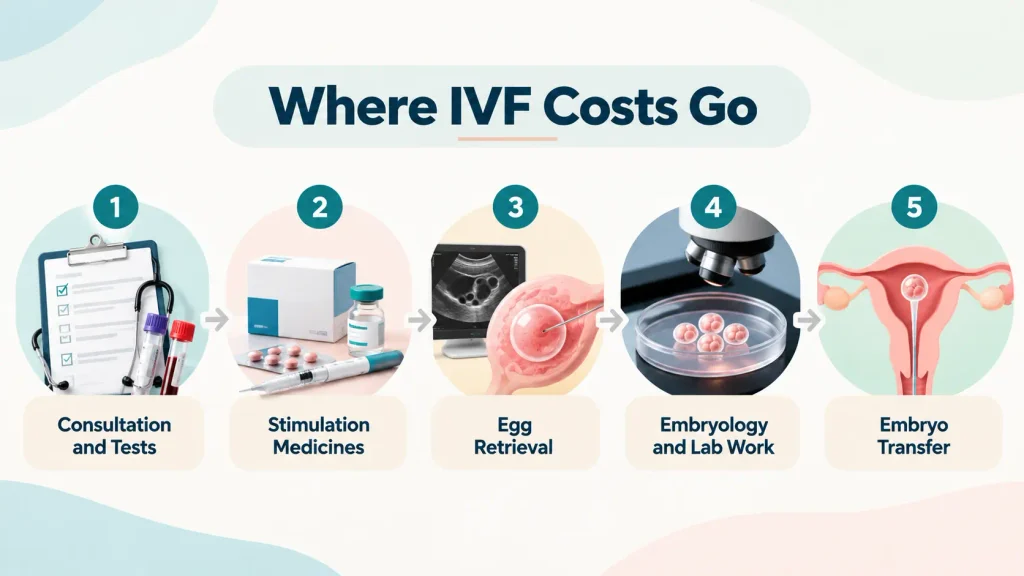
Think of one fresh cycle as five stages. Cleveland Clinic’s IVF overview describes the same sequence: ovarian stimulation, egg retrieval, fertilisation and embryo culture, then embryo transfer, with tests before it all begins.
| Stage | Indicative range | What it usually covers |
|---|---|---|
| Consultation and tests | ₹5,000 to ₹25,000 | Doctor review, scans, AMH and hormone tests, semen analysis, infection screening |
| Stimulation medicines | ₹50,000 to ₹1,00,000 | Daily injections, trigger injection, monitoring based dose changes |
| Egg retrieval | ₹20,000 to ₹40,000 | Procedure, sedation or anaesthesia, daycare bed |
| Embryology and lab | ₹40,000 to ₹80,000 | Fertilisation, embryo culture, grading, lab consumables |
| Embryo transfer | ₹10,000 to ₹30,000 | Transfer procedure, catheter, ultrasound guidance |
These are indicative market ranges across Indian clinics, not the 6Venus price list. Egg retrieval cost and embryo transfer cost look small next to stimulation medicines and lab work, which is why the headline figure moves so much from one couple to the next.
Ask every clinic for the same five rows. If you would like an estimate in that format, request it from our Pimpri Chinchwad IVF centre after your first consultation, once your tests are available.
Why Medicines Swing the Bill More Than the Procedure
Two couples can follow the same protocol and pay very different drug bills. Picture a woman with a high AMH who responds to a low dose for about nine days, and another with a low AMH who needs higher doses for twelve days or more. The procedure is identical. The invoice is not.
Several factors move the drug total:
- Age of the woman and her ovarian reserve.
- The stimulation protocol your doctor selects.
- How many days of injections your ovaries need.
- Medicines after transfer, such as progesterone support.
IVF medicine cost often falls between ₹50,000 and ₹1,00,000 per cycle, and in the PLOS ONE study drugs were the single largest share of couples’ spending. NHS guidance on IVF points out that each clinic sets its own prices, which is why medicine lines deserve a separate comparison.
Brand names matter less than dose and duration. Ask your doctor to estimate the drug total after your scan and AMH result, because a general estimate given before tests can miss by tens of thousands of rupees.
Add Ons That Change the Bill: ICSI, PGT, Freezing and Donor Cycles
An add on is anything beyond the basic fresh cycle. Each one can be right for some couples and unnecessary for others, so each deserves its own line in your estimate.
- ICSI: a single sperm is injected into each mature egg. Doctors commonly advise it for low sperm count, poor movement or earlier fertilisation failure. ICSI cost is often listed separately from the base package.
- PGT: preimplantation genetic testing screens embryos for chromosomal or specific genetic conditions. It suits some couples, such as those with a known genetic condition or repeated pregnancy loss, and not others. Our page on PGT and DFI testing explains who it may suit.
- Embryo freezing: spare embryos are frozen for later use, which adds a freezing fee and yearly storage.
- Donor programmes: donor egg or donor sperm cycles add screening, matching and consent steps, and they are regulated under the Assisted Reproductive Technology (Regulation) Act, 2021. They cost more than a cycle with your own eggs and sperm.
A good estimate shows add ons as separate lines that you accept or decline after speaking to your doctor. Nothing should be added by default.
What a Quoted Package Usually Leaves Out
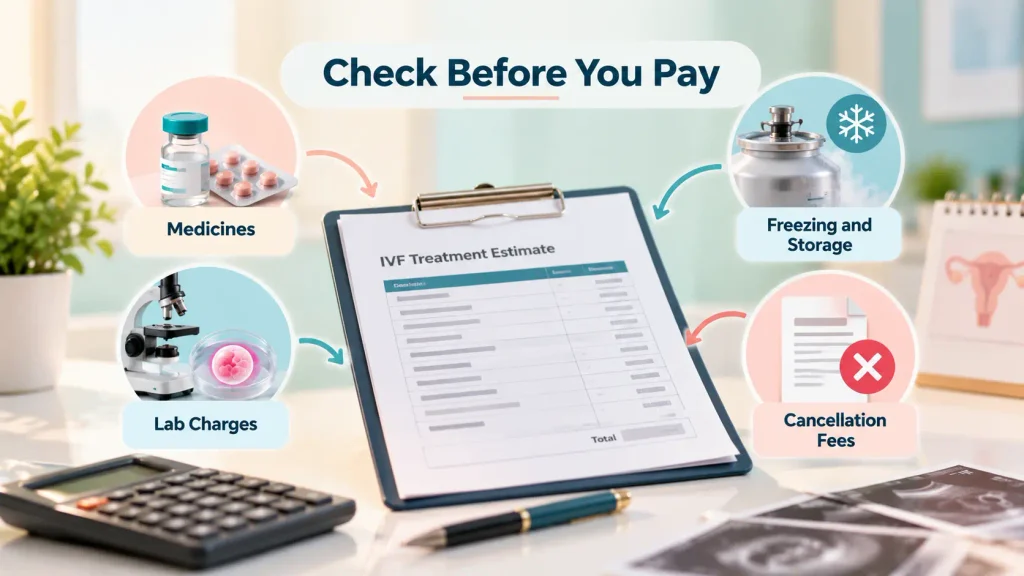
A quoted package rarely equals the final bill. These are the items couples most often find outside the quote:
- Anaesthesia and daycare charges for egg retrieval.
- Monitoring scans beyond the number the package includes.
- Medicines after embryo transfer.
- Embryo storage after the first year.
- Extra consultations and repeat tests.
- Fees if a cycle is cancelled or stopped early.
Storage deserves a closer look. Freezing embryos is routine, and storage usually carries a yearly fee. If you may also freeze eggs or sperm on their own, read about egg and sperm freezing before you sign, so you know which charges apply and when.
Ask what happens if a cycle is cancelled because too few follicles grow. Some clinics keep part of the fee, while others refund unused medicines or lab charges. The answer should be in writing.
How IVF Cost in Pimpri Chinchwad Differs Across Wakad, Chinchwad, Nigdi, Ravet and Bhosari
At one centre, the procedure price does not change with your address. A couple in Ravet and a couple in Bhosari pay the same fee for the same retrieval and transfer. What changes is travel, time off and how easily you can fit scans around work.
- Wakad and Hinjewadi: the shortest trip for many IT professionals, with scans possible before office hours.
- Chinchwad, Nigdi and Akurdi: a longer cross town drive, so plan for traffic at early morning scan slots.
- Ravet and Punawale: a moderate commute that depends on the route you take.
- Bhosari and MIDC: shift timings may decide which scan slots work.
Add fuel, parking, cab fares and a day or two of leave for retrieval and transfer to any quote. Couples who also compare IVF cost in Pune city should use the same itemised approach, because each clinic sets its own prices and neither area has a fixed rate. Our separate page on IVF cost in Wakad shows how a Wakad estimate is structured.
Budgeting for More Than One IVF Cycle
One cycle is a budget, not a promise. Some couples conceive in the first cycle, and others need more than one attempt. Your doctor will advise after your tests, and age shapes the odds, so read success rates by age before you fix a number.
A practical way to build the figure:
- Start with the clinic’s quoted total for one fresh cycle.
- Add medicines if they sit outside the quote.
- Add any add ons your doctor has recommended.
- Add travel, parking and lost wages for scan days.
- Hold a reserve for a second attempt or a frozen transfer.
Hypothetical example: a couple quoted ₹2,00,000 for a fresh cycle, with ₹40,000 of medicines billed separately and ₹20,000 of travel and leave, should plan for about ₹2,60,000 for one attempt and keep a reserve for the next.
If a first cycle produces spare embryos, a later frozen embryo transfer usually costs less than a second fresh cycle, because stimulation and retrieval are not repeated. You still pay for lining preparation, thawing, transfer and storage.
Eight Questions to Ask Before You Pay the First Instalment
Take these questions to every consultation. Written answers are worth more than verbal ones.
- Which stages and medicines does this quote include, in writing?
- Is ICSI included, and for how many eggs?
- How many monitoring scans are in the price?
- What is excluded: anaesthesia, daycare, medicines after transfer?
- When does embryo storage start, and what does it cost each year?
- What happens to my fee if the cycle is cancelled or stopped early?
- Is the clinic registered under the Assisted Reproductive Technology (Regulation) Act, 2021, and can I see the registration?
- Can I have the estimate as an itemised, signed document before I pay?
Screenshot this list and use it on every visit. Compare IVF cost in Pimpri Chinchwad on the same itemised terms each time, and ask for a written cost estimate before you pay the first instalment. A qualified fertility specialist can turn your test results into a personal range, and an article cannot replace that conversation.
Frequently Asked Questions About IVF Costs
1. How much does one IVF cycle cost in Pimpri Chinchwad?
Most Indian clinics quote roughly ₹1,20,000 to ₹3,00,000 for one fresh cycle, and quotes in Pimpri Chinchwad sit within that spread. Your own figure depends on age, ovarian reserve, medicine doses and add ons such as ICSI or embryo freezing. Ask for an itemised written estimate that separates procedures, medicines and storage, because a single package number hides most of that detail. Your fertility specialist can confirm a personal range after your tests.
2. Why do IVF packages in Pune vary so much in price?
Packages bundle different things. Some include medicines, ICSI, anaesthesia and a year of embryo storage, while others price the procedure alone. Lab set up, doctor experience, add ons and cancellation terms also differ. A low IVF package price in Pune can end up higher after extras, and a higher one may already include them. Compare itemised lists line by line instead of comparing totals.
3. Is ICSI included in the IVF package cost?
Not always. Some packages include ICSI as standard, and others list it as an add on. ICSI places one sperm into each mature egg and is commonly advised when sperm count or movement is low, or when fertilisation failed earlier. Ask whether ICSI is in your quote, whether it applies to every egg, and what happens to the price if your doctor recommends it later.
4. How much do IVF injections cost separately?
Stimulation injections and the medicines after transfer are often billed outside the package. Couples across India commonly spend between ₹50,000 and ₹1,00,000 per cycle on medicines, and the figure rises with lower ovarian reserve or longer stimulation. A quote taken after your scan and AMH result is more reliable than a general estimate. Take only medicines prescribed by your doctor.
5. What is not included in a quoted IVF package?
Common exclusions are anaesthesia and daycare charges, repeat monitoring scans, medicines after embryo transfer, embryo freezing and yearly storage, genetic testing and extra consultations. Cancelled cycle terms differ between clinics as well. Ask for a written list of inclusions and exclusions before you pay, and confirm what happens to the fee if stimulation is stopped early. Keep that list with your treatment papers so every later bill can be checked against it.
6. How many IVF cycles should I budget for?
No one can promise a number. Some couples conceive in the first cycle, and others need more than one attempt, depending on age, ovarian reserve, sperm quality and embryo development. A practical approach is to plan for one full cycle with medicines and add ons, then hold a reserve for a second attempt or a frozen transfer. Your doctor will advise after your tests.
7. Is a frozen embryo transfer cheaper than a fresh IVF cycle?
Usually, yes. A frozen embryo transfer uses embryos from an earlier cycle, so stimulation, egg retrieval and most lab work are not repeated. You still pay for monitoring, medicines that prepare the uterine lining, thawing, the transfer itself and embryo storage. Ask your clinic to list the transfer fee as a separate line so you can plan the later attempt properly.
8. Is IVF cheaper in Pimpri Chinchwad than in central Pune?
There is no fixed rule. Each clinic sets its own prices, and both areas show a wide spread of quotes. What changes with location is travel, parking and time off work during roughly two weeks of monitoring scans. Compare itemised written quotes from more than one clinic, add your own travel costs, and then decide which option suits your schedule and budget.
9. Can I pay for IVF in instalments?
Some clinics offer staged payments or work with finance providers, while others ask for the package fee upfront. Ask whether instalments carry interest, whether payments are refundable if a cycle is cancelled, and whether medicines are covered. Read any loan terms yourself before signing, and ask the clinic’s accounts team to explain every charge in writing. A clear answer to these questions should come before the first payment, not after it.
10. Does health insurance in India cover IVF?
Many individual policies exclude infertility treatment, and some employer group policies cover part of it. Policies differ widely, so read the exclusions and waiting period sections of your policy wording, or ask your insurer or HR team in writing before you start a cycle. Do not assume cover, and keep the written reply with your treatment papers. If a claim is refused later, that reply is the document your insurer or employer will want to see first.