

In the UK national registry for 2019, 32% of embryo transfers led to a live birth for patients under 35, and 5% or fewer did for patients aged 43 and over using their own eggs. Age moves the number a long way, which is why a single figure for IVF success rate in Pimpri Chinchwad means little until you know whose age it counts, what it counts, and per what.
Couples at this stage often carry a number from a friend, a hoarding or a forwarded message. Test that number with three questions: which women does it cover, is it a baby or a positive test, and is it per transfer or per started cycle? The sections below give you the tools to do that, and the registry figures to hold any claim against.
Why Advertised Success Rates Are Almost Never Comparable
Clinic advertising does not follow one reporting format. One clinic reports positive pregnancy tests, another reports a heartbeat on the scan, and a third reports live births but only for its best prognosis patients. All three can be accurate and still impossible to compare.
Numbers get flattered or narrowed in a handful of familiar ways:
- Counting per transfer, not per started cycle: cycles cancelled before transfer disappear from the figure.
- Reporting only the youngest group: an under 35 result is presented as if it applies to everyone.
- Counting pregnancy, not birth: early pregnancies that end in miscarriage still count as successes.
- Mixing donor egg cycles with own egg cycles: donor cycles raise the average for older patients.
A fair figure names the age group, the egg source and what was counted. NHS guidance on IVF says the chance of a baby depends on the cause of the fertility problem, age, body mass index and lifestyle factors such as smoking, so one number for everyone cannot be right.
Live Birth Rate, Clinical Pregnancy Rate and Implantation Rate Are Three Different Numbers
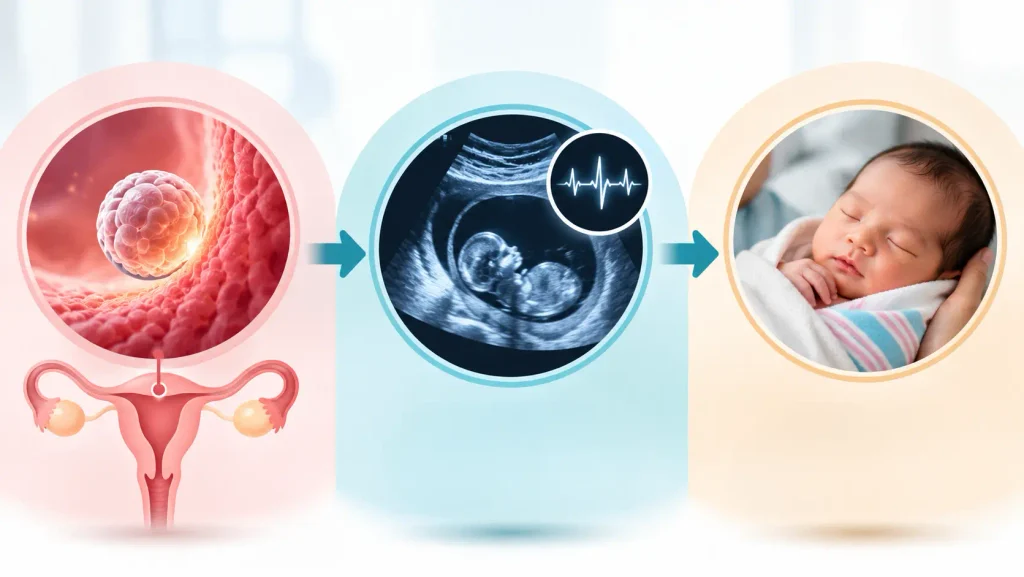
Live birth rate counts babies born, clinical pregnancy rate counts pregnancies with a heartbeat seen on ultrasound, and implantation rate counts the share of transferred embryos that attach to the uterus. Live birth rate is the figure that matches what couples actually want, so live birth rate vs pregnancy rate is the comparison worth making first.
- Implantation rate: how many transferred embryos attach.
- Clinical pregnancy rate: how many cycles reach a scan with a heartbeat.
- Live birth rate: how many cycles end with a baby.
Hypothetical example: out of 100 transfers, 50 give a positive pregnancy test, 40 show a heartbeat on scan and 32 end in a live birth. A clinic quoting 50% and a clinic quoting 32% may be describing the same results.
The denominator matters just as much. A per transfer figure counts only cycles that reached transfer, while a per started cycle figure also counts cycles that stopped earlier. The CDC ART success rates pages report both measures, which shows how much the choice changes the result. Implantation also depends on the embryo itself, so it helps to understand embryo quality grading before you judge any percentage.
IVF Success Rate by Age: Under 35, 35 to 37, 38 to 39, 40 to 42 and Over 42

Registry data show the pattern clearly. These figures come from the UK regulator, the Human Fertilisation and Embryology Authority, for 2019, and they count live births per embryo transferred using a patient’s own eggs.
| Age of the woman | Live birth per embryo transferred (own eggs, UK 2019) |
|---|---|
| Under 35 | 32% |
| 35 to 37 | 25% |
| 38 to 39 | 19% |
| 40 to 42 | Lower again, so ask your doctor for an individual estimate |
| 43 and over | 5% or below |
Two cautions apply. These are UK figures from 2019, and Indian outcomes can differ with patient mix and clinic practice. Averages also hide individual differences, so two women of the same age can have very different odds.
- The cause of infertility, such as blocked tubes, endometriosis or low sperm count.
- Ovarian reserve and how the ovaries respond to stimulation.
- Sperm quality and embryo development in the lab.
- The health of the uterine lining at the time of transfer.
Searches for IVF success rate at 35 or IVF success rate at 40 usually come from couples who have just been told that age is a factor. The honest answer is that the curve bends gradually from the mid thirties and falls more steeply after 40. The factors behind IVF success explain what sits behind those averages. For older patients, doctors may also discuss donor eggs, and the UK regulator reports live birth rates above 30% per embryo transferred at all ages when donor eggs were used.
What AMH and Antral Follicle Count Change About Your Odds
AMH is a blood test that reflects how many eggs remain, and the antral follicle count is a scan based count of small follicles in the ovaries. Together they describe ovarian reserve. They predict how many eggs you are likely to collect, not how good those eggs are.
- High AMH: usually more eggs, with a higher chance of an over response to medicines that your doctor will watch for.
- Low AMH: usually fewer eggs per cycle, so some couples need more than one retrieval to bank enough embryos.
- Normal AMH at an older age: the number of eggs may be fine, but age still shapes egg quality.
That is the real link between AMH level and IVF success: AMH tells your doctor how to plan the stimulation, while age tells you more about egg quality. A low result is not a verdict. Our page on AMH testing and treatment explains how a low AMH is approached.
How Much Male Factor Moves the Number
In many couples a male factor contributes to the problem, either alone or alongside a female factor. Doctors look at sperm count, movement and shape, and sometimes at DNA fragmentation. A routine semen analysis is the usual first test.
- Low count or poor movement: often handled with ICSI in the lab.
- High DNA fragmentation: can affect embryo development even when a routine report looks acceptable.
- No sperm in the ejaculate: may still allow treatment if sperm can be retrieved surgically.
A normal semen report does not always close the question, and an abnormal one does not always mean poor odds. Your doctor decides which further tests change the plan, so the male partner should be assessed at the start, not after a failed cycle.
Cumulative Success Across Three Cycles Is the Figure That Matters
One failed cycle tells you very little, because a single attempt is a single draw. What matters is the chance of at least one live birth across the attempts you are prepared to make. The table below uses simple arithmetic on the UK 2019 figures to show how the odds build.
| Age of the woman | Per embryo transferred | At least one live birth across three transfers |
|---|---|---|
| Under 35 | 32% | About 69% |
| 35 to 37 | 25% | About 58% |
| 38 to 39 | 19% | About 47% |
This is an illustration, not a forecast. It assumes each transfer has the same chance, while real outcomes vary with embryo quality and the reasons behind an earlier failure. Frozen transfers from one retrieval also mean that three attempts do not always need three egg collections.
So how many IVF cycles to get pregnant? There is no fixed number. Some couples conceive on the first attempt, and the figure for the IVF success rate first attempt is simply the per transfer rate for your age band. Others need further transfers or a change of plan. Your doctor will advise after your tests.
Six Questions to Ask About IVF Success Rate in Pimpri Chinchwad
Any clinic can answer these, and a clear answer is a good sign.
- Which age group does this figure cover, and were donor eggs included?
- Does it count live births, or only positive tests or heartbeats?
- Is it per started cycle or per embryo transfer?
- Are cancelled cycles and cycles with no embryo included?
- How many cycles and which years does the figure cover?
- Can I have the figure and its method in writing?
Ask the same six at our Pimpri Chinchwad IVF centre and at any other clinic you consider. Answers you can compare side by side are worth more than any headline percentage.
How We Report Our Own Outcomes and What We Count
Reporting basis: when 6Venus shares its own results, the counting method is stated beside the figure: live births, per started cycle, grouped by the woman’s age at egg retrieval.
Until a clinic figure can be backed by clinic records, this page relies on published registry data and does not quote a 6Venus success percentage. Couples near Wakad can also read about IVF success in Wakad, which covers the questions couples ask there.
Treat the numbers above as a map, not a verdict. When you compare any claim about IVF success rate in Pimpri Chinchwad, check the age group, the egg source and what was counted, and ask for the method in writing. A qualified fertility specialist can turn your test results into a personal estimate, and no article can replace that conversation.
Frequently Asked Questions About IVF Success Rates
1. What is a good IVF success rate in India?
There is no single good number, because the answer depends on age, egg source and what is counted. A figure is only useful when it states live births, the age group and whether it is per started cycle or per embryo transfer. For reference, UK registry data for 2019 show 32% live birth per embryo transferred under 35. Ask any clinic to explain its figures in writing before you compare.
2. Does IVF success drop sharply after 35?
The decline is gradual through the mid thirties and steeper after 40. UK registry data for 2019 show 32% per embryo transferred under 35, 25% at 35 to 37 and 19% at 38 to 39. Individual results vary with ovarian reserve, sperm quality and embryo development, so an average cannot predict your own outcome. Your doctor can give an individual estimate after tests.
3. Why do clinics advertise different success rates?
Clinics may count different things. One may report positive pregnancy tests, another heartbeats on scan, and another live births. Some quote per embryo transfer while others quote per started cycle, and some show only younger patients. These choices change the number without changing the care. Ask which age group, which egg source and which outcome a figure covers, and request the method in writing.
4. What is the difference between pregnancy rate and live birth rate?
Pregnancy rate counts pregnancies, either by a positive blood test or by a heartbeat on scan. Live birth rate counts babies born. The two differ because some early pregnancies end in miscarriage. Live birth rate is the more meaningful figure for couples, so when you compare clinics, ask for it first and check whether it is counted per started cycle or per transfer.
5. How does AMH affect my IVF chances?
AMH reflects ovarian reserve, meaning roughly how many eggs remain. It helps predict how many eggs a stimulation cycle may collect, and it guides medicine doses. It does not measure egg quality, which is shaped mainly by age. A low AMH may mean fewer eggs per cycle, and some couples plan more than one retrieval. Your doctor will interpret it alongside your age and scan findings.
6. What are my odds across three IVF cycles?
Odds build with each attempt. As simple arithmetic on UK 2019 figures, a 32% chance per transfer becomes about 69% across three transfers, and 25% becomes about 58%. This is an illustration, because real chances vary with embryo quality and earlier results. Frozen transfers from one retrieval can also count as separate attempts. Your doctor can estimate a realistic plan for you.
7. What is the IVF success rate at 40?
Registry data show a steep fall after 38. UK figures for 2019 were 19% per embryo transferred at 38 to 39 and 5% or below at 43 and over, so patients aged 40 to 42 sit between those two. Individual results depend on ovarian reserve, sperm quality and embryo development. Some doctors discuss donor eggs at this stage. Ask for an individual estimate after your tests.
8. What is the IVF success rate on the first attempt?
The first attempt follows the same age pattern as later ones. In UK data for 2019, one embryo transfer led to a live birth in about one in three cases under 35 and about one in four at 35 to 37. Many couples conceive on a later transfer, and some need a change of plan. A first attempt that fails does not predict the next one.
9. How many IVF cycles does it take to get pregnant?
No honest clinic can promise a number. Some couples conceive on the first transfer, and others need several, depending on age, ovarian reserve, sperm quality and embryo development. Cumulative chances rise with each attempt, which is why planning for more than one transfer is sensible. Your doctor will advise after your tests, and a clear written plan helps you decide how many attempts to prepare for.
10. Does a failed first cycle mean IVF will not work for me?
No. One failed attempt is one result, and it often carries useful information about the protocol, the embryos or the uterine lining. Doctors review the cycle records before suggesting changes, and some couples succeed on a later attempt. A failed cycle can feel heavy, so ask your doctor for a full review of what happened and what could be done differently next time.