
A single IVF cycle can mean, for example, six or more early morning visits in about two weeks, and two of them are timed by your treatment rather than your calendar. That one fact changes how couples in Pimpri Chinchwad should think about where to treat. Search for an IVF centre in Pune and you get lists, rankings and star ratings. What you rarely get is a way to judge a clinic yourself, which is what actually settles the choice between an IVF centre in central Pune and one closer to home in PCMC.
What Matters Most When Choosing an IVF Centre in Pune: Three Factors
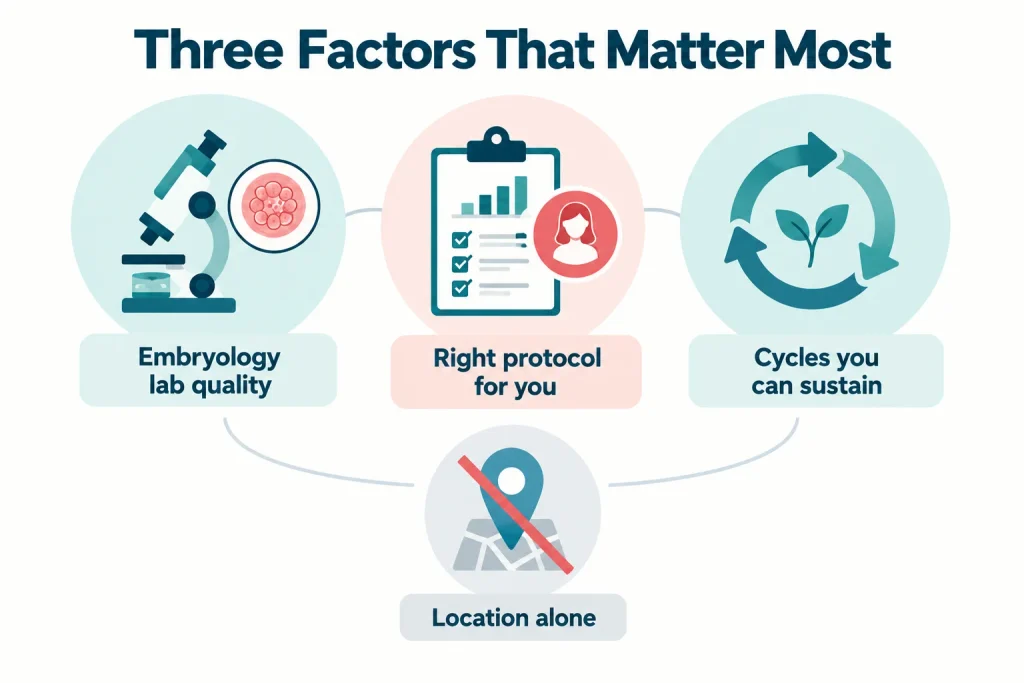
Many things shape an IVF outcome, including age and diagnosis. When comparing clinics, three factors matter most, whether the clinic is in Wakad, Baner or Deccan.
- The embryology lab: how eggs, sperm and embryos are handled, cultured and frozen in the days you never see.
- The protocol decision: whether the stimulation plan suits your age, ovarian reserve and history, and whether it changes when your scans say it should.
- The number of cycles you can sustain: financially, physically and emotionally. Many couples need more than one attempt, so a plan you can afford to repeat often matters more than one expensive cycle.
Notice what is missing: a headline success rate. India has no single national format for reporting outcomes, so one clinic may count pregnancies per transfer while another counts live births per cycle started. Any figure, including pages on IVF success rates in Wakad, only makes sense once you know what was counted, for which age group and over what period.
How a Non Specialist Can Judge IVF Lab Quality in India
You cannot walk into an embryology lab, but you can ask questions that reveal a great deal. A clinic with a well run lab answers them easily.
- Who runs the lab? Ask whether a qualified clinical embryologist is present for every egg retrieval and embryo transfer, including weekends, since retrievals do fall on Sundays.
- What do they measure? Good labs track their own fertilisation rate, blastocyst development rate and embryo survival after thawing. The ESHRE Vienna consensus sets out 19 such lab indicators. No single number proves a lab is good, but a lab that tracks them knows how it is performing.
- How are samples tracked? Ask how eggs, sperm and embryos are identified at every step, and whether the lab uses manual double witnessing or an electronic witnessing system.
- How are embryos graded? Ask to see a sample embryo report. Our guide to how embryo quality is graded explains what the letters and numbers mean.
- How do they decide how many embryos to transfer? The answer should depend on your age, embryo quality and history, with a clear explanation of when single embryo transfer is advised and the risks of twins.
- Is the clinic registered? The Assisted Reproductive Technology (Regulation) Act, 2021 requires IVF clinics to register, and the National ART and Surrogacy Registry is the central public record. Any clinic should share its registration number on request.
A lab that cannot tell you its own fertilisation or thaw survival rate is not necessarily a poor lab. It is, however, a lab that has not shown you how it checks itself.
Why Monitoring Visits Make Travel More Than a Convenience Question
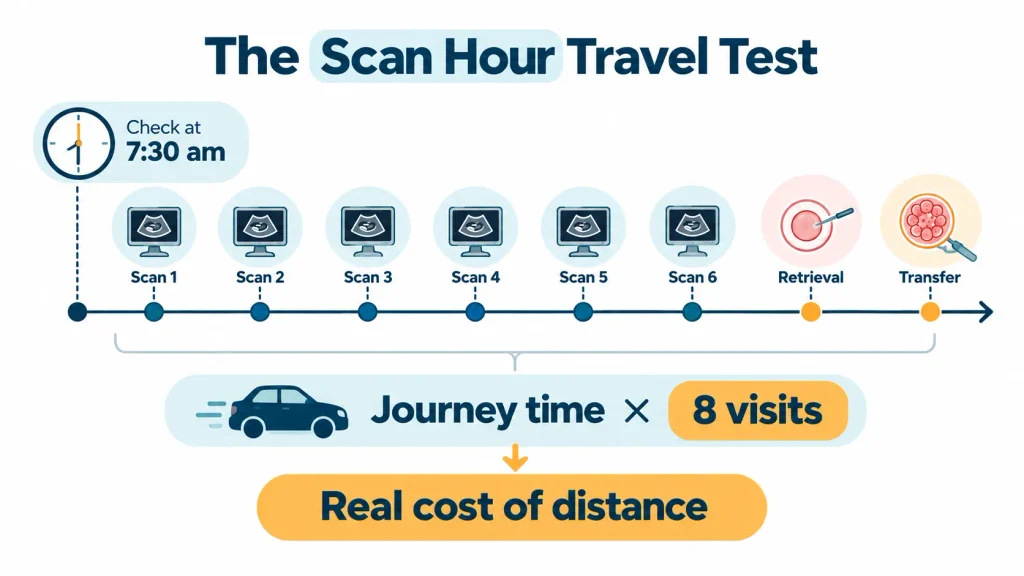
During stimulation, travel becomes part of how smoothly treatment runs. According to Cleveland Clinic, stimulation usually lasts eight to fourteen days, with scans and blood tests every few days or even daily. Each scan helps the doctor decide whether to adjust the dose.
Then come the fixed points. Egg retrieval is usually scheduled 34 to 36 hours after the trigger injection. If a fresh transfer is planned, it typically follows a few days after retrieval, depending on how the embryos develop, while many couples instead freeze embryos for transfer in a later cycle. The NHS overview of IVF describes the same sequence. In this window, long journeys can make things harder:
- Scans get pushed later in the morning, which can make same day dose changes harder to manage.
- Couples start rescheduling scans because each one costs half a working day.
- Stress climbs, and the partner who drives often stops coming.
- Retrieval is done under sedation, so you follow the clinic’s instructions on fasting and arrival time, and someone has to drive you home afterwards.
Distance does not change the biology of your eggs or embryos, and none of this makes the nearest clinic automatically right. It does mean a 20 minute journey and a 90 minute journey are not equal choices, even when everything else looks the same.
IVF Cost in Pune vs PCMC: Where the Real Differences Hide
Couples often assume IVF is cheaper in PCMC than in central Pune. Sometimes it is, sometimes not. Quoted packages across the city overlap widely, and the clinic’s address is a weaker guide to the final bill than what the package includes. The bigger differences usually sit in three places:
- Medicines: stimulation drugs are often the largest single cost and are the same products wherever you treat. Your dose, driven by age and ovarian reserve, matters far more than location.
- Inclusions: ICSI, embryo freezing, storage after year one, anaesthesia and extra scans are included in some quotes and billed separately in others.
- Getting there: fuel or cabs, parking and lost working hours for both partners across eight or more visits.
For the clinic side of the bill, our guide to IVF cost in Pimpri Chinchwad breaks a cycle down stage by stage.
Traffic Reality: Wakad to Baner, Aundh, Deccan and Kothrud at Scan Hours
Scan slots usually fall between 7 and 10 in the morning, exactly when routes into the city are slowest. Couples weighing IVF in Baner or Wakad, or further in, should picture these journeys at that hour.
- Baner and Aundh: the nearer pair, but both involve highway junctions and river crossings that back up in office hours.
- Deccan: means crossing into the older city core, usually through busy morning corridors around the University area.
- Kothrud: sits on the far side of the city from PCMC, so the journey depends heavily on which route is moving that day.
A practical test: on a weekday, open a maps app at 7:30 am and check the live journey time from home to each clinic on your shortlist. That number, multiplied by the visits, is the real travel cost of your choice.
When Travelling Further Genuinely Is the Right Call
Sometimes the right clinic is not the closest one, whether that means central Pune or another city.
- Complex surgery first: severe endometriosis, large fibroids or a uterine abnormality may need a surgeon with a specific laparoscopic or hysteroscopic skill set before IVF.
- Repeated failure with an unanswered question: after several well run cycles, an individual review of the earlier cycles by a specialist with relevant experience may justify the distance.
- Single gene conditions: testing embryos for a known inherited disorder needs a lab with that specific genetic capability.
- Cancer treatment: fertility preservation is usually easiest to coordinate close to the treating oncology team.
For most couples, though, the deciding factors remain the lab, the protocol and how many cycles they can sustain. Our overview of fertility treatment options covers which situations call for IVF and which do not.
Continuity of Care and Seeing the Same Doctor Through the Cycle
A doctor who has watched your follicles grow across several scans is better placed to judge the trigger day than someone seeing your chart for the first time. Ask each clinic on your shortlist:
- Who reads my monitoring scans, and will it be the same doctor each time?
- Who performs the egg retrieval?
- Who performs the embryo transfer?
- If I have a problem at 10 at night after the trigger injection, who do I call?
At 6Venus, fertility consultations are with Dr Pavan Bendale, and you are welcome to ask these same four questions on your first visit.
An IVF Clinic Comparison Checklist for Any Two Clinics
This is how to choose an IVF clinic without leaning on rankings. Write two clinic names on a page and mark each yes, no or unsure against every point. The clinic that answers more of them clearly is usually the better fit. Couples looking for a fertility hospital near Wakad can put our Pimpri Chinchwad centre through exactly the same test.
- Gave its ART Act registration number when asked.
- Has a qualified embryologist present for every retrieval and transfer, including weekends.
- Could tell you its lab’s fertilisation and thaw survival rates.
- Explained how its success rates are counted: live births per cycle started, by age group.
- Gave a written, itemised estimate including medicines and freezing.
- Told you which costs the package leaves out.
- Named the doctor who will read scans, retrieve eggs and transfer embryos.
- Gave a clear contact number for problems after the trigger injection.
- Is reachable within 30 to 40 minutes at 7:30 am on a weekday.
- Gave you time to decide, without pressure or a limited time offer.
Whether you live in Hinjewadi, Ravet, Pimple Saudagar, Chinchwad or Nigdi, the decision comes down to the same things. The right IVF centre in Pune for you is one that is verifiably registered, suits your clinical situation, is open about how it counts results and what it charges, and is close enough that a 7 am scan never feels like a battle.
Frequently Asked Questions About Choosing Where to Have IVF in Pune
1. Is it worth travelling to central Pune for IVF if we live in PCMC?
It depends on why you would travel. If a clinic in central Pune offers something you specifically need, such as a surgeon for complex endometriosis or a lab that tests embryos for a known genetic condition, the distance can be worth it. A cycle involves several early morning scans plus fixed retrieval and transfer times. Compare the lab, the doctor and the full cost first, then factor in the commute.
2. How do I judge the quality of an IVF lab?
Ask direct questions and watch how easily they are answered. Is a qualified embryologist present for every retrieval and transfer, including weekends? Does the lab track its own fertilisation rate, blastocyst development rate and survival after thawing? How are samples identified and witnessed, manually or electronically? What does an embryo grading report look like? How is the number of embryos to transfer decided? Also ask for its registration number under the ART Act, 2021.
3. Does distance to the clinic affect IVF outcomes?
Distance does not change the biology of your eggs or embryos. It can change how the cycle is managed. Long journeys can make it harder to attend every monitoring scan on time, which matters because those scans guide dose adjustments, and they add strain on retrieval day, when you are sedated and need someone to drive you home. A sensible rule is to choose a clinic you can reach comfortably at 7:30 am on a weekday, unless a specific medical need justifies more.
4. How much cheaper is IVF in PCMC than in Pune city?
No reliable public data shows a fixed difference, and quoted packages across Pune overlap widely. What usually changes the final bill is what the package includes: medicines, ICSI, embryo freezing, storage after the first year, anaesthesia and extra scans. Medicines are often the largest single cost and depend on your dose, not the clinic’s address. To compare fairly, ask two clinics for written, itemised estimates, then add your own travel costs and lost working hours.
5. Will I see the same doctor through the whole IVF cycle?
It varies, so ask before you start. In some centres one specialist reads your scans, performs the retrieval and does the transfer. In larger set ups, different doctors may cover different days. Continuity helps because the doctor who has followed your follicles across several scans is better placed to time the trigger injection. Ask who reads your scans, who retrieves the eggs, who transfers the embryos, and who you call at night if there is a problem.
6. How can I check whether an IVF centre is registered in India?
Under the Assisted Reproductive Technology (Regulation) Act, 2021, every ART clinic and bank in India must be registered. The National ART and Surrogacy Registry, under the Ministry of Health and Family Welfare, is the central public record. Ask any clinic on your shortlist for its registration number, and check that the registered name and address match the place where you will actually be treated. A registered clinic should share this readily, and it is a sensible first filter.
7. Should I choose an IVF clinic by its success rate?
Use success rates carefully. India has no single national reporting format, so one clinic may count pregnancies per transfer while another counts live births per cycle started, and the two can look very different. Results also depend on the age and diagnosis of the patients a clinic treats. If you ask, ask for live births per cycle started, for women in your age band, over a stated period.
8. Can I have monitoring scans near home and travel only for egg retrieval?
Sometimes, but it needs careful coordination. The treating clinic must receive each scan report quickly, trust the measurements and adjust your dose the same day. Different machines and different people measuring follicles can give slightly different readings, which matters when trigger timing depends on them. Many clinics prefer to do all monitoring themselves for that reason. If your chosen clinic is far away, ask openly whether shared monitoring is possible and how daily dose decisions would reach you.
9. Can frozen embryos be moved to another clinic if we switch?
In most cases, yes, but it takes planning. Both clinics need to agree, both partners usually sign written consent, and the embryos travel frozen in a specialised liquid nitrogen container handled by trained staff. Ask your current clinic for the embryology report, freezing method and storage details, and check whether there are transfer or storage charges. The receiving clinic will want to confirm it can thaw embryos frozen by that method. If you think you might switch later, ask about this before you freeze.
10. Is a large IVF chain better than a standalone centre?
Neither is automatically better. Chains may offer standard processes and several locations, while standalone centres may offer more direct contact with one doctor and one lab team. What matters is the same in both: the specific lab that will handle your embryos, the experience of the doctor managing your protocol, transparent costs, and how easily you can reach the clinic at scan hours.