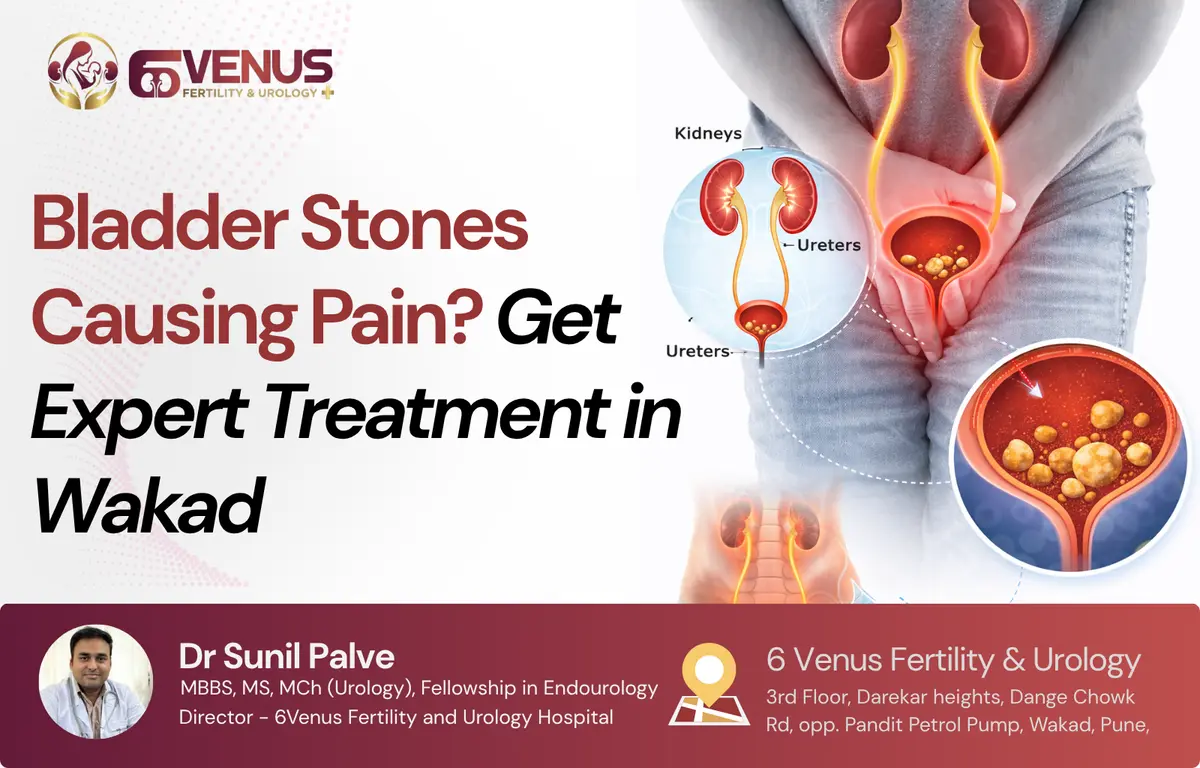
Bladder stones account for roughly 5% of all urinary stones in India, and according to StatPearls on NCBI, men with an enlarged prostate are eight times more likely to develop bladder stones than men without one. That single fact changes how bladder stone treatment needs to be approached.
Most men in Wakad who are diagnosed with a bladder stone on ultrasound focus entirely on getting the stone removed. What they often do not realise is that if the enlarged prostate causing the urine retention is not treated alongside the stone, a new stone will form. Removing the stone and ignoring the prostate is treating the symptom, not the problem.
At 6Venus Urology Hospital in Wakad, Dr. Sunil Palve, MCh Urology, evaluates and treats both the bladder stone and its underlying cause in a single, coordinated clinical plan. That is what separates specialist urology from a general approach to this condition.
Why Bladder Stones Form: The Connection Most Clinics Skip
A bladder stone does not form out of nowhere. Something causes urine to stagnate inside the bladder. When urine sits there for too long instead of draining completely, minerals in the urine crystallise and clump together into a stone.
The most common reasons this happens:
- Enlarged prostate (BPH): The prostate surrounds the urethra. When it enlarges, it narrows the urethra and obstructs urine flow. Men cannot empty their bladder completely. Residual urine sits and concentrates. Minerals crystallise. A stone forms. According to NCBI Bookshelf on BPH, BPH affects 50% of Indian men by age 60 and up to 80% of men by age 70
- Neurogenic bladder: Nerve damage from diabetes, spinal injury, or Parkinson’s disease disrupts the bladder’s ability to contract and empty properly
- Bladder diverticula: Small pouches that form in the bladder wall and trap urine
- Urethral stricture: Narrowing of the urethra from infection, injury, or previous surgery
- Recurrent UTIs: Certain bacteria produce enzymes that split urea, creating an alkaline urine environment where struvite stones form rapidly
- Kidney stones that migrated: Small stones from the kidney can travel down the ureter, enter the bladder, and grow larger inside it
“The guidelines suggest that BPH obstruction should be managed along with removal of bladder stones. Managing one without the other leads to recurrence.” — Indian Journal of Health Sciences and Biomedical Research. That obstruction usually announces itself long before a stone ever forms, and our guide to enlarged prostate symptoms covers the early signs men tend to write off as ageing.
Bladder Stone Symptoms: What Wakad Patients Describe
Bladder stone symptoms often get confused with a UTI or prostate problem, because all three share several features. Here is what patients typically experience:
- Burning or pain during urination
- Frequent urge to urinate, even when the bladder is not full
- Interrupted urine stream, starting and stopping mid-flow
- Blood in urine (pink, red, or dark-coloured urine)
- Pain in the lower abdomen or pelvis, sometimes radiating to the groin
- Dribbling at the end of urination
- Cloudy or foul-smelling urine (often signals concurrent infection)
- Sudden sharp pain if the stone moves and partially blocks the bladder outlet
Some bladder stones are completely silent. They show up on a routine ultrasound or scan done for another reason. Silent stones still need treatment because they will eventually grow large enough to cause obstruction, infection, or both.
If you have any of these symptoms in Wakad, Hinjewadi, Pimple Saudagar, or the surrounding areas, do not assume it is just a UTI. A proper ultrasound with post-void residual measurement and a review by a urologist gives the definitive picture in a single visit.
Diagnosing a Bladder Stone at 6Venus Wakad
Dr. Palve does not guess. Before any treatment decision is made, he reviews your specific findings. At 6Venus, the diagnostic workup for a suspected bladder stone includes:
- Ultrasound KUB: Fast, non-invasive. Shows stone size, number, and position in the bladder. Also screens the kidneys and ureters for concurrent stones. Post-void residual measurement tells Dr. Palve how much urine remains after you urinate, which is the clearest indicator of underlying obstruction
- Urine analysis and culture: Confirms whether infection is present. This matters before any instrumentation because operating through an infected urinary tract risks sepsis
- Serum creatinine and renal function: If there is significant obstruction, kidney function may be compromised. Knowing this before surgery affects anaesthesia decisions and post-operative care
- X-ray KUB: Confirms whether the stone is calcium-based (radio-opaque) or uric acid based (radiolucent). Matters for post-treatment prevention planning
- Uroflowmetry: Measures urine flow rate. Reduced flow in a man over 50 with a bladder stone almost always points to an underlying prostatic obstruction
- Prostate assessment: PSA, transrectal ultrasound, or abdominal ultrasound to assess prostate size if BPH is suspected as the root cause
Bladder Stone Treatment Options at 6Venus Wakad
The treatment depends on stone size, number, hardness, and the underlying cause. Dr. Palve selects the most appropriate procedure after reviewing all diagnostic findings.
Option 1: Cystolitholapaxy (Transurethral Bladder Stone Removal)
This is the standard treatment for most bladder stones at 6Venus. A rigid or semi-rigid cystoscope is passed through the urethra into the bladder under anaesthesia. Dr. Palve directly visualises the stone and uses holmium laser energy to break it into small pieces. These fragments are then flushed out of the bladder through the scope. No incision is made anywhere.
- Suitable for most stones up to 4-5cm
- Day-care procedure, same-day discharge in most cases
- Operating time: 30 to 60 minutes depending on stone size
- Catheter placed for 24-48 hours after surgery and removed at follow-up
- Return to normal activity within 3-5 days
Option 2: Percutaneous Cystolitholapaxy
For very large bladder stones (above 4cm) or when transurethral access is limited due to urethral anatomy, Dr. Palve makes a small puncture in the lower abdomen to access the bladder directly. A nephroscope breaks and removes the stone through this pinhole access. This approach avoids open surgery entirely while handling stones too large for the standard transurethral route.
- Used for stones above 4-5cm or multiple large stones
- Still a minimally invasive approach, no large incision
- Hospital stay of 24 to 48 hours
- Recovery similar to PCNL for kidney stones
Option 3: Open Cystolithotomy (Rarely Needed)
Open bladder stone surgery is almost never needed with modern endourology equipment. Dr. Palve performs open cystolithotomy only when stones are extremely large (above 8-10cm), multiple and densely packed, or when a simultaneous open prostate procedure is being performed for another reason. At 6Venus, this is an uncommon scenario.
Option 4: ESWL for Small Bladder Stones
Extracorporeal shockwave lithotripsy can break small bladder stones without any instrumentation. It works best for small, soft stones in a bladder that empties well. In men with prostatic obstruction, ESWL alone is often not appropriate because the fragments cannot drain properly if the outlet is blocked. Dr. Palve evaluates this case by case. Where stones have travelled down from the kidney, RIRS kidney stone surgery is often the cleaner way to clear them.
Treating the Stone and the Prostate Together
This is the part that most bladder stone treatment articles miss entirely.
When a bladder stone is caused by BPH-related obstruction, the stone and the prostate need to be addressed together. At 6Venus, Dr. Palve frequently performs cystolitholapaxy combined with TURP in the same anaesthetic session.
TURP removes the obstructing prostate tissue that was blocking urine flow. Cystolitholapaxy removes the stone that formed because of that obstruction. Both in one procedure, one anaesthesia, one recovery.
This combined approach is recommended by urological guidelines and is something Dr. Palve performs regularly because 6Venus has full endourology capability in-house. A hospital that can only do one or the other forces patients to come back for a second procedure under a second anaesthesia.
For men in Wakad over 50 with both a bladder stone and urinary symptoms like weak flow, frequent urination, or incomplete bladder emptying, this dual approach is often the most clinically sound and cost-efficient path.
Bladder Stone Treatment Cost in Wakad: What to Expect
Cost at specialist urology centres in Wakad and Pune varies by procedure. Approximate ranges:
| Procedure | Approx Cost (Pune) | Hospital Stay |
|---|---|---|
| Transurethral cystolitholapaxy (laser) | Rs. 35,000 to Rs. 70,000 | Day care |
| Percutaneous cystolitholapaxy | Rs. 60,000 to Rs. 1,10,000 | 24 to 48 hours |
| Combined cystolitholapaxy and TURP | Rs. 80,000 to Rs. 1,50,000 | 24 to 48 hours |
| Pre-operative diagnostics | Rs. 3,000 to Rs. 7,000 | Not applicable |
These are approximate ranges. The actual cost at 6Venus depends on stone size and complexity, the specific instruments used, anaesthesia type, and whether a concurrent prostate procedure is needed. For a detailed cost breakdown of all urological stone procedures in Wakad, visit the kidney and bladder stone treatment cost page at 6Venus.
Health insurance covers bladder stone surgery as a medically necessary procedure under most standard and corporate group policies. The 6Venus billing team assists with pre-authorisation and claim documentation. For stones higher up in the tract, laser kidney stone surgery is costed and explained on its own page.
Recovery After Bladder Stone Surgery at 6Venus
Recovery after transurethral cystolitholapaxy at 6Venus is straightforward for most patients:
- Day of surgery: Procedure under anaesthesia, recovery room for 2 to 3 hours, catheter placed, discharge by evening in most cases
- Day 1 to 3: Catheter in place. Mild burning and pink-tinged urine is normal. Drink 2.5 to 3 litres of water daily to flush the bladder. Light activity. No heavy lifting
- Day 2 to 3: Catheter removed at 6Venus in a short follow-up visit. Urination typically resumes normally
- Day 4 to 7: Return to desk work. Avoid strenuous exercise for 2 weeks
- Week 2: Follow-up ultrasound confirms bladder is clear and draining well. If TURP was combined, Dr. Palve checks urinary flow rate
Preventing Bladder Stones From Coming Back
Bladder stone recurrence is high when the underlying cause is not addressed. After treatment at 6Venus, Dr. Palve gives every patient a specific prevention plan based on stone composition and root cause:
- If caused by BPH: Medical therapy with alpha-blockers or 5-alpha reductase inhibitors to keep the prostate controlled and urine flowing freely. TURP if medical therapy is insufficient
- If caused by UTI or struvite: Antibiotics to clear active infection, plus long-term measures to prevent recurrent UTIs. See the 6Venus UTI specialist page for how chronic urinary infections feed stone formation
- If caused by dehydration: Hydration targets of 2.5 to 3 litres daily to maintain dilute urine. Particularly relevant for IT professionals in Wakad and Hinjewadi who spend extended hours in air-conditioned offices without drinking enough water
- If caused by neurogenic bladder: Clean intermittent self-catheterisation training to ensure complete bladder emptying, preventing urine stasis
- Dietary adjustments: Based on stone composition. Calcium phosphate stones respond to reduced sodium intake. Uric acid stones respond to reduced purine diet and alkalinisation of urine
Why 6Venus Is the Right Choice for Bladder Stone Treatment in Wakad
Most hospitals handle bladder stones. What makes 6Venus different is the integrated approach.
Dr. Sunil Palve’s MCh Urology qualification from Osmania Medical College, 15 years of clinical experience, and 750+ stone surgeries give him a level of endourological precision that general surgery units cannot match. His ability to perform cystolitholapaxy and TURP in the same session, using advanced laser and endoscopy equipment in-house at 6Venus, means Wakad patients do not need to be referred to distant multispecialty hospitals for complete management.
Men in Wakad, Hinjewadi, Pimple Saudagar, Marunji, Punawale, and Pimpri-Chinchwad are within 10 to 15 minutes of 6Venus on Dange Chowk Road. That accessibility is not a small detail when post-operative follow-up visits and catheter removal need to happen within days of surgery.
Visit 6Venus Fertility and Urology Hospital to book a consultation with Dr. Sunil Palve, or visit the men’s health urology page at 6Venus to understand the full scope of urological conditions Dr. Palve treats. Patients closer to the old town can be seen at our urology hospital in Pimpri-Chinchwad, where the same consultant list applies.
10 Questions Patients Ask About Bladder Stone Treatment in Wakad
1. How do I know if I have a bladder stone or just a UTI?
Both share symptoms: burning urination, frequency, and cloudy urine. But bladder stones also cause interrupted urine flow, sharp pain that eases when you change position, and blood in urine without fever. A UTI causes fever and systemic symptoms. An ultrasound tells the difference in minutes. If you have any combination of these symptoms in Wakad, do not self-treat with antibiotics alone. Get an ultrasound first.
2. Can a bladder stone pass on its own?
Very small bladder stones, under 5mm, can sometimes pass in urine with high fluid intake. But the majority of bladder stones that cause symptoms are too large to pass. More importantly, if there is an underlying prostatic obstruction or poor bladder drainage, the stone cannot pass even if it is small. Increasing water intake helps but does not resolve the root cause. A urologist’s evaluation is needed to determine whether watchful waiting is appropriate or whether intervention is required.
3. Is bladder stone surgery painful?
Transurethral cystolitholapaxy is performed under anaesthesia. There is no pain during the procedure. After surgery, a urinary catheter is in place for 24 to 48 hours, which causes some discomfort and mild burning. Once the catheter is removed at 6Venus, most patients describe immediate relief. Oral painkillers manage any residual discomfort. Most desk-work patients return to normal activity within 4 to 5 days.
4. What is the connection between bladder stones and an enlarged prostate?
An enlarged prostate narrows the urethra and prevents the bladder from emptying completely. Urine pools in the bladder between voids. Over months to years, minerals in that stagnant urine concentrate and crystallise into a stone. A published Indian journal study found that men with BPH are eight times more likely to develop bladder stones than men without BPH. This is why Dr. Palve evaluates and treats the prostate alongside the bladder stone wherever BPH is confirmed.
5. Will the bladder stone come back after treatment?
It can, and often does if the underlying cause is not treated. A bladder stone removed without addressing an enlarged prostate or recurrent UTI will very likely recur within months to years. At 6Venus, Dr. Palve identifies the root cause before discharge and builds a post-operative prevention plan based on stone composition and the specific condition causing urine retention. This is the step most treatment approaches skip.
6. What is the bladder stone treatment cost in Wakad?
Transurethral laser cystolitholapaxy at specialist centres in Wakad costs approximately Rs. 35,000 to Rs. 70,000 for the procedure and day-care stay. If a concurrent TURP for prostate obstruction is performed in the same session, combined cost runs Rs. 80,000 to Rs. 1,50,000. Pre-operative diagnostics add Rs. 3,000 to Rs. 7,000. Most standard health insurance policies cover bladder stone surgery as a medically necessary procedure. For full cost details, see the stone treatment cost page at 6Venus.
7. Can the bladder stone be treated on the same day as the prostate problem?
Yes. At 6Venus, Dr. Palve frequently performs cystolitholapaxy to remove the bladder stone and TURP to address the obstructing prostate in the same anaesthetic session. One surgery, one recovery. This is standard urological practice when both conditions are confirmed and the patient is fit for a combined procedure. It avoids the need for a second hospitalisation, second anaesthesia, and second recovery period.
8. How long is the hospital stay for bladder stone surgery in Wakad?
Transurethral cystolitholapaxy at 6Venus is a day-care procedure in most cases. Patients arrive fasting, undergo surgery under anaesthesia, recover for 2 to 3 hours, and go home the same day with a catheter in place. The catheter is removed 24 to 48 hours later at a follow-up visit. If a combined cystolitholapaxy and TURP is performed, the hospital stay is typically 24 to 48 hours.
9. Is bladder stone surgery covered by health insurance in India?
Yes. Bladder stone surgery is covered as a medically necessary procedure under most standard Indian health insurance plans and corporate group policies. Day-care surgery coverage now applies to transurethral cystolitholapaxy under most updated policy terms. TURP is covered under all standard hospitalisation policies. The 6Venus billing team assists with pre-authorisation and claim documentation before the procedure date. Bring your insurance card and policy details to your initial consultation.
10. When should I see a urologist for a bladder stone in Wakad?
See Dr. Palve at 6Venus if you have a confirmed bladder stone on ultrasound, if you have any symptoms of bladder stones including blood in urine, interrupted flow, or lower abdominal pain, if you are a man over 50 with urinary symptoms that suggest an enlarged prostate, or if you have had recurrent UTIs without a clear explanation. Do not wait for the stone to enlarge further or for a urinary infection to develop. An early consultation at 6Venus Wakad gives you a diagnosis, a treatment plan, and an honest cost estimate in a single visit. If what you actually have is an infection rather than a stone, urinary infection treatment explains how that is diagnosed and treated.