

In a large UK study of 156,947 women, 29.5% had a live birth after their first IVF cycle, and the figure kept climbing with later cycles, as the repeat cycle UK study showed. A negative result still feels like a door closing. If you are typing failed ivf what next into Google tonight, the useful answer is a plan: collect your records, understand each stage of the cycle, and ask a second specialist what could change.
A second opinion after a failed IVF cycle is a structured review of your previous cycle by another fertility specialist. The doctor studies your stimulation protocol, egg and embryo reports, transfer details, endometrium scans and semen results, then explains what may have contributed and what could be done differently next time.
Failed IVF What Next? One Failed Cycle Is Not a Verdict
Couples who search why did my IVF fail are often surprised to learn that a single failed cycle tells far less than they fear. The UK study followed women through repeated cycles. Among women under 40 using their own eggs, the live birth rate was 32.3% in the first cycle and stayed above 20% up to the fourth cycle. After adjusting for couples who stopped treatment, the cumulative figure reached 68.4% by the sixth cycle. For women aged 40 to 42, the first cycle figure was 12.3% and the six cycle figure was 31.5%.
These are UK figures from 2003 to 2010, not a promise for any individual couple. Age, ovarian reserve, semen quality and the cause of infertility all move the number.
Repeated failure after good quality embryos has its own name, recurrent implantation failure, and it deserves a structured work up rather than guesswork. Our article on embryo implantation failure explains the common causes. Meanwhile, keep in mind what one cycle can and cannot tell you:
- It can show how your ovaries responded to stimulation.
- How your embryos developed in the laboratory is also visible.
- Why an embryo did not implant is the one thing a single cycle cannot reveal on its own.
The Six Records to Collect from Your Previous Clinic
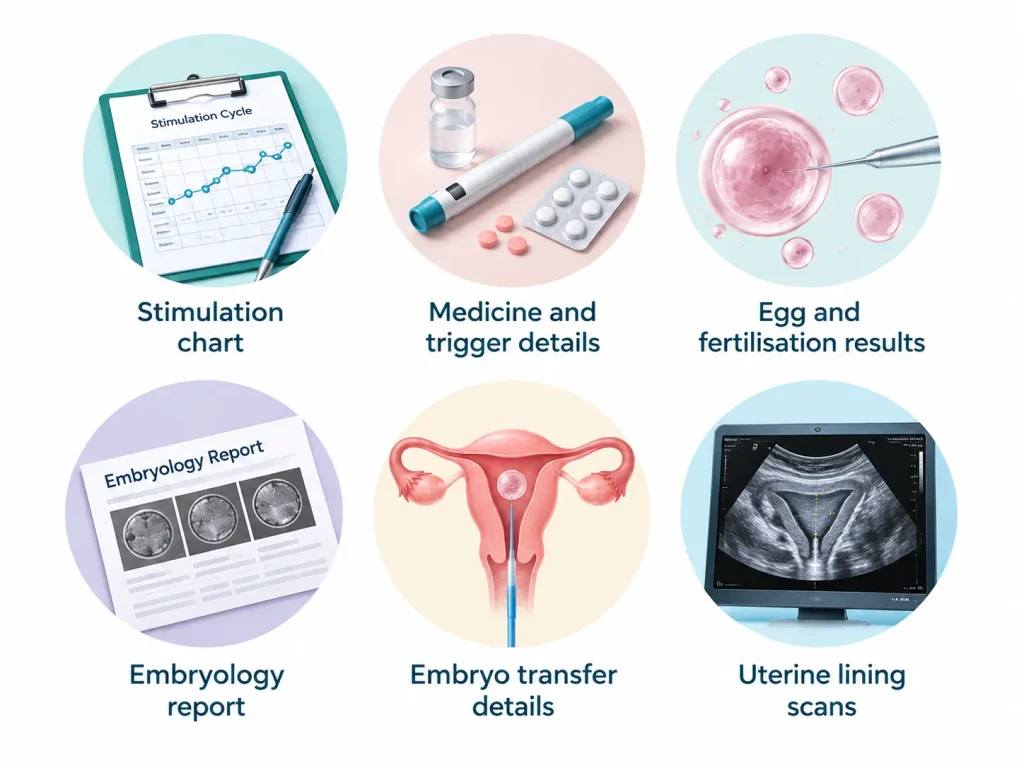
A second specialist cannot review what they cannot see. Patients can request copies of their own records, and a short written request listing exactly what you need tends to get a faster reply. Ask for these six items:
- Stimulation chart. The day by day record of medicines taken and scan measurements.
- Drug doses and trigger details. Which medicines, at what dose, and when the trigger injection was given.
- Retrieval numbers. How many eggs were collected, how many were mature, and how many fertilised.
- Embryology report. Embryo grades, the day each embryo was assessed, and how many were frozen.
- Transfer record. The day of transfer, the grade and number of embryos placed, and whether the transfer was fresh or frozen.
- Endometrium scans. Lining thickness and pattern on or near the transfer day.
Add any semen analysis reports, thyroid and hormone tests, and earlier ultrasound reports. Bring everything in one folder. Requesting records is routine, and it is not a complaint about your previous doctor.
Reading Your Stimulation Protocol and Whether It Suited Your AMH
A stimulation protocol is the medicine plan that grows several eggs at once. Most clinics use one of a few standard designs, and no single design is right for everyone.
- Antagonist protocol. Medicines that prevent early ovulation start midway through stimulation. It is shorter, and doctors often choose it for women with a high AMH or PCOS because it lowers the risk of ovarian hyperstimulation syndrome.
- Agonist protocol. Medicines first switch off the natural cycle, then stimulation begins. Some doctors prefer it in selected situations, such as certain women with endometriosis.
- Mild or minimal stimulation. Lower doses give fewer eggs. Doctors sometimes consider it for women with a low ovarian reserve or a poor response to high doses.
Three questions help you judge the match. Were the doses sensible for your age and AMH? How many follicles did the scans show? How many of the eggs collected were mature? A low egg count does not doom the next attempt. In the UK study, the number of eggs collected in one cycle did not change the chance of a live birth in later cycles.
AMH predicts how many eggs you may produce, not how good they are. Ask your doctor to explain how your own response compares with what was expected.
Embryo Grading: What Your Report Should Have Told You
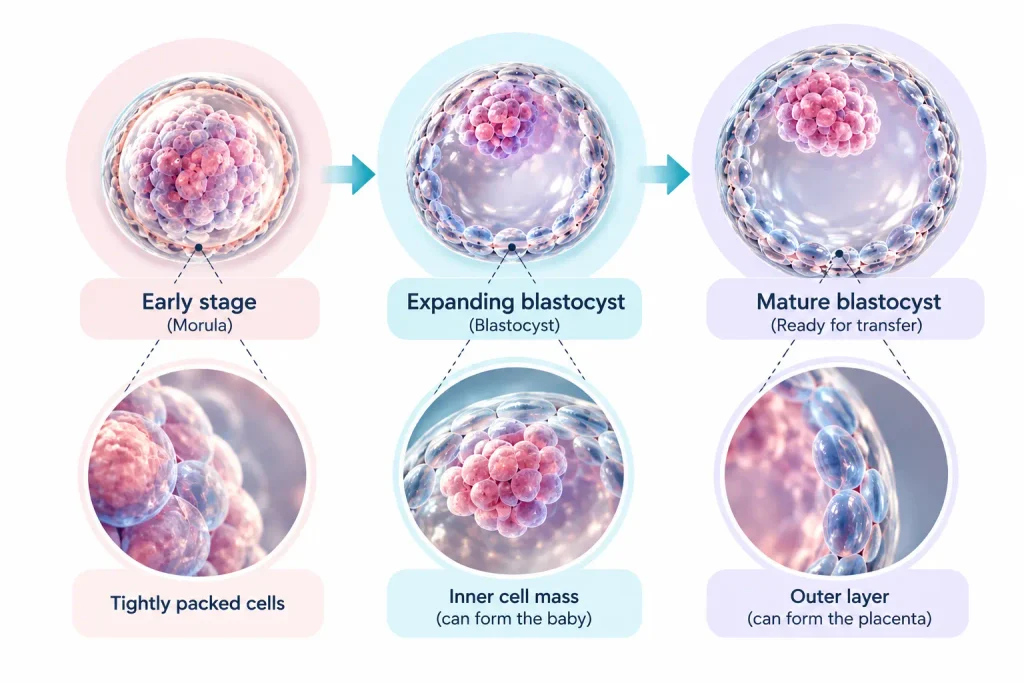
Most clinics grade blastocysts with the Gardner system, which gives three pieces of information in a code such as 4AA.
- A number from 1 to 6 shows how far the blastocyst has expanded.
- The first letter, from A to C, grades the inner cell mass, the part that can form the baby.
- A second letter, from A to C, grades the trophectoderm, the outer layer that can form the placenta.
A 4AA embryo is expanded with excellent grades on both parts. Yet grading has limits. A blastocyst grading review describes grading as subjective, with variation between embryologists. Grades also say nothing about chromosomes, so a lower grade embryo can still lead to a live birth. Our guide to embryo quality explains why quality matters more than count.
A grade describes how an embryo looks, not what its chromosomes contain.
Endometrium and Implantation: The Checks Most Often Skipped
An embryo needs a receptive lining to implant. Four checks are often missed or never explained.
- Lining thickness and pattern. Scans during the transfer cycle show both. Many clinics look for around 7 mm or more, though thresholds vary, and our article on thin endometrium and pregnancy covers causes and options.
- The uterine cavity. A hysteroscopy can find polyps, fibroids pressing into the cavity, scar tissue or a septum that an ordinary scan may miss.
- Chronic endometritis. Low grade inflammation of the lining can be tested by biopsy, and doctors treat it with antibiotics when it is confirmed.
- Hydrosalpinx. A blocked, fluid filled fallopian tube can reduce the chance of implantation, and doctors often advise treating the tube before another transfer.
Tests that time the transfer window, such as endometrial receptivity analysis, are still debated, and trials have not shown a clear benefit for every patient. A good doctor will explain why a test is or is not recommended in your case.
Male Factor Retests Worth Repeating, Including DFI
Semen quality often gets one test and is then forgotten. Yet sperm supply half of the embryo’s genetic material, and in some studies sperm DNA damage has been linked with poorer embryo development and implantation.
Sperm quality changes over time, so one old report is not the last word.
A repeat semen analysis makes sense when the first report was borderline, was collected during an illness or fever, or is more than a few months old. Sperm take roughly two to three months to develop, so changes in health habits show up with a delay.
A DNA fragmentation index test, known as DFI, may be worth discussing when:
- Embryos developed poorly despite good looking eggs.
- Earlier cycles failed without a clear reason.
- There have been miscarriages.
Doctors also look for treatable contributors such as a varicocele or an infection, and they may advise reducing heat exposure, smoking and alcohol.
Genetic Testing: When PGT A Is Justified and When It Is Not
PGT A tests embryos for an abnormal number of chromosomes before transfer. Many couples ask for it after a failed cycle, and some clinics offer it as a routine add on. The evidence is more mixed than marketing suggests.
- May help: women over 35 with several embryos, couples with repeated miscarriage, and some couples with a known chromosome rearrangement.
- Less likely to help: younger women with few embryos, because the biopsy and testing can leave fewer embryos to transfer.
Randomised trials in unselected women have not shown a clear gain in live births per started cycle, although testing can shorten the time to pregnancy for some groups. A doctor who advises against PGT A after reviewing your case is giving honest advice, not holding back care. Details of the service are on our PGT and DFI diagnosis page. In India, genetic testing cannot be used to select the sex of a baby.
What Actually Changes in a Second Opinion Plan
If you are deciding what to do after a failed IVF cycle, a good second opinion ends with specific changes, not a general reassurance. Depending on your records, the plan may include:
- A different stimulation protocol or dose.
- Freezing all embryos and transferring in a later cycle when the lining and embryo timing do not match.
- A change in how the lining is prepared.
- Treating a uterine or tubal problem before the next transfer.
- Treating or retesting male factors.
- Extra tests only where there is a clear reason for them.
A second opinion usually starts with a records review and a consultation, followed by tests only where the records leave a gap. Ask the clinic how long the review takes and what it costs.
Ask for a written plan that states what will change and why.
Many couples also find counselling helpful after a failed cycle, and your doctor can refer you to one. Take the time you need before deciding on the next step.
So when the question is failed ivf what next, the answer is rarely to repeat the same cycle unchanged and rarely that it will never work. Gather the six records, ask for a clear explanation of each stage, and bring them to a doctor you trust. Every couple’s situation differs, and your doctor’s assessment guides the plan.
Questions Couples Ask After a Failed IVF Cycle
1. Should I change clinics after one failed IVF cycle?
Not necessarily. Changing IVF clinic after a single failed cycle is a personal choice, and a failed cycle does not mean your clinic made a mistake. Asking for a detailed review of the cycle is a reasonable first step. A second opinion becomes more useful when nobody has explained why the cycle failed, when your questions go unanswered, or after two or more unsuccessful transfers. Seeking a second opinion is your right and says nothing about your trust in your doctor. Collect your records first, because any second specialist will need them to give you a meaningful view.
2. What records should I ask my previous clinic for?
Ask for six things: the stimulation chart with daily doses and scan measurements, the trigger injection details, retrieval numbers including mature eggs and fertilisation, the embryology report with grades and freezing details, the transfer record, and the endometrium scan reports. Add semen analysis reports for the male partner and any hormone or thyroid tests. Put the request in writing and keep copies. A polite, specific list speeds things up.
3. How do I know if my protocol suited my AMH?
A protocol suits your AMH when your response matches what the doctor expected for your age and ovarian reserve. Compare three things: the doses used, the number of follicles on scans, and the number of mature eggs collected. A very low or very high response may mean the dose or design needs changing. AMH only estimates egg quantity, so a doctor also considers age, antral follicle count and past response. Ask your specialist to explain the match in plain language.
4. What does my embryo grading report actually mean?
Most blastocyst reports use a number from 1 to 6 for expansion, followed by two letters from A to C. The first letter grades the inner cell mass, which can form the baby. The second grades the trophectoderm, which can form the placenta. A grade such as 4AA looks excellent, while 3BC looks weaker. Grading is subjective and cannot show chromosomes, so embryos with lower grades can still lead to a live birth. Ask your embryologist to walk you through your own report.
5. Is PGT A worth it after a failed cycle?
It depends on your situation. PGT A can help some couples, for example women over 35 with several embryos or couples with repeated miscarriage. In younger women with few embryos, the biopsy may reduce the embryos available without improving the chance of a live birth. Trials in unselected women have not shown a clear gain per started cycle. Ask your doctor what the result would change in your plan. If the answer is nothing, testing may not be worth the cost.
6. How soon can I start a second cycle?
Many doctors suggest allowing at least one full menstrual cycle after a negative result so your body and mind can settle, although some couples proceed sooner when frozen embryos are ready. The right timing depends on your hormone levels, any tests you still need, such as a hysteroscopy, and how you feel. Your doctor will advise you. Using the break to collect records and complete missing tests is often more useful than rushing.
7. Does one failed cycle mean IVF will not work for us?
No. In the large UK study mentioned above, 29.5% of women had a live birth after the first cycle, and the cumulative figure kept rising across later cycles. Those numbers vary with age and cause, and no figure predicts your own result. A failed cycle gives your doctor information about how your ovaries responded and how your embryos developed. That information helps the next plan fit you better.
8. How many IVF cycles do most couples need?
There is no fixed number. UK data show that live birth rates rise across repeated cycles, reaching roughly two thirds by the sixth cycle for women under 40 after adjustment. In practice, couples decide based on age, ovarian reserve, embryo quality, finances and emotional energy. Discuss a realistic plan with your doctor before starting, including how many cycles you can sustain and when you would review the approach together.
9. Did I do something wrong to cause this failure?
Very unlikely. Working, travelling, sitting at a desk or having a stressful week does not cause an embryo to fail to implant. Most failed cycles trace back to embryo chromosomes, uterine factors or chance, none of which you control. Blame is a common feeling and an unhelpful one. Focus instead on the information a second review can give you, and on looking after your sleep, nutrition and relationships through the next stage.
10. How do we cope emotionally after a failed cycle?
Grief, anger and numbness are all common, and partners often cope differently. Talk openly about what each of you needs, and give yourselves time before making the next decision. Many fertility clinics offer counselling or can refer you to a counsellor, and speaking to a professional is a sign of care, not weakness. If low mood lasts for weeks or affects sleep, work or daily life, speak to your doctor or a mental health professional.