
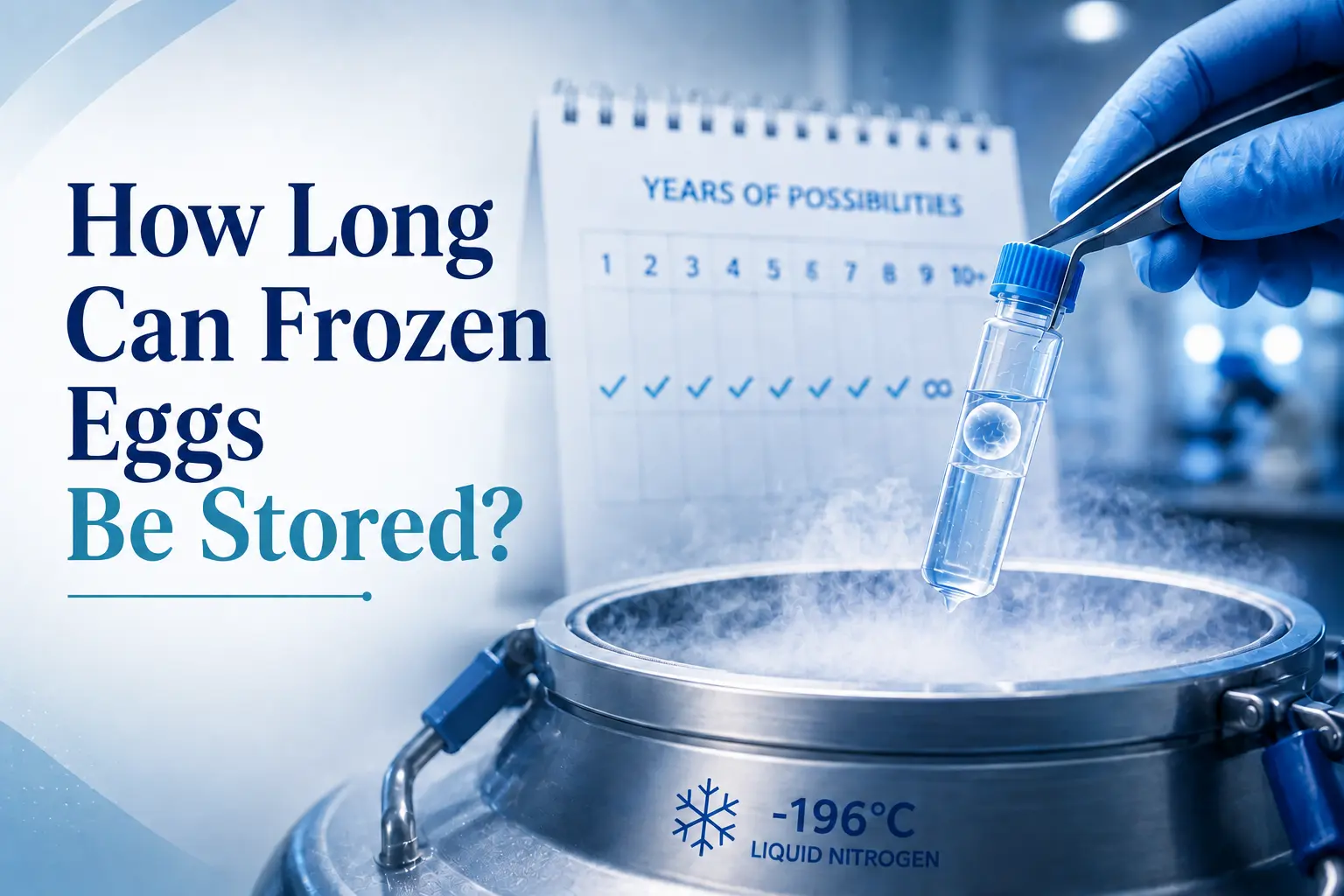
A vitrified egg does not carry a clock inside the storage tank. It carries the age it was on the day it was frozen, and that single detail decides almost everything about how long frozen eggs can be stored in Wakad. Patients who walk into a fertility centre in Wakad after freezing their eggs usually expect one clean number of years. The real answer depends on the freezing method, Indian regulation, and the woman’s own family planning timeline, not a countdown printed on the tank.
What Egg Vitrification Actually Does to a Frozen Egg
Egg vitrification is a flash freezing technique that cools a mature egg to around minus 196 degrees Celsius within seconds, avoiding the slow ice crystal formation that damaged eggs under older freezing methods. Because the egg reaches this temperature almost instantly, its internal structure stays intact, which is one reason long term egg storage has become a realistic option for far more women than it was even a decade ago.
Once an egg is vitrified, it sits in liquid nitrogen in a state where biological activity effectively pauses. No cell division happens. No aging happens at the chromosomal level. The egg simply waits.
Vitrified eggs show survival rates of 90 to 95 percent after thawing when the freezing and storage protocol is followed correctly, according to fertility laboratory data cited across major reproductive medicine centres.
This is the science behind the question patients ask most often, which is simply how long frozen eggs can be stored in Wakad without any real risk to their future usability. Storage duration on its own is not the enemy. Poor freezing technique, inconsistent tank temperature, or an inexperienced laboratory are the real risks, and they matter far more on day one than they do at year eight.
Does Time in the Tank Wear Down Egg Quality?
Patients often assume a frozen egg behaves like food in a freezer, slowly losing quality the longer it sits. That is not how vitrification works. Once an egg is properly frozen, its biological age stays fixed at whatever it was on the retrieval date, and the eggs themselves do not continue to age while stored.
The single most useful thing to understand about how long frozen eggs can be stored in Wakad is that the calendar keeps moving for the woman, not for the egg.
Cleveland Clinic notes that once eggs are properly vitrified, they can remain viable for essentially unlimited periods, and most patients end up using their eggs somewhere between a few years and about a decade later with no added risk simply from the passage of time. What actually determines success later is the woman’s age at the point of freezing, not the number of years the eggs spend in the tank afterward.
This matters for anyone planning frozen egg storage duration in Pune or Wakad around a career milestone, a medical treatment, or simply personal readiness. A woman who freezes her eggs at 29 and uses them at 38 is working with 29 year old eggs, not 38 year old eggs. The pause is real.
How Long Frozen Eggs Can Be Stored in Wakad Under Indian Law
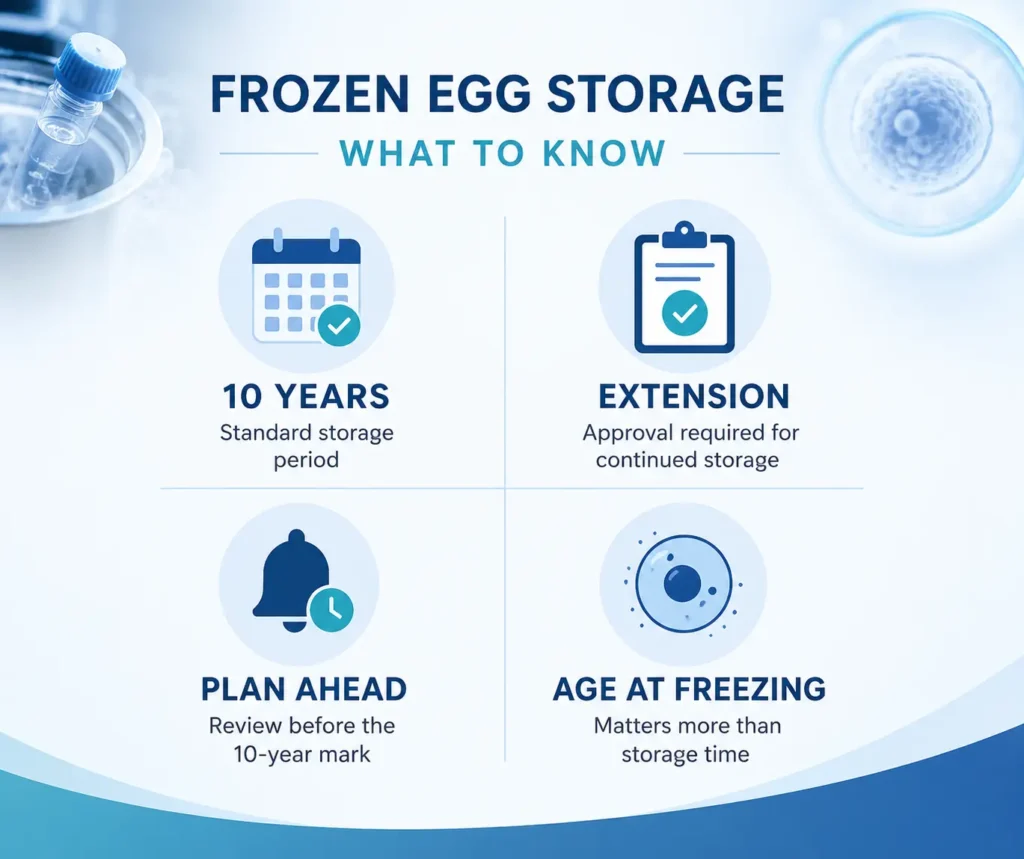
Biology allows for near indefinite storage, but Indian regulation sets its own boundary. Under the Assisted Reproductive Technology Regulation Act of 2021, ART banks and clinics in India, including centres serving Wakad and greater Pune, may store eggs, sperm and embryos for up to ten years as a standard limit.
Extensions beyond that ten year mark are possible, but they are not automatic. A clinic must apply to the National Board with a documented reason, such as ongoing cancer treatment or another medical condition affecting fertility, before storage can continue past the standard period. For most patients doing elective egg freezing purely to buy time for family planning, the ten year window is the practical figure to plan around.
- Standard storage period allowed under the ART Act: up to ten years.
- Extension beyond ten years: possible with National Board approval for documented medical circumstances.
- Review point: clinics typically contact patients well before the ten year mark to discuss renewal, use, or disposal.
Anyone freezing eggs in their late twenties or early thirties should treat this ten year figure as a planning horizon rather than a hard deadline they might miss without warning. A good fertility centre in Wakad will build reminders into the process long before the clock becomes urgent.
When Is the Right Time to Use Frozen Eggs for Pregnancy?
There is no single correct year to thaw and use frozen eggs. The right time depends on when a woman is ready to pursue pregnancy, not on some fixed point after freezing. That said, a few practical factors shape the decision.
- Readiness for pregnancy, whether alone or with a partner.
- Uterine health and overall reproductive fitness at the time of transfer.
- Where the storage period sits within the ten year window under Indian regulation.
- Financial readiness for the thaw, fertilisation, and transfer cycle.
The most consistent finding across fertility research is that the egg’s age at retrieval predicts outcomes far more reliably than storage length. NHS fertility guidance points out that a woman’s chances of conceiving fall as she ages, mainly because both the quantity and quality of her eggs decline over time, which is exactly why freezing earlier tends to protect better outcomes later. Using frozen eggs for pregnancy at 40 with eggs frozen at 30 still carries the advantage of the younger egg, even though the woman herself is older when treatment begins.
Many patients at an IVF centre in Wakad ask whether waiting longer inside the ten year window changes anything. It generally does not, provided the storage facility maintains consistent conditions. The decision to use the eggs should be driven by readiness for pregnancy, partner status, uterine health, and overall family planning, not by a fear that the eggs are quietly losing value with each passing year.

What Happens When You Are Ready: The Egg Thawing Process
When a patient decides to move forward, the egg thawing process follows a structured laboratory sequence designed to protect the fragile cell as it returns to a living state.
- The embryologist retrieves the required number of vitrified eggs from liquid nitrogen storage and begins a rapid, controlled warming process.
- Each egg is checked under a microscope to confirm it survived the thaw with its structure intact.
- Surviving eggs are fertilised using intracytoplasmic sperm injection, since a single sperm must be injected directly rather than relying on natural fertilisation.
- Fertilised eggs are cultured in the laboratory for several days while embryologists monitor cell division and embryo quality.
- The strongest embryo, or embryos, are selected for transfer into the uterus, following the same protocol used in a standard IVF cycle.
Patients asking how long frozen eggs can be stored in Wakad before starting this process should know the thaw itself takes only a single day. Not every thawed egg survives, and not every fertilised egg becomes a transferable embryo. This is normal and expected, which is why clinics generally recommend freezing more eggs than the number a patient believes she will eventually need.
What Long Term Egg Storage Costs in Wakad and Pune
Cost is one of the most practical concerns tied to how long frozen eggs can be stored in Wakad, since fees accumulate for every year the eggs remain in the tank. Storage fees are usually charged on an annual basis, and many centres offer a discount for patients who prepay several years at once rather than renewing every twelve months.
A few cost factors worth understanding before committing to frozen egg storage duration in Pune or Wakad specifically:
- Annual storage fee: the ongoing charge for maintaining tank conditions and monitoring.
- Multi year prepayment: often reduces the per year cost compared to renewing annually.
- Number of eggs stored: some centres price per batch rather than per individual egg.
- Transfer between clinics: additional logistics and fees apply if eggs are moved to another facility or city.
Patients should ask their fertility centre in Wakad for a written breakdown of storage costs at the time of freezing, including what happens financially if the eggs are not used within the standard period and an extension becomes necessary.
Choosing a Fertility Centre in Wakad for Long Term Egg Storage
Not every clinic offering egg freezing has the same level of experience with long term storage. Since the eggs may remain in the tank for several years, the choice of centre matters as much as the freezing procedure itself.
Look for a centre that can clearly explain its egg and sperm freezing services, including how tank temperature is monitored, what backup systems exist during a power failure, and how often patients receive updates about their stored eggs. A centre attached to a full IVF centre in Wakad also means the same team that froze the eggs can manage the thaw, fertilisation, and transfer when the time comes, without handing the case between unfamiliar providers.
A centre worth trusting with long term storage should be able to answer, in one conversation, exactly how your eggs are monitored, what happens at the ten year mark, and who to call if you have a question in year six.
It also helps to understand the IVF process step by step before freezing even begins, so there are no surprises when eggs are eventually thawed years later. Patients weighing whether frozen eggs are worth the investment often ask about outcomes as well, and reviewing published IVF success rates in Wakad gives a realistic picture rather than relying on national averages that may not reflect local outcomes.
Freezing eggs is a decision about future flexibility, not a guarantee of pregnancy. Most patients who understand exactly how long frozen eggs can be stored in Wakad, what the process involves, and what it costs make the decision with far less anxiety than those going in without clear information. Speaking with a fertility specialist before freezing, and again well before any storage renewal deadline, keeps the entire process predictable from start to finish.
1. How long can frozen eggs be stored in Wakad before they must be used?
Under India’s Assisted Reproductive Technology Regulation Act, clinics can store eggs for up to ten years as a standard limit. Extensions beyond that period require approval from the National Board and are usually granted for documented medical reasons such as cancer treatment. For most patients freezing eggs electively, ten years is the realistic planning window, and a good fertility centre in Wakad will contact patients well ahead of that date to discuss options rather than letting the deadline arrive as a surprise.
2. Do frozen eggs lose quality the longer they stay in storage?
No, not when the eggs were vitrified correctly and storage conditions remain stable. Vitrification pauses biological activity, so an egg frozen at 30 is still biologically 30 years old whether it is thawed after two years or after nine. What matters far more than storage length is the age of the woman at the time the eggs were originally retrieved and frozen.
3. What happens to frozen eggs after ten years under Indian law?
Once the standard ten year storage period under the ART Act is reached, the clinic must either secure National Board approval to continue storage for a documented medical reason or discuss next steps with the patient, which may include using the eggs, discarding them, or in some cases donating them depending on the original consent given. Clinics typically reach out well in advance so patients are not caught off guard.
4. Can I extend egg storage beyond the standard period?
Yes, but the extension is not automatic. The clinic must apply to the National Board with documentation supporting the need for continued storage, most commonly linked to ongoing medical treatment that affects fertility. Elective storage extensions outside a documented medical reason are far more limited under current Indian regulation, so patients should raise this question early with their fertility centre.
5. How is egg vitrification different from older freezing methods?
Older slow freezing methods allowed ice crystals to form inside the egg, which often damaged its delicate internal structure. Vitrification cools the egg to roughly minus 196 degrees Celsius within seconds, which prevents ice crystals from forming at all. This is the main reason survival and pregnancy rates from frozen eggs improved significantly once vitrification became the standard technique. Most reputable fertility centres serving Wakad and the wider Pune region now use vitrification exclusively, since it produces consistently higher post thaw survival rates than older slow freezing protocols.
6. What is the ideal age to freeze eggs for the best chance later?
Most fertility specialists recommend freezing eggs before 35, since egg quantity and quality decline more noticeably after this age. Freezing earlier does not guarantee a future pregnancy, but it does mean any eggs used later carry the biological advantage of a younger age, regardless of how many years pass in storage. A consultation can assess ovarian reserve through AMH levels and antral follicle counts, which gives a clearer picture of the ideal freezing window than age alone.
7. How successful is IVF using frozen eggs compared to fresh eggs?
Success rates with properly vitrified eggs have become close to those seen with fresh eggs in many clinics, largely because vitrification protects egg structure so well during freezing and thawing. Individual outcomes still depend on the woman’s age at freezing, the number of eggs retrieved, and overall reproductive health, so a personal consultation gives a more accurate picture than general statistics alone.
8. What does the egg thawing process involve before IVF?
The embryologist warms the eggs in a controlled process, checks each one for survival under a microscope, then fertilises surviving eggs using intracytoplasmic sperm injection. The resulting embryos are cultured for several days before the strongest one is selected for transfer, following the same general timeline used in a standard IVF cycle. The entire thaw and fertilisation stage typically takes about a week, though the exact schedule depends on how embryo development progresses.
9. How much does long term egg storage cost in Pune and Wakad?
Storage is typically billed annually, and many centres offer reduced rates for patients who prepay multiple years upfront. Costs can vary based on the number of eggs stored and whether the batch is priced individually or as a group. Patients should request a clear written cost breakdown at the time of freezing so there are no surprises at renewal time.
10. What happens if I decide not to use my frozen eggs?
Patients retain control over this decision based on the consent they signed at the time of freezing. Options generally include continuing storage within the legal limit, discarding the eggs, or in some cases donating them for research or to another patient, depending on clinic policy and the original consent terms. This decision can be revisited at any point before the storage period ends.