Every year, thousands of people in Pune’s western corridor discover they have a kidney stone on a routine ultrasound or because the pain hits them suddenly on a working day. The stone is real. The fear of surgery is also real. What most people in Wakad do not know is that for the majority of kidney stones between 5mm and 2cm, there is a procedure that requires no incision, no hospital stay, and gets them back to their desk job in 48 hours.
That procedure is RIRS, short for Retrograde Intrarenal Surgery. At 6Venus Urology Hospital in Wakad, Dr. Sunil Palve, MCh Urology, performs RIRS using holmium laser dusting technology as a day-care procedure with no cuts, no drainage tubes, and discharge the same day or within 24 hours.
What RIRS Actually Is and Why It Changed Kidney Stone Treatment
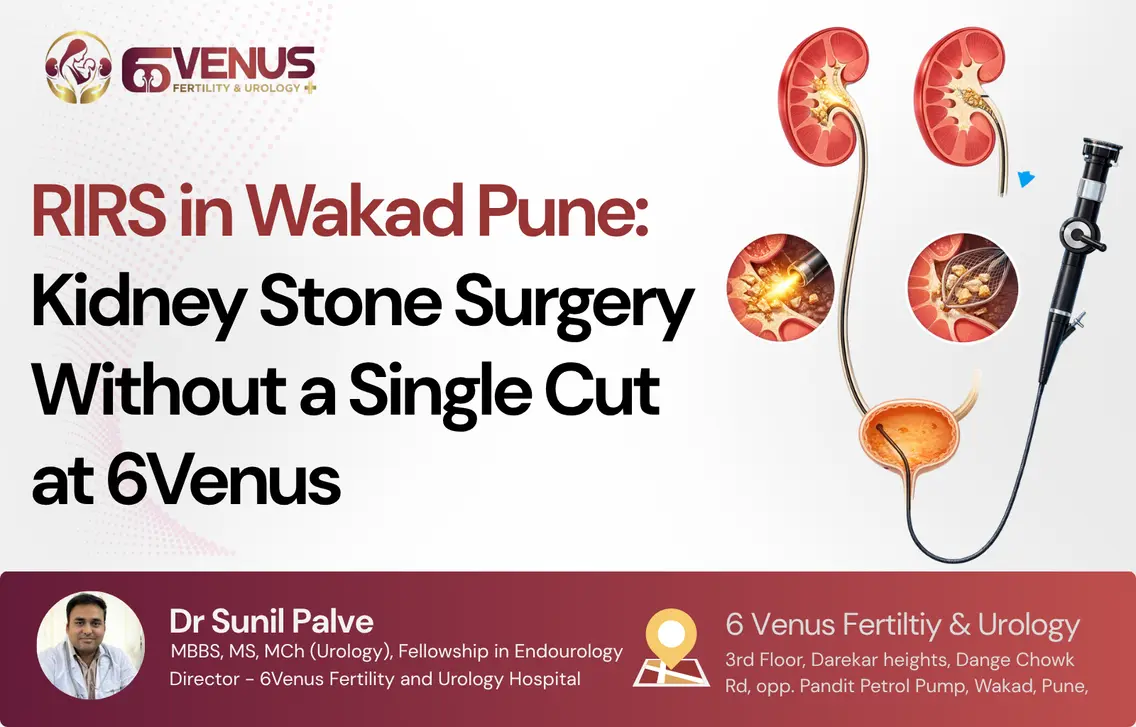
RIRS uses a thin, flexible fibre-optic tube called a ureteroscope. It travels through the urethra, into the bladder, up the ureter, and directly into the kidney’s collecting system. The entire journey happens through the body’s natural passages. Nothing is cut. Nothing is punctured.
Once the scope reaches the stone, a laser fibre runs through it and delivers precise bursts of holmium laser energy directly onto the stone surface. At 6Venus, Dr. Palve uses a laser dusting technique that turns the stone into particles finer than sand. These particles flush out naturally in urine over the next few days without any basket retrieval, wire manipulation, or scraping of the ureter walls.
Before RIRS became the standard for mid-sized kidney stones, patients needed either ESWL (external shockwaves with unpredictable fragmentation results) or open surgery. RIRS changed that equation entirely for stones up to 2cm.
Dr. Sunil Palve: The Urologist Performing RIRS in Wakad
Dr. Sunil Palve holds MBBS, MS General Surgery, and MCh Urology from Osmania Medical College, Hyderabad, one of India’s most respected government surgical training institutions. He has completed 15 years of clinical urology practice and has performed more than 750 stone surgeries at 6Venus, including kidney stones, ureteric stones, and bladder stones using advanced endourological techniques.
His expertise goes significantly beyond standard RIRS:
- Laser dusting: High-frequency holmium laser vaporises the stone into sub-millimetre particles. No basket retrieval needed. Significantly less intraoperative trauma to the ureter
- Supine PCNL: For stones larger than 2cm where RIRS is not sufficient, Dr. Palve operates with the patient on their back rather than face-down, which is safer for anaesthesia and allows faster surgery
- Tubeless PCNL: When PCNL is required, Dr. Palve avoids external drainage tubes entirely, cutting post-operative pain and discharge time significantly
- Pre-operative CT stone analysis: Low-dose CT scan before every procedure to map stone position and measure Hounsfield units (stone hardness), which determines whether the stone will respond to laser dusting or requires a different approach
As Dr. Palve puts it: “We don’t just break the stone. We vaporise it. And we choose the specific method that clears it completely in a single session.”
Who Is a Good Candidate for RIRS in Wakad Pune
RIRS is not the right procedure for every stone. Dr. Palve selects the technique after reviewing CT scan findings. RIRS works best in these situations:
- Kidney stones between 5mm and 20mm (2cm) in size
- Stones in any part of the kidney collecting system including upper, middle, and lower calyces
- Ureteric stones that have not passed on their own after a trial of medical expulsive therapy
- Patients who have had previous ESWL that failed to clear the stone fully
- Patients with a solitary kidney where surgical safety and minimal trauma are especially important
- Patients with bleeding disorders where PCNL carries higher risk
- Stones that are recurrent and require a reliable, repeatable approach
RIRS is generally not recommended for stones above 2cm, stones with very high Hounsfield units (extremely hard stones) that resist laser energy, or when anatomical variation in the ureter prevents the flexible scope from reaching the kidney. In those cases, Dr. Palve transitions to Tubeless Supine PCNL at 6Venus.
The RIRS Procedure at 6Venus Wakad: Step by Step
Patients coming for RIRS at 6Venus Wakad typically arrive fasting. The entire procedure and recovery fits into a single day.
- Pre-operative assessment: Blood tests, urine culture, CT scan review, and anaesthesia evaluation are completed at the pre-admission visit. Surgery is not scheduled until urine infection is excluded, as operating through an infected urinary tract risks sepsis
- Anaesthesia: Spinal anaesthesia is preferred for RIRS at 6Venus because it allows the patient to remain conscious but fully pain-free below the waist, with faster recovery than general anaesthesia. General anaesthesia is used when spinal is contraindicated
- Ureteral access sheath placement: A thin access sheath is placed through the urethra and bladder into the ureter to create a stable, protected corridor for the flexible ureteroscope. This also maintains low intrarenal pressure during the procedure, which reduces the risk of bacteria or stone debris being pushed into the bloodstream
- Scope navigation: The flexible ureteroscope travels through the access sheath, past the ureter, and into the kidney collecting system. Dr. Palve navigates to the stone using direct camera visualisation. The flexibility of the scope allows access to even lower-pole calyces that rigid scopes cannot reach
- Laser dusting: The holmium laser fibre, thinner than a human hair, passes through the working channel of the scope and delivers focused laser energy directly onto the stone surface. The stone is vaporised systematically until nothing remains but fine dust. Operating time is typically 45 to 90 minutes depending on stone size and location
- Stent placement: In most cases, a temporary double-J stent is placed at the end of the procedure. The stent runs from the kidney to the bladder and keeps the ureter open while any residual swelling settles. It is removed in a short outpatient visit 1 to 2 weeks after RIRS
- Recovery and discharge: The patient moves to the recovery area for 2 to 3 hours of monitoring. Once vitals are stable and oral fluids are tolerated, discharge happens the same afternoon or by the next morning. Most patients are back to desk work within 48 to 72 hours
RIRS Cost in Wakad Pune: What Patients at 6Venus Pay
The cost of RIRS in Wakad and across Pune typically ranges from Rs. 70,000 to Rs. 1,10,000 for the complete day-care procedure. This includes surgeon’s fees, anaesthesia, scope use, laser charges, stent placement, and the hospital day. Pre-operative diagnostics including CT scan, blood work, and urine culture are usually billed separately and add approximately Rs. 4,000 to Rs. 8,000. Stent removal 1 to 2 weeks later is a short outpatient procedure with its own nominal charge.
For a complete breakdown of all kidney stone treatment costs by procedure type at 6Venus, including RIRS, PCNL, ESWL, and URS, visit the kidney stone treatment cost page for Wakad patients.
Health insurance covers RIRS as a medically necessary procedure under most standard Indian policies including corporate group insurance plans common among IT employees in Hinjewadi and Wakad. Day-care surgery coverage now applies to RIRS under most updated policy terms. The 6Venus billing team assists with pre-authorisation and claim documentation before the procedure is scheduled.
RIRS vs ESWL vs PCNL: Choosing the Right Procedure in Wakad
| Factor | ESWL | RIRS at 6Venus | PCNL at 6Venus |
|---|---|---|---|
| Stone size suitability | Up to 1cm, accessible position | 5mm to 2cm, any calyx | Above 2cm, complex stones |
| Incision | None | None | Tiny pinhole in back |
| Stone clearance in one session | Partial, may need repeat sessions | Complete in single session | Complete in single session |
| Works on hard stones (high HU) | Poorly | Well with holmium laser | Very well |
| Hospital stay | No admission | Day care, same-day discharge | 24 hours (Tubeless PCNL) |
| Return to work | 1-2 days | 2-3 days | 3-5 days |
| Insurance coverage | Varies by insurer | Yes, most policies | Yes, all policies |
ESWL is appropriate for a narrow range of soft, well-positioned small stones. For most kidney stones presenting in Wakad patients, RIRS gives more reliable single-session clearance without any incision. For stones too large for RIRS, Dr. Palve’s Tubeless Supine PCNL at 6Venus is the next step.
See the full laser kidney stone surgery page at 6Venus for a complete explanation of how Dr. Palve selects between RIRS and PCNL based on imaging findings.
Why Kidney Stones Are So Common in Wakad and Hinjewadi
Wakad sits in the middle of Pune’s hardest water zones. Pune’s municipal water supply has elevated calcium and magnesium levels, and hard water is a well-documented risk factor for calcium oxalate stone formation. Combine that with the lifestyle of the average IT professional in the area: 8 to 10 hours of air-conditioned office time, minimal water intake because cold office environments suppress thirst, high-protein diets, and the low physical activity that comes with desk jobs.
Chronic subclinical dehydration is the single biggest driver of stone formation. When urine is concentrated over months and years, dissolved minerals crystallise and aggregate. For most IT professionals in Hinjewadi and Wakad, the stone that shows up on an ultrasound did not form last month. It has been building for years.
After RIRS clears the current stone, Dr. Palve addresses the conditions that led to it: stone composition analysis, dietary changes, hydration targets, and metabolic screening for conditions like hyperparathyroidism or hyperuricemia that cause recurrent stones regardless of lifestyle. Treating the stone alone without understanding why it formed is treating the symptom, not the problem.
Recovery After RIRS at 6Venus: What the First Two Weeks Look Like
Most patients underestimate how manageable the RIRS recovery is. Here is a realistic timeline:
- Day 0 (surgery day): Procedure takes 45 to 90 minutes. Recovery area for 2 to 3 hours. Discharge in the afternoon in most cases. Mild pelvic discomfort and urinary frequency from the stent are normal
- Days 1 to 3: Rest at home. Mild burning during urination is common because of the stent. Drink 2.5 to 3 litres of water per day to flush stone dust. Oral painkillers manage discomfort effectively. Most desk-work patients return to remote work by Day 2 or 3
- Days 4 to 7: Physical discomfort largely resolves. Stent awareness (a sensation of needing to urinate) decreases. Avoid strenuous physical activity and heavy lifting until stent removal
- Week 2: Stent removal at 6Venus as a short outpatient procedure taking under 5 minutes. No anaesthesia needed for most patients. Immediate significant relief of urinary symptoms. Follow-up CT or X-ray confirms complete stone clearance
One practical note for IT professionals in Wakad: the stent period (typically 1 to 2 weeks) involves some urinary frequency and occasional blood-tinged urine. Working from home during this window makes the recovery significantly more comfortable than commuting to an office. Most patients who disclose their situation to their employer or manager require only a single day of medical leave for the procedure itself.
Recurrent Kidney Stones After RIRS: Preventing the Next One
RIRS clears the stone. It does not prevent the next one unless the underlying cause is addressed. Stone recurrence rates in India are high, with research suggesting roughly 50% of patients form a new stone within 10 years if no preventive action is taken.
At 6Venus, every patient who undergoes RIRS receives a post-operative plan that includes:
- Stone composition analysis (the removed material or expelled dust is sent for characterisation where possible)
- 24-hour urine collection to identify metabolic abnormalities
- Dietary guidance specific to the stone type found
- Hydration targets calibrated to the patient’s body size and activity level
- Pharmacological options where appropriate (potassium citrate for calcium oxalate stones, allopurinol for uric acid stones)
The connection between UTIs and stone formation is also evaluated at 6Venus. Struvite stones form specifically in the presence of urea-splitting bacteria. If UTI history is relevant to your case, the 6Venus UTI page at UTI specialist care in Pune covers how chronic infections interact with stone disease.
Booking RIRS at 6Venus Urology Hospital, Wakad
If you have a kidney stone on imaging and want to understand whether RIRS is the right procedure for your case, a consultation with Dr. Sunil Palve at 6Venus gives you a clear clinical answer. Bring your ultrasound report, CT scan if available, and any previous stone treatment records.
6Venus Fertility and Urology Hospital is at 3rd Floor, Darekar Heights, Dange Chowk Road, opposite Pandit Petrol Pump, Yashoda Colony, Wakad, Pune 411033. It is accessible from Hinjewadi, Pimple Saudagar, Marunji, Punawale, Ravet, and Pimpri-Chinchwad within 10 to 15 minutes.
Visit 6Venus Fertility and Urology Hospital to book your consultation with Dr. Sunil Palve, or call the clinic directly for an appointment.
Frequently Asked Questions: RIRS in Wakad Pune
1. What size kidney stone can be treated with RIRS in Wakad?
RIRS at 6Venus is suitable for kidney and ureteric stones up to 2cm (20mm) in size. Stones between 5mm and 20mm in any part of the kidney collecting system, including difficult lower-pole locations, can be treated with RIRS. For stones above 2cm, Dr. Sunil Palve evaluates whether RIRS is feasible or whether Tubeless Supine PCNL is the better choice based on CT findings.
2. Is RIRS painful? What should I expect during recovery?
The procedure itself is done under anaesthesia, so there is no pain during surgery. After RIRS, mild burning during urination and some urinary frequency are common for the duration of the ureteral stent (1 to 2 weeks). This is manageable with oral painkillers. Most patients at 6Venus Wakad return to desk work within 48 to 72 hours. Stent removal in the second week brings immediate relief from most residual symptoms.
3. How is RIRS at 6Venus different from RIRS at a general hospital?
The key difference is Dr. Palve’s laser dusting technique. Most standard RIRS procedures break the stone into fragments that are then removed with a basket or wire. Laser dusting vaporises the stone into particles too fine to retrieve, which then flush out in urine on their own. This significantly reduces intraoperative trauma to the ureter and improves single-session stone-free rates. The low-dose CT stone hardness assessment before surgery is also not routine at most general hospitals but is standard at 6Venus.
4. What is the cost of RIRS in Wakad Pune?
RIRS at specialist urology centres in Wakad and Pune typically costs between Rs. 70,000 and Rs. 1,10,000 including surgeon’s fees, anaesthesia, hospital charges, and stent placement. Pre-operative diagnostics add approximately Rs. 4,000 to Rs. 8,000. Health insurance covers RIRS as a medically necessary procedure under most standard and corporate policies. For a full cost breakdown by procedure type, see the kidney stone treatment cost page at 6Venus.
5. How long does the RIRS procedure take at 6Venus?
RIRS at 6Venus typically takes 45 to 90 minutes of operating time, depending on stone size, number of stones, and their location within the kidney. A single large stone in an accessible position may take under an hour. Multiple stones or lower-pole locations requiring scope manoeuvring take longer. The full day at the hospital, including pre-operative preparation, anaesthesia, procedure, and recovery room time, is typically 6 to 8 hours before discharge.
6. Will I need a stent after RIRS and what does it feel like?
In most RIRS cases at 6Venus, Dr. Palve places a double-J stent at the end of the procedure. The stent keeps the ureter open while swelling resolves and allows stone dust to pass freely into the bladder. Most patients are aware of the stent as a sensation of urinary urgency and mild discomfort during urination. It is not debilitating for most people. The stent is removed 1 to 2 weeks later in a short outpatient visit at 6Venus with no anaesthesia required.
7. Can RIRS treat stones in both kidneys in one session?
Bilateral RIRS, treating both kidneys in a single anaesthetic session, is possible and is sometimes done at 6Venus when both kidneys have symptomatic stones. However, bilateral RIRS is a longer procedure and the decision depends on each stone’s size and complexity, the patient’s overall health and anaesthesia tolerance, and whether simultaneous treatment is clinically appropriate. Dr. Palve discusses this case by case at the pre-operative consultation.
8. Does health insurance cover RIRS surgery in Wakad?
Yes. RIRS is covered as a medically necessary procedure under most standard Indian health insurance policies and corporate group plans. Day-care surgery coverage applies to RIRS at most insurers under updated policy terms. The 6Venus billing team manages pre-authorisation requests and prepares claim documentation before the procedure. Bring your insurance card and policy details to your consultation to verify coverage.
9. What happens if RIRS does not clear the stone completely?
In rare cases, stone residual fragments remain after RIRS, particularly with very hard stones or complex stone anatomy. If a follow-up CT scan at 6Venus shows residual stone of clinical significance, Dr. Palve discusses the options: a second RIRS session, or a transition to PCNL if the residual stone is too large or positioned for effective laser treatment through the flexible scope. A complete stone-free outcome in a single session is the goal at every RIRS at 6Venus, which is why pre-operative CT stone hardness assessment guides technique selection before the procedure begins.
10. How do I prevent kidney stones from forming again after RIRS in Wakad?
Stone prevention starts with understanding what type of stone you had. At 6Venus, Dr. Palve analyses stone composition post-procedure and recommends a prevention plan tailored to your stone type and metabolic findings. For the majority of IT professionals in Wakad and Hinjewadi, the most impactful change is increasing daily water intake to at least 2.5 litres, targeting pale yellow urine throughout the day. Dietary modifications, specific supplements, and where appropriate, medications to reduce urinary mineral concentration are all discussed at the post-operative follow-up. A stone that is cleared without addressing why it formed will almost certainly return.